Ch. 15 - Recombinant DNA Technology and Its Applications
Sanders - Genetic Analysis: An Integrated Approach 3rd Edition
Sanders3rd EditionGenetic Analysis: An Integrated ApproachISBN: 9780135564172당신이 사용하는 게 아니라요?교과서 변경
15장, 문제 20

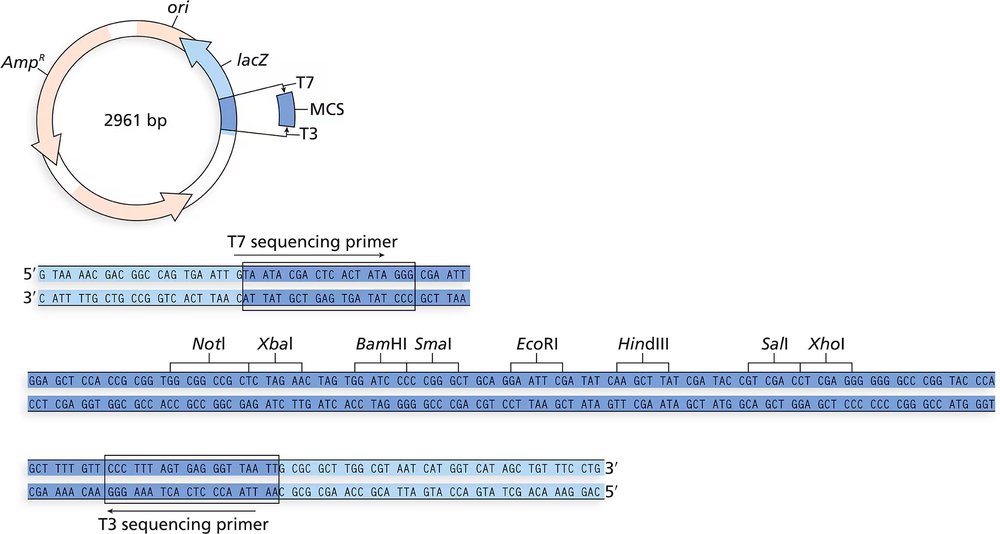
You have identified a 0.80-kb cDNA clone that contains the entire coding sequence of the Arabidopsis gene CRABS CLAW. In the construction of the cDNA library, linkers with EcoRI sites were added to each end of the cDNA, and the cDNA was inserted into the EcoRI site of the MCS of the vector shown in the accompanying figure. You perform digests on the CRABS CLAW cDNA clone with restriction enzymes and obtain the following results. Can you determine the orientation of the cDNA clone with respect to the restriction enzyme sites in the vector? The restriction enzyme sites listed in the dark blue region are found only in the MCS of the vector.
Circular plasmid map with multiple cloning site and sequencing primers, plus DNA sequence with labeled restriction sites.

검증된 단계별 안내
1
Step 1: Identify the restriction enzyme sites present in the multiple cloning site (MCS) of the vector, as these are the only sites relevant for determining the orientation of the cDNA insert. Note the order and position of these sites in the vector map.
Step 2: Analyze the restriction digest results of the cDNA clone with the enzymes used. Compare the sizes of the resulting fragments to the expected sizes if the cDNA were inserted in one orientation versus the opposite orientation.
Step 3: Use the known length of the cDNA insert (0.80 kb) and the positions of the EcoRI sites (added via linkers at both ends) to predict fragment sizes for each possible orientation of the insert within the vector.
Step 4: Match the observed fragment sizes from the digest to the predicted fragment sizes for each orientation. The orientation that produces fragment sizes consistent with the observed data is the correct orientation of the cDNA clone.
Step 5: Confirm your conclusion by considering any additional restriction sites within the cDNA or vector that might affect fragment sizes, ensuring that the orientation assignment is consistent with all observed digestion patterns.

비슷한 문제에 대한 검증된 영상 답변:

이 영상 해법은 위 문제에 도움이 된다고 튜터들이 추천한 것입니다.
영상 길이:
2m
도움이 되었나요?

주요 개념

질문에 올바르게 답하기 위해 반드시 이해해야 하는 핵심 개념들은 다음과 같습니다.

cDNA Cloning and Library Construction

cDNA cloning involves synthesizing complementary DNA from mRNA to capture expressed genes without introns. Linkers containing restriction sites, like EcoRI, are added to cDNA ends to facilitate insertion into vectors at matching sites. Understanding this process is essential to interpret how the cDNA is integrated into the vector and how its orientation can be analyzed.
추천 영상:
가이드 코스
07:
Positional Cloning

Multiple Cloning Site (MCS) and Restriction Enzyme Mapping

The MCS is a short vector region containing multiple unique restriction sites used for inserting DNA fragments. By digesting the recombinant plasmid with specific enzymes and analyzing fragment sizes, one can map the insert’s position and orientation relative to the vector. This technique helps determine how the cDNA is oriented within the vector.
추천 영상:
가이드 코스
07:39
Genetic Cloning

Determining Insert Orientation Using Restriction Digests

Orientation of an insert can be deduced by comparing restriction fragment patterns from enzyme digests that cut within the vector and insert. Different orientations produce distinct fragment sizes due to the relative positions of restriction sites. This concept is key to interpreting experimental digest results to establish the cDNA’s direction in the vector.
추천 영상:
가이드 코스
09:28
Genomic Variation
관련 실천
교과서 질문

You have isolated another cDNA clone of the CRABS CLAW gene from a cDNA library. The cDNA was directionally cloned using the EcoRI and XhoI sites. You sequence the recombinant plasmid using primers complementary to the T7 and T3 promoter sites flanking the MCS. The first 30 to 60 bases of sequence are usually discarded since they tend to contain errors.

Will the long stretch of T residues in the T3 sequence exist in the genomic sequence of the gene?

493
views
교과서 질문

You have isolated a genomic clone with an EcoRI fragment of 11 kb that encompasses the CRABS CLAW gene. You digest the genomic clone with HindIII and note that the 11-kb EcoRI fragment is split into three fragments of 9 kb, 1.5 kb, and 0.5 kb.

Does this tell you anything about where the CRABS CLAW gene is located within the 11-kb genomic clone?

613
views
교과서 질문

To further analyze the CRABS CLAW gene, you create a map of the genomic clone. The 11-kb EcoRI fragment is ligated into the EcoRI site of the MCS of the vector shown in Problem 18. You digest the double-stranded form of the genome with several restriction enzymes and obtain the following results. Draw, as far as possible, a map of the genomic clone of CRABS CLAW.

What restriction digest would help resolve any ambiguity in the map?

438
views
교과서 질문

You have isolated a genomic clone with an EcoRI fragment of 11 kb that encompasses the CRABS CLAW gene (see Problem 18). You digest the genomic clone with HindIII and note that the 11-kb EcoRI fragment is split into three fragments of 9 kb, 1.5 kb, and 0.5 kb.

Restriction enzyme sites within a cDNA clone are often also found in the genomic sequence. Can you think of a reason why occasionally this is not the case? What about the converse: Are restriction enzyme sites in a genomic clone always in a cDNA clone of the same gene?

554
views
교과서 질문

You have isolated another cDNA clone of the CRABS CLAW gene from a cDNA library. The cDNA was directionally cloned using the EcoRI and XhoI sites. You sequence the recombinant plasmid using primers complementary to the T7 and T3 promoter sites flanking the MCS. The first 30 to 60 bases of sequence are usually discarded since they tend to contain errors.

Can you identify the start of the coding region in the end of the gene? What does the sequence preceding the start codon represent?

603
views
교과서 질문

You have isolated another cDNA clone of the CRABS CLAW gene from a cDNA library.. The cDNA was directionally cloned using the EcoRI and XhoI sites. You sequence the recombinant plasmid using primers complementary to the T7 and T3 promoter sites flanking the MCS. The first 30 to 60 bases of sequence are usually discarded since they tend to contain errors.

Can you identify which sequence portions are derived from the vector (specifically the MCS) and which are derived from the cDNA clone?

548
views