Ch. 15 - Recombinant DNA Technology and Its Applications
Sanders - Genetic Analysis: An Integrated Approach 3rd Edition
Sanders3rd EditionGenetic Analysis: An Integrated ApproachISBN: 9780135564172당신이 사용하는 게 아니라요?교과서 변경
15장, 문제 21d

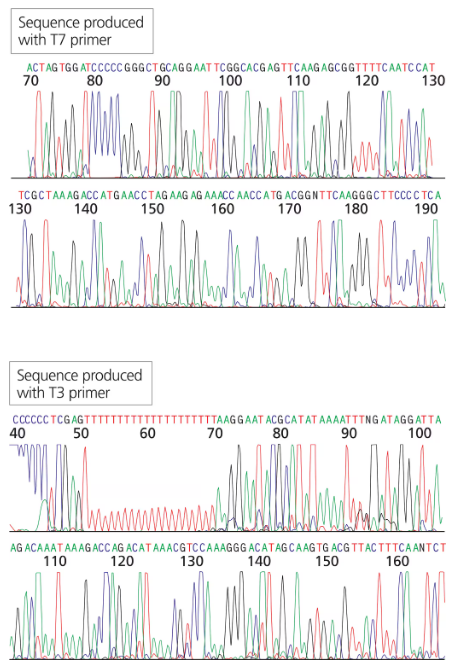
You have isolated another cDNA clone of the CRABS CLAW gene from a cDNA library. The cDNA was directionally cloned using the EcoRI and XhoI sites. You sequence the recombinant plasmid using primers complementary to the T7 and T3 promoter sites flanking the MCS. The first 30 to 60 bases of sequence are usually discarded since they tend to contain errors.
Can you identify the start of the coding region in the end of the gene? What does the sequence preceding the start codon represent?
DNA sequencing results showing chromatograms from T7 and T3 primers, indicating base pairs and sequence quality.

검증된 단계별 안내
1
Step 1: Understand the context of the problem. The CRABS CLAW gene cDNA has been directionally cloned into a vector using EcoRI and XhoI restriction sites. Directional cloning ensures that the cDNA is inserted in a specific orientation, which is crucial for proper transcription and translation.
Step 2: Recognize the significance of the primers (T7 and T3 promoter sites). These primers are used to sequence the recombinant plasmid, and they flank the multiple cloning site (MCS). The sequencing will provide information about the inserted cDNA, including the coding region and any preceding sequences.
Step 3: Identify the start of the coding region. The coding region begins at the start codon, typically AUG in mRNA (or ATG in the DNA sequence). To locate this, analyze the sequence data obtained from the primers and look for the start codon within the cDNA sequence.
Step 4: Determine what the sequence preceding the start codon represents. The sequence before the start codon may include untranslated regions (UTRs), such as the 5' UTR, which can contain regulatory elements that influence gene expression. It may also include vector-derived sequences if the cloning process introduced additional bases.
Step 5: Discard the first 30 to 60 bases of sequence data, as they are prone to errors. Focus on the reliable sequence data to identify the start codon and analyze the preceding region for its biological significance.

비슷한 문제에 대한 검증된 영상 답변:

이 영상 해법은 위 문제에 도움이 된다고 튜터들이 추천한 것입니다.
영상 길이:
2m
도움이 되었나요?

주요 개념

질문에 올바르게 답하기 위해 반드시 이해해야 하는 핵심 개념들은 다음과 같습니다.

cDNA Cloning

cDNA cloning involves synthesizing complementary DNA (cDNA) from messenger RNA (mRNA) using the enzyme reverse transcriptase. This process allows researchers to create a DNA copy of a specific gene, which can then be inserted into a vector for further study. The cDNA is often used to analyze gene expression and function, as it reflects the mRNA present in a cell at a given time.
추천 영상:
가이드 코스
07:39
Genetic Cloning

Start Codon and Coding Region

The start codon, typically AUG, marks the beginning of the coding region in mRNA, signaling the start of translation into a protein. The coding region consists of sequences that are translated into amino acids, forming a polypeptide chain. Identifying the start codon is crucial for understanding where the protein-coding sequence begins and how the gene is expressed.
추천 영상:
가이드 코스
11:43
The Genetic Code

5' Untranslated Region (5' UTR)

The sequence preceding the start codon is known as the 5' untranslated region (5' UTR). This region is not translated into protein but plays important roles in the regulation of translation, mRNA stability, and the initiation of protein synthesis. The 5' UTR can contain regulatory elements that influence how efficiently the ribosome binds and translates the mRNA.
추천 영상:
가이드 코스
00:30
Regions of X Chromosomes
관련 실천
교과서 질문

You have isolated another cDNA clone of the CRABS CLAW gene from a cDNA library. The cDNA was directionally cloned using the EcoRI and XhoI sites. You sequence the recombinant plasmid using primers complementary to the T7 and T3 promoter sites flanking the MCS. The first 30 to 60 bases of sequence are usually discarded since they tend to contain errors.

Will the long stretch of T residues in the T3 sequence exist in the genomic sequence of the gene?

493
views
교과서 질문

You have identified a 0.80-kb cDNA clone that contains the entire coding sequence of the Arabidopsis gene CRABS CLAW. In the construction of the cDNA library, linkers with EcoRI sites were added to each end of the cDNA, and the cDNA was inserted into the EcoRI site of the MCS of the vector shown in the accompanying figure. You perform digests on the CRABS CLAW cDNA clone with restriction enzymes and obtain the following results. Can you determine the orientation of the cDNA clone with respect to the restriction enzyme sites in the vector? The restriction enzyme sites listed in the dark blue region are found only in the MCS of the vector.

877
views
교과서 질문

You have generated three transgenic lines of maize that are resistant to the European corn borer, a significant pest in many regions of the world. The transgenic lines (T₁ in the accompanying table) were created using Agrobacterium-mediated transformation with a T-DNA having two genes, the first being a gene conferring resistance to the corn borer and the second being a gene conferring resistance to a herbicide that you used as a selectable marker to obtain your transgenic plants. You crossed each of the lines to a wild-type maize plant and also generated a T2 population by self-fertilization of the T1 plant. The following segregation results were observed (herbicide resistant : herbicide sensitive):

Explain these segregation ratios.

551
views
교과서 질문

You have identified five genes in S. cerevisiae that are induced when the yeast are grown in a high-salt (NaCl) medium. To study the potential roles of these genes in acclimation to growth in high-salt conditions, you wish to examine the phenotypes of loss- and gain-of-function alleles of each. How would your answer differ if you were working with tomato plants instead of yeast?

564
views
교과서 질문

You have identified five genes in S. cerevisiae that are induced when the yeast are grown in a high-salt (NaCl) medium. To study the potential roles of these genes in acclimation to growth in high-salt conditions, you wish to examine the phenotypes of loss- and gain-of-function alleles of each. How will you do this?

500
views
교과서 질문

You have isolated another cDNA clone of the CRABS CLAW gene from a cDNA library.. The cDNA was directionally cloned using the EcoRI and XhoI sites. You sequence the recombinant plasmid using primers complementary to the T7 and T3 promoter sites flanking the MCS. The first 30 to 60 bases of sequence are usually discarded since they tend to contain errors.

Can you identify which sequence portions are derived from the vector (specifically the MCS) and which are derived from the cDNA clone?

548
views