Ch. 16 - Genomics: Genetics from a Whole-Genome Perspective
Sanders - Genetic Analysis: An Integrated Approach 3rd Edition
Sanders3rd EditionGenetic Analysis: An Integrated ApproachISBN: 9780135564172당신이 사용하는 게 아니라요?교과서 변경
16장, 문제 22a

A substantial fraction of almost every genome sequenced consists of genes that have no known function and that do not have sequence similarity to any genes with known function. Describe two approaches to ascertaining the biological role of these genes in S. cerevisiae.

검증된 단계별 안내
1
Identify the gene of interest in S. cerevisiae and create a gene knockout or deletion mutant. This involves removing or disrupting the gene to observe the resulting phenotype. If the organism exhibits a specific change in growth, morphology, or metabolic activity, this can provide clues about the gene's biological role.
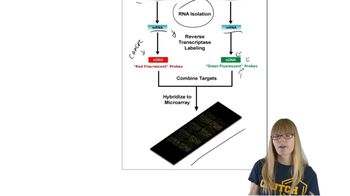
Perform transcriptomic or proteomic analysis to study the expression patterns of the gene under various environmental or stress conditions. By analyzing when and where the gene is expressed, you can infer its potential role in cellular processes or pathways.
Use epistasis analysis by combining the knockout of the gene of interest with mutations in other genes. This can help determine if the gene interacts with known pathways or processes, providing further insight into its function.
Conduct a synthetic lethality screen by introducing the gene knockout into a library of mutants with deletions in other genes. If the double mutant is inviable, it suggests that the gene of interest is functionally redundant with another gene or part of an essential pathway.
Perform protein interaction studies, such as yeast two-hybrid assays or co-immunoprecipitation, to identify proteins that interact with the gene product. These interactions can provide clues about the gene's role in specific cellular processes or complexes.

비슷한 문제에 대한 검증된 영상 답변:

이 영상 해법은 위 문제에 도움이 된다고 튜터들이 추천한 것입니다.
영상 길이:
1m

주요 개념

질문에 올바르게 답하기 위해 반드시 이해해야 하는 핵심 개념들은 다음과 같습니다.

Gene Function Annotation

Gene function annotation involves assigning biological roles to genes based on experimental data, computational predictions, or comparative genomics. This process helps identify potential functions of uncharacterized genes by analyzing their expression patterns, interactions with other proteins, and phenotypic effects when mutated. In S. cerevisiae, researchers often use high-throughput techniques to gather data that can suggest the roles of these genes.
추천 영상:
가이드 코스
08:26
Functional Genomics

Gene Knockout Studies

Gene knockout studies involve creating organisms in which specific genes are inactivated or 'knocked out' to observe the resulting phenotypic changes. In S. cerevisiae, this approach allows researchers to determine the biological significance of uncharacterized genes by assessing how the absence of these genes affects cellular processes, growth, and survival under various conditions.
추천 영상:

Functional Genomics

Functional genomics is the field that aims to understand the relationship between genes and their functions through various experimental techniques. In S. cerevisiae, methods such as transcriptomics, proteomics, and metabolomics can be employed to analyze gene expression and protein interactions, providing insights into the roles of genes with unknown functions by correlating them with observable traits or responses to environmental changes.
추천 영상:
가이드 코스
08:26
Functional Genomics
관련 실천
교과서 질문

A modification of the two-hybrid system, called the one-hybrid system, is used for identifying proteins that can bind specific DNA sequences. In this method, the DNA sequence to be tested, the bait, is fused to a TATA box to drive expression of a reporter gene. The reporter gene is often chosen to complement a mutant phenotype; for example, a HIS gene may be used in a his⁻ mutant yeast strain. A cDNA library is constructed with the cDNA sequences translationally fused to the GAL4 activation domain and transformed into this yeast strain. Diagram how trans-acting proteins that bind to cis-acting regulatory sequences can be identified using a one-hybrid screen.

548
views
교과서 질문

A substantial fraction of almost every genome sequenced consists of genes that have no known function and that do not have sequence similarity to any genes with known function. How would your approach change if the genes of unknown function were in the human genome?

672
views
교과서 질문

In the globin gene family (shown in the below diagram), which pair of genes would exhibit a higher level of sequence similarity, the human δ-globin and human β-globin genes or the human β-globin and chimpanzee β-globin genes? Can you explain your answer in terms of the timing of gene duplications?

546
views
교과서 질문

You are studying similarities and differences in how organisms respond to high salt concentrations and high temperatures. You begin your investigation by using microarrays to compare gene expression patterns of S. cerevisiae in normal growth conditions, in high salt concentrations, and at high temperatures. The results are shown here, with the values of red and green representing the extent of increase and decrease, respectively, of expression for genes a–s in the experimental conditions versus the control (normal growth) conditions. What is the first step you will take to analyze your data?

380
views
교과서 질문

Symbiodinium minutum is a dinoflagellate with a genome size that encodes more than 40,000 protein-coding genes. In contrast, the genome of Plasmodium falciparum has only a little more than 5000 protein-coding genes. Both Symbiodinium and Plasmodium are members of the Alveolate lineage of eukaryotes. What might be the cause of such a wide variation in their genome sizes?

512
views
교과서 질문

Substantial fractions of the genomes of many plants consist of segmental duplications; for example, approximately 40% of genes in the Arabidopsis genome are duplicated. How might you approach the functional characterization of such genes using reverse genetics?

372
views