Ch. 18 - Developmental Genetics
Sanders - Genetic Analysis: An Integrated Approach 3rd Edition
Sanders3rd EditionGenetic Analysis: An Integrated ApproachISBN: 9780135564172당신이 사용하는 게 아니라요?교과서 변경
18장, 문제 8

Compare and contrast the specification of segmental identity in Drosophila with that of floral organ specification in Arabidopsis. What is the same in this process, and what is different?

검증된 단계별 안내
1
Step 1: Understand the concept of segmental identity in Drosophila. Segmental identity in Drosophila is determined by a group of genes known as Hox genes. These genes are responsible for the development of specific body segments and ensure that each segment develops the appropriate structures.
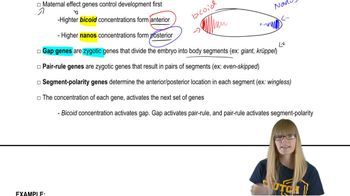
Step 2: Explore the role of Hox genes in Drosophila. Hox genes are expressed in specific patterns along the anterior-posterior axis of the embryo, and their expression is regulated by a hierarchy of gene interactions, including gap genes, pair-rule genes, and segment polarity genes.
Step 3: Learn about floral organ specification in Arabidopsis. In Arabidopsis, floral organ identity is specified by the ABC model, which involves three classes of genes (A, B, and C) that interact to determine the identity of the floral organs: sepals, petals, stamens, and carpels.
Step 4: Compare the genetic mechanisms. Both Drosophila and Arabidopsis use a combinatorial code of gene expression to specify identity, but the specific genes and their interactions differ. In Drosophila, Hox genes are key, while in Arabidopsis, the ABC model genes play a central role.
Step 5: Contrast the developmental contexts. Drosophila segmental identity involves the development of body segments in an animal, while Arabidopsis floral organ specification involves the development of flower parts in a plant. Despite these differences, both processes illustrate how specific gene expression patterns can lead to the development of distinct structures.

비슷한 문제에 대한 검증된 영상 답변:

이 영상 해법은 위 문제에 도움이 된다고 튜터들이 추천한 것입니다.
영상 길이:
2m
도움이 되었나요?

주요 개념

질문에 올바르게 답하기 위해 반드시 이해해야 하는 핵심 개념들은 다음과 같습니다.

Segmental Identity in Drosophila

In Drosophila, segmental identity is determined by a series of genes known as segmentation genes, which include gap, pair-rule, and segment polarity genes. These genes establish the anterior-posterior axis and define the identity of each segment through a cascade of regulatory interactions. The homeotic genes then specify the characteristics of each segment, ensuring that body parts develop in the correct locations.
추천 영상:
가이드 코스
11:19
Segmentation Genes

Floral Organ Specification in Arabidopsis

In Arabidopsis, floral organ specification is governed by the ABC model of flower development, which involves three classes of genes (A, B, and C) that interact to determine the identity of floral organs. Class A genes specify sepals, A and B together specify petals, B and C specify stamens, and C alone specifies carpels. This model illustrates how specific gene interactions lead to the formation of distinct floral structures.
추천 영상:
가이드 코스
09:12
Transgenic Organisms and Gene Therapy

Comparative Developmental Genetics

Comparative developmental genetics examines how different organisms use similar genetic mechanisms to achieve diverse developmental outcomes. In both Drosophila and Arabidopsis, gene regulatory networks play a crucial role in determining body and organ identity. While the specific genes and their interactions differ, the underlying principles of spatial and temporal gene expression are fundamental to both processes, highlighting evolutionary conservation in developmental biology.
추천 영상:
가이드 코스
03:45
Descriptive Genetics
관련 실천
교과서 질문

Why do loss-of-function mutations in Hox genes usually result in embryo lethality, whereas gain-of-function mutants can be viable? Why are flies homozygous for the recessive loss-of-function alleles  and  viable?

497
views
교과서 질문

Actinomycin D is a drug that inhibits the activity of RNA polymerase II. In the presence of actinomycin D, early development in many vertebrate species, such as frogs, can proceed past the formation of a blastula, a hollow ball of cells that forms after early cleavage divisions, but development ceases before gastrulation (the stage at which cell layers are established). What does this tell you about maternal versus zygotic gene activity in early frog development?

538
views
교과서 질문

What is the difference between a parasegment and a segment in Drosophila development? Why do developmental biologists think of parasegments as the subdivisions that are produced during the development of flies?

1251
views
교과서 질문

Consider the even-skipped regulatory sequences in Figure 18.9.

Explain what you expect to see happen to even-skipped stripe 2 if it is expressed in a Krüppel mutant background. What about a hunchback mutant background? A giant mutant background? A bicoid mutant background?

698
views
교과서 질문

Ablation of the anchor cell in wild-type C. elegans results in a vulva-less phenotype.

What about if the anchor cell is ablated in a let-23 gain-of-function mutant?

386
views
교과서 질문

Ablation of the anchor cell in wild-type C. elegans results in a vulva-less phenotype.

What phenotype is to be expected if the anchor cell is ablated in a let-23 loss-of-function mutant?

444
views