Ch. 18 - Developmental Genetics
Sanders - Genetic Analysis: An Integrated Approach 3rd Edition
Sanders3rd EditionGenetic Analysis: An Integrated ApproachISBN: 9780135564172당신이 사용하는 게 아니라요?교과서 변경
18장, 문제 6

What is the difference between a parasegment and a segment in Drosophila development? Why do developmental biologists think of parasegments as the subdivisions that are produced during the development of flies?

검증된 단계별 안내
1
Understand the definitions: A 'segment' in Drosophila refers to the visible, anatomical divisions of the larva or adult fly, such as the head, thorax, and abdomen. A 'parasegment,' on the other hand, is a developmental unit defined by gene expression patterns during early embryogenesis, which does not directly correspond to the visible segments.
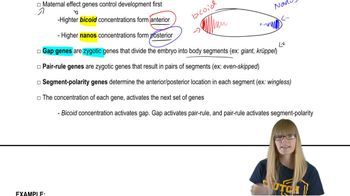
Recognize the genetic basis: Parasegments are defined by the expression of specific 'pair-rule' genes and 'segment polarity' genes. These genes establish boundaries and patterns of gene expression that guide the development of the embryo.
Note the spatial relationship: Parasegments are offset from anatomical segments. Each parasegment includes the posterior part of one anatomical segment and the anterior part of the next. This offset is due to the way developmental genes are expressed and how cells communicate during early development.
Understand why parasegments are important: Developmental biologists focus on parasegments because they represent the fundamental units of gene regulation and pattern formation during early development. These units are critical for establishing the body plan of the fly.
Connect to broader concepts: The study of parasegments highlights the importance of genetic and molecular mechanisms in development. It also demonstrates how early gene expression patterns can influence the final anatomical structure of an organism.

비슷한 문제에 대한 검증된 영상 답변:

이 영상 해법은 위 문제에 도움이 된다고 튜터들이 추천한 것입니다.
영상 길이:
3m
도움이 되었나요?

주요 개념

질문에 올바르게 답하기 위해 반드시 이해해야 하는 핵심 개념들은 다음과 같습니다.

Segments in Drosophila Development

Segments are the primary body divisions in Drosophila, established during early embryonic development. Each segment corresponds to a specific region of the adult fly's body plan, such as the thorax and abdomen. Segmentation is crucial for organizing the body structure and is regulated by various genes that dictate the identity and function of each segment.
추천 영상:
가이드 코스
03:46
Drosophilia Development

Parasegments in Drosophila Development

Parasegments are developmental units that are offset from the segments, consisting of parts of two adjacent segments. They play a key role in the organization of the embryonic body plan and are important for the proper placement of structures like limbs and organs. Parasegments are formed during the early stages of development and are essential for understanding the spatial organization of the fly's body.
추천 영상:
가이드 코스
03:46
Drosophilia Development

Developmental Biology and Body Patterning

Developmental biology studies how organisms grow and develop, focusing on the processes that lead to the formation of body structures. In Drosophila, the concept of parasegments helps researchers understand how genetic and molecular signals coordinate the development of complex body patterns. This understanding is crucial for elucidating how similar processes may occur in other organisms, including humans.
추천 영상:
가이드 코스
11:19
Segmentation Genes
관련 실천
교과서 질문

Why do loss-of-function mutations in Hox genes usually result in embryo lethality, whereas gain-of-function mutants can be viable? Why are flies homozygous for the recessive loss-of-function alleles  and  viable?

497
views
교과서 질문

Actinomycin D is a drug that inhibits the activity of RNA polymerase II. In the presence of actinomycin D, early development in many vertebrate species, such as frogs, can proceed past the formation of a blastula, a hollow ball of cells that forms after early cleavage divisions, but development ceases before gastrulation (the stage at which cell layers are established). What does this tell you about maternal versus zygotic gene activity in early frog development?

538
views
교과서 질문

Consider the even-skipped regulatory sequences in Figure 18.9.

Explain what you expect to see happen to even-skipped stripe 2 if it is expressed in a Krüppel mutant background. What about a hunchback mutant background? A giant mutant background? A bicoid mutant background?

698
views
교과서 질문

Consider the even-skipped regulatory sequences in the following figure:

How are the sharp boundaries of expression of Eve Stripe 2 formed?

469
views
교과서 질문

Compare and contrast the specification of segmental identity in Drosophila with that of floral organ specification in Arabidopsis. What is the same in this process, and what is different?

559
views
교과서 질문

Consider the even-skipped regulatory sequences in Figure 18.9.

Consider the binding sites for gap proteins and Bicoid in the stripe 2 enhancer module. What sites are occupied in parasegments 2, 3, and 4, and how does this result in expression or no expression?

554
views