Ch. 19 - Genetic Analysis of Quantitative Traits
Sanders - Genetic Analysis: An Integrated Approach 3rd Edition
Sanders3rd EditionGenetic Analysis: An Integrated ApproachISBN: 9780135564172당신이 사용하는 게 아니라요?교과서 변경
19장, 문제 3

Compare and contrast broad sense heritability and narrow sense heritability, giving an example of each measurement and identifying how the measurement is used.

검증된 단계별 안내
1
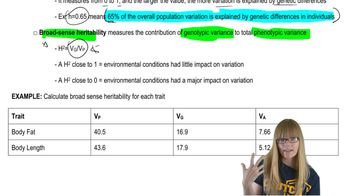
Broad sense heritability (H²) measures the proportion of phenotypic variance in a population that is attributable to all genetic variance, including additive, dominance, and epistatic effects. Narrow sense heritability (h²), on the other hand, measures the proportion of phenotypic variance that is due specifically to additive genetic variance, which is the component passed from parents to offspring.
To calculate broad sense heritability (H²), use the formula: H²=VGVP, where VG is the total genetic variance and VP is the total phenotypic variance.
To calculate narrow sense heritability (h²), use the formula: h²=VAVP, where VA is the additive genetic variance and VP is the total phenotypic variance.
An example of broad sense heritability is studying the genetic contribution to height in a population, where dominance and epistatic effects are included. This measurement is used to understand the overall genetic influence on a trait.
An example of narrow sense heritability is estimating the heritability of milk production in dairy cattle, focusing on additive genetic variance. This measurement is used in selective breeding programs to predict the response to selection.

비슷한 문제에 대한 검증된 영상 답변:

이 영상 해법은 위 문제에 도움이 된다고 튜터들이 추천한 것입니다.
영상 길이:
3m
도움이 되었나요?

주요 개념

질문에 올바르게 답하기 위해 반드시 이해해야 하는 핵심 개념들은 다음과 같습니다.

Broad Sense Heritability

Broad sense heritability (H²) measures the proportion of phenotypic variance in a trait that can be attributed to genetic variance, including additive, dominance, and interaction effects among alleles. It provides a comprehensive view of genetic influence on traits, but does not distinguish between different types of genetic contributions. For example, in a study of plant height, broad sense heritability would consider all genetic factors affecting height, making it useful for understanding overall genetic potential.
추천 영상:
가이드 코스
07:04
Calculating Heritability

Narrow Sense Heritability

Narrow sense heritability (h²) focuses specifically on the proportion of phenotypic variance that is due to additive genetic variance alone. This measurement is crucial for predicting the response to selection in breeding programs, as it reflects the heritable traits that can be passed on to the next generation. For instance, in livestock breeding, narrow sense heritability would be used to estimate how much of the variation in milk production is due to additive genetic factors, guiding selection decisions.
추천 영상:
가이드 코스
07:04
Calculating Heritability

Applications in Genetics

Both broad and narrow sense heritability are essential in genetics for understanding trait inheritance and guiding breeding strategies. Broad sense heritability helps researchers assess the overall genetic contribution to traits, while narrow sense heritability is more applicable in predicting the outcomes of selective breeding. For example, in agriculture, knowing the narrow sense heritability of crop yield can inform farmers on which plants to select for future planting to enhance yield.
추천 영상:
가이드 코스
03:45
Descriptive Genetics