Ch. 19 - Genetic Analysis of Quantitative Traits
Sanders - Genetic Analysis: An Integrated Approach 3rd Edition
Sanders3rd EditionGenetic Analysis: An Integrated ApproachISBN: 9780135564172당신이 사용하는 게 아니라요?교과서 변경
19장, 문제 5

Describe the difference between continuous phenotypic variation and discontinuous variation. Explain how polygenic inheritance could be the basis of a trait showing continuous phenotypic variation. Explain how polygenic inheritance can be the basis of a threshold trait.

검증된 단계별 안내
1
Continuous phenotypic variation refers to traits that show a range of values, such as height or skin color, where intermediate phenotypes are possible. Discontinuous variation, on the other hand, refers to traits that fall into distinct categories, such as blood type (A, B, AB, O) or pea plant flower color (purple or white).
Polygenic inheritance involves multiple genes contributing to a single trait. Each gene may have multiple alleles, and the combined effect of these alleles produces a wide range of phenotypes. For example, in traits like human height, the additive effects of alleles at several loci result in continuous variation.
In polygenic inheritance, the more genes involved, the greater the number of possible allele combinations, leading to a smoother and more continuous distribution of phenotypes. This is often represented as a bell-shaped curve in a population.
A threshold trait is a special case of polygenic inheritance where the trait is determined by the cumulative effect of multiple genes, but the phenotype is expressed only when a certain threshold level of genetic and environmental factors is reached. For example, diseases like Type 2 diabetes may only manifest when the genetic predisposition and environmental factors (e.g., diet, lifestyle) exceed a critical threshold.
In threshold traits, individuals below the threshold appear unaffected, while those above the threshold express the trait. This creates a discontinuous phenotypic outcome (affected or unaffected) despite the underlying polygenic basis, which involves continuous variation in genetic predisposition.

비슷한 문제에 대한 검증된 영상 답변:

이 영상 해법은 위 문제에 도움이 된다고 튜터들이 추천한 것입니다.
영상 길이:
2m
도움이 되었나요?

주요 개념

질문에 올바르게 답하기 위해 반드시 이해해야 하는 핵심 개념들은 다음과 같습니다.

Continuous vs. Discontinuous Variation

Continuous variation refers to traits that show a range of phenotypes, such as height or skin color, where individuals can have any value within a spectrum. In contrast, discontinuous variation involves distinct categories or classes, such as blood type or flower color, where traits are clearly defined and do not blend. Understanding these differences is crucial for analyzing how traits are inherited and expressed.
추천 영상:
가이드 코스
09:28
Genomic Variation

Polygenic Inheritance

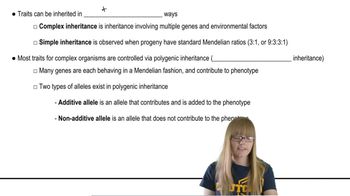
Polygenic inheritance occurs when multiple genes contribute to a single trait, resulting in a continuous range of phenotypes. Each gene may have a small additive effect, leading to traits that vary smoothly rather than in discrete categories. This mechanism explains why traits like height or skin color exhibit continuous variation, as the cumulative effects of many genes influence the final phenotype.
추천 영상:
가이드 코스
05:13
Organelle Inheritance

Threshold Traits

Threshold traits are characteristics that are influenced by multiple genes and environmental factors, where a certain threshold must be reached for the trait to be expressed. For example, a person may have a genetic predisposition for a condition, but it only manifests if environmental factors exceed a specific level. This concept illustrates how polygenic inheritance can lead to traits that are not continuously variable but instead appear once a threshold is crossed.
추천 영상:
가이드 코스
13:40
Traits and Variance