Ch. 19 - Genetic Analysis of Quantitative Traits
Sanders - Genetic Analysis: An Integrated Approach 3rd Edition
Sanders3rd EditionGenetic Analysis: An Integrated ApproachISBN: 9780135564172당신이 사용하는 게 아니라요?교과서 변경
19장, 문제 19

During a visit, your grandparents comment on how tall you are compared with them. You tell them that in your genetics class, you learned that height in humans has high heritability, although environmental factors also influence adult height. You correctly explain the meaning of heritability, and your grandfather asks, 'How can height be highly heritable and still be influenced by the environment?' What explanation do you give your grandfather?

검증된 단계별 안내
1
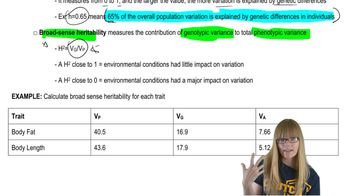
Explain the concept of heritability: Heritability is a measure of how much of the variation in a trait, such as height, within a population is due to genetic differences among individuals. It is expressed as a proportion, ranging from 0 to 1, where 1 indicates that all variation is genetic and 0 indicates that none is genetic.
Clarify that heritability applies to populations, not individuals: Heritability does not mean that a trait is entirely determined by genetics in every individual. Instead, it reflects the relative contribution of genetic factors to the variation observed in a population under specific environmental conditions.
Discuss the role of environmental factors: Even if a trait like height has high heritability, environmental factors such as nutrition, health during childhood, and access to resources can still influence the expression of the trait. For example, poor nutrition during growth years can limit height potential, even if the genetic predisposition for tall stature exists.
Provide an analogy: Use an analogy to make the concept clearer. For instance, you could say, 'Think of heritability like the blueprint of a house. The blueprint determines the structure, but the final appearance of the house can be influenced by external factors like weather, materials used, and construction quality.'
Conclude with the interaction between genes and environment: Emphasize that traits like height are influenced by both genetic and environmental factors. High heritability means genetics play a significant role in the variation of height within a population, but environmental factors can still modify the outcome for individuals.

비슷한 문제에 대한 검증된 영상 답변:

이 영상 해법은 위 문제에 도움이 된다고 튜터들이 추천한 것입니다.
영상 길이:
2m
도움이 되었나요?

주요 개념

질문에 올바르게 답하기 위해 반드시 이해해야 하는 핵심 개념들은 다음과 같습니다.

Heritability

Heritability is a statistical measure that estimates the proportion of variation in a trait, such as height, that can be attributed to genetic differences among individuals in a population. A high heritability value indicates that genetics play a significant role in determining that trait, but it does not imply that the trait is solely determined by genes.
추천 영상:
가이드 코스
07:04
Calculating Heritability

Environmental Influence

Environmental factors encompass a wide range of influences, including nutrition, health, and lifestyle, that can affect an individual's development and traits. Even with high heritability, these factors can modify the expression of genetic potential, meaning that two individuals with similar genetic backgrounds may still exhibit different heights due to their unique environmental experiences.
추천 영상:
가이드 코스
03:38
Maternal Effect

Gene-Environment Interaction

Gene-environment interaction refers to the complex interplay between genetic predispositions and environmental conditions. This concept explains that while genetics set a potential range for traits like height, the actual outcome can vary significantly based on environmental factors, illustrating that both genetics and environment are crucial in shaping an individual's characteristics.
추천 영상:
가이드 코스
07:56
Interacting Genes Overview
관련 실천
교과서 질문

Two pure-breeding wheat strains, one producing dark red kernels and the other producing white kernels, are crossed to produce F₁ with pink kernel color. When an F₁ plant is self-fertilized and its seed collected and planted, the resulting F₂ consists of 160 plants with kernel colors as shown in the following table.

Using clearly defined allele symbols of your choice, give genotypes for the parental strains and the F₁. Describe the genotypes that produce the different phenotypes in the F₂.

470
views
교과서 질문

Applied to the study of the human genome, a goal of GWAS is to locate chromosome regions that are likely to contain genes influencing the risk of disease. Specific genes can be identified in these regions, and particular mutant alleles that increase disease risk can be sequenced. To date, the identification of alleles that increase disease risk has occasionally led to a new therapeutic strategy, but more often the identification of disease alleles is the only outcome.

From a physician's point of view, what is the value of being able to identify alleles that increase the risk of a particular disease?

375
views
교과서 질문

Applied to the study of the human genome, a goal of GWAS is to locate chromosome regions that are likely to contain genes influencing the risk of disease. Specific genes can be identified in these regions, and particular mutant alleles that increase disease risk can be sequenced. To date, the identification of alleles that increase disease risk has occasionally led to a new therapeutic strategy, but more often the identification of disease alleles is the only outcome.

What is the value of being able to identify alleles that increase disease risk for a person who is currently free of the disease but who is at risk of developing the disease due to its presence in the family?

419
views
교과서 질문

An association of racehorse owners is seeking a new genetic strategy to improve the running speed of their horses. Traditional breeding of fast male and female horses has proven expensive and time-consuming, and the breeders are interested in an approach using quantitative trait loci as a basis for selecting breeding pairs of horses. Write a brief synopsis (∼50 words) of QTL mapping to explain how genes influencing running speed might be identified in horses.

421
views
교과서 질문

In studies of human MZ and DZ twin pairs of the same sex who are reared together, the following concordance values are identified for various traits. Based on the values shown, describe the relative importance of genes versus the influence of environmental factors for each trait.

484
views
교과서 질문

Two pure-breeding wheat strains, one producing dark red kernels and the other producing white kernels, are crossed to produce F₁ with pink kernel color. When an F₁ plant is self-fertilized and its seed collected and planted, the resulting F₂ consists of 160 plants with kernel colors as shown in the following table.

If an F₁ plant is crossed to a dark red plant, what are the expected progeny phenotypes, and what is the expected proportion of each phenotype?

437
views