Ch. 2 - Transmission Genetics
Sanders - Genetic Analysis: An Integrated Approach 3rd Edition
Sanders3rd EditionGenetic Analysis: An Integrated ApproachISBN: 9780135564172당신이 사용하는 게 아니라요?교과서 변경
2장, 문제 7c

If a chi-square test produces a chi-square value of 7.83 with 4 degrees of freedom,


Above what chi-square value would you reject the chance hypothesis for an experiment with 7 degrees of freedom?

검증된 단계별 안내
1
Understand the problem: The question is asking for the chi-square value above which you would reject the null hypothesis (chance hypothesis) for an experiment with 7 degrees of freedom. This involves using a chi-square distribution table or formula to find the critical value for a given significance level (commonly 0.05 unless otherwise specified).
Identify the degrees of freedom: The problem specifies 7 degrees of freedom for the experiment. This is a key parameter for determining the critical chi-square value.
Determine the significance level: If not explicitly stated, assume a common significance level of 0.05 (5%). This is the probability threshold for rejecting the null hypothesis.
Use a chi-square distribution table or statistical software: Locate the critical chi-square value corresponding to 7 degrees of freedom and a significance level of 0.05. In a chi-square table, find the row for 7 degrees of freedom and the column for 0.05.
Interpret the result: The critical chi-square value you find is the threshold. If the chi-square value from your experiment exceeds this critical value, you would reject the null hypothesis. Otherwise, you fail to reject it.

비슷한 문제에 대한 검증된 영상 답변:

이 영상 해법은 위 문제에 도움이 된다고 튜터들이 추천한 것입니다.
영상 길이:
2m

주요 개념

질문에 올바르게 답하기 위해 반드시 이해해야 하는 핵심 개념들은 다음과 같습니다.

Chi-Square Test

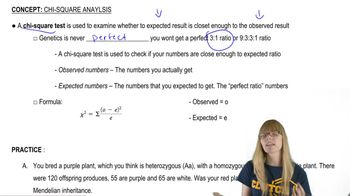
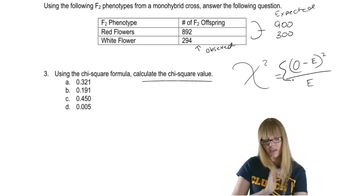
The chi-square test is a statistical method used to determine if there is a significant association between categorical variables. It compares the observed frequencies in each category to the expected frequencies, which are calculated under the null hypothesis. A higher chi-square value indicates a greater discrepancy between observed and expected values, suggesting that the null hypothesis may be rejected.
추천 영상:
가이드 코스
02:48
Chi Square Analysis

Degrees of Freedom

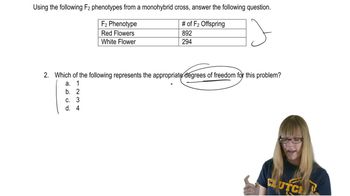
Degrees of freedom (df) refer to the number of independent values or quantities that can vary in an analysis without violating any constraints. In the context of the chi-square test, degrees of freedom are calculated as the number of categories minus one. They are crucial for determining the critical value of chi-square from statistical tables, which helps in deciding whether to reject the null hypothesis.
추천 영상:

Critical Value

The critical value in a chi-square test is the threshold that the calculated chi-square statistic must exceed to reject the null hypothesis. This value is determined based on the desired significance level (commonly 0.05) and the degrees of freedom. For 7 degrees of freedom, the critical value can be found in chi-square distribution tables, and it indicates the point beyond which the observed data is considered statistically significant.
추천 영상: