Ch. 4 - Gene Interaction
Sanders - Genetic Analysis: An Integrated Approach 3rd Edition
Sanders3rd EditionGenetic Analysis: An Integrated ApproachISBN: 9780135564172당신이 사용하는 게 아니라요?교과서 변경
4장, 문제 4c

Fifteen bacterial colonies growing on a complete medium are transferred to a minimal medium. Twelve of the colonies grow on minimal medium.
The serine biosynthetic pathway is a three-step pathway in which each step is catalyzed by the enzyme product of a different gene, identified as enzymes A, B, and C in the diagram below.


Diagram of the serine biosynthetic pathway with enzymes A, B, and C.
Mutant 1 grows only on min + Ser. In addition to growth on min + Ser, mutant 2 also grows on min + 3-PHP and min + 3-PS. Mutant 3 grows on min + 3-PS and min + Ser. Identify the step of the serine biosynthesis pathway at which each mutant is defective.

검증된 단계별 안내
1
Step 1: Understand the serine biosynthetic pathway diagram. The pathway starts with 3-Phosphoglycerate, which is converted to 3-Phospho-hydroxypyruvate (3-PHP) by Enzyme A. Then, 3-PHP is converted to 3-Phosphoserine (3-PS) by Enzyme B. Finally, 3-PS is converted to Serine (Ser) by Enzyme C.
Step 2: Analyze the growth patterns of the mutants. Mutant 1 grows only when provided with 3-PS, indicating it cannot synthesize 3-PS from 3-PHP. This suggests a defect in Enzyme B.
Step 3: Mutant 2 grows when provided with 3-PHP or 3-PS, indicating it cannot synthesize 3-PHP from 3-Phosphoglycerate. This suggests a defect in Enzyme A.
Step 4: Mutant 3 grows when provided with 3-PS or Serine, indicating it cannot synthesize Serine from 3-PS. This suggests a defect in Enzyme C.
Step 5: Assign the defective step for each mutant based on the analysis: Mutant 1 is defective in the step catalyzed by Enzyme B, Mutant 2 is defective in the step catalyzed by Enzyme A, and Mutant 3 is defective in the step catalyzed by Enzyme C.

비슷한 문제에 대한 검증된 영상 답변:

이 영상 해법은 위 문제에 도움이 된다고 튜터들이 추천한 것입니다.
영상 길이:
2m
도움이 되었나요?

주요 개념

질문에 올바르게 답하기 위해 반드시 이해해야 하는 핵심 개념들은 다음과 같습니다.

Serine Biosynthetic Pathway

The serine biosynthetic pathway is a metabolic route that converts 3-phosphoglycerate into serine through a series of enzymatic reactions. This pathway involves three key enzymes, A, B, and C, each catalyzing a specific step. Understanding this pathway is crucial for identifying where mutations may disrupt serine production in bacterial mutants.
추천 영상:
가이드 코스
05:44
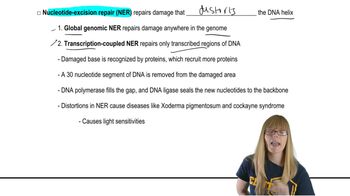
Repair Pathways

Mutant Analysis

In genetics, mutant analysis involves studying organisms with specific genetic alterations to determine the effects on metabolic pathways. By observing which media the mutants can grow on, researchers can infer which enzymes are functional or defective, thus pinpointing the specific step in the biosynthetic pathway that is affected by each mutation.
추천 영상:
가이드 코스
02:48
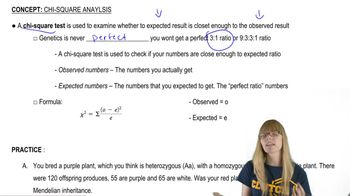
Chi Square Analysis

Minimal vs. Complete Medium

Minimal medium contains only the essential nutrients required for growth, while complete medium provides additional nutrients, including amino acids like serine. The ability of bacterial colonies to grow on minimal medium indicates their capacity to synthesize necessary compounds, such as serine, which is vital for understanding the implications of mutations in the serine biosynthetic pathway.
추천 영상:
가이드 코스
04:17
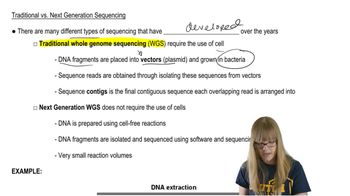
Traditional vs. Next-Gen
관련 실천
교과서 질문

Fifteen bacterial colonies growing on a complete medium are transferred to a minimal medium. Twelve of the colonies grow on minimal medium.

The three colonies that do not grow on minimal medium are transferred to minimal medium supplemented with the amino acid serine (min + Ser), and all three colonies grow. Characterize these three colonies.

461
views
교과서 질문

When working on barley plants, two researchers independently identify a short-plant mutation and develop homozygous recessive lines of short plants. Careful measurements of the height of mutant short plants versus normal tall plants indicate that the two mutant lines have the same height. How would you determine if these two mutant lines carry mutation of the same gene or of different genes?

701
views
교과서 질문

In a type of parakeet known as a "budgie," feather color is controlled by two genes. A yellow pigment is synthesized under the control of a dominant allele Y. Budgies that are homozygous for the recessive y allele do not synthesize yellow pigment. At an independently assorting gene, the dominant allele B directs synthesis of a blue pigment. Recessive homozygotes with the bb genotype do not produce blue pigment. Budgies that produce both yellow and blue pigments have green feathers; those that produce only yellow pigment or only blue pigment have yellow or blue feathers, respectively; and budgies that produce neither pigment are white (albino).

c. What are the genotype(s) and phenotype(s) of the F₁ progeny of the cross described in part (b)?

535
views
교과서 질문

In a type of parakeet known as a "budgie," feather color is controlled by two genes. A yellow pigment is synthesized under the control of a dominant allele Y. Budgies that are homozygous for the recessive y allele do not synthesize yellow pigment. At an independently assorting gene, the dominant allele B directs synthesis of a blue pigment. Recessive homozygotes with the bb genotype do not produce blue pigment. Budgies that produce both yellow and blue pigments have green feathers; those that produce only yellow pigment or only blue pigment have yellow or blue feathers, respectively; and budgies that produce neither pigment are white (albino).

a. List the genotypes for green, yellow, blue, and albino budgies

1351
views
교과서 질문

Fifteen bacterial colonies growing on a complete medium are transferred to a minimal medium. Twelve of the colonies grow on minimal medium.

Using terminology, characterize the 12 colonies that grow on minimal medium and the 3 colonies that do not.

745
views
교과서 질문

In a type of parakeet known as a "budgie," feather color is controlled by two genes. A yellow pigment is synthesized under the control of a dominant allele Y. Budgies that are homozygous for the recessive y allele do not synthesize yellow pigment. At an independently assorting gene, the dominant allele B directs synthesis of a blue pigment. Recessive homozygotes with the bb genotype do not produce blue pigment. Budgies that produce both yellow and blue pigments have green feathers; those that produce only yellow pigment or only blue pigment have yellow or blue feathers, respectively; and budgies that produce neither pigment are white (albino).

b. A cross is made between a pure-breeding green budgie and a pure-breeding albino budgie. What are the genotypes of the parent birds?

527
views