Ch. 4 - Gene Interaction
Sanders - Genetic Analysis: An Integrated Approach 3rd Edition
Sanders3rd EditionGenetic Analysis: An Integrated ApproachISBN: 9780135564172당신이 사용하는 게 아니라요?교과서 변경
4장, 문제 3

When working on barley plants, two researchers independently identify a short-plant mutation and develop homozygous recessive lines of short plants. Careful measurements of the height of mutant short plants versus normal tall plants indicate that the two mutant lines have the same height. How would you determine if these two mutant lines carry mutation of the same gene or of different genes?

검증된 단계별 안내
1
Step 1: Understand the problem. The researchers have two homozygous recessive mutant lines of barley plants that are short in height. The goal is to determine if the mutations causing the short phenotype are in the same gene or in different genes. This can be done using a genetic complementation test.
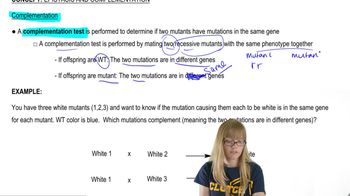
Step 2: Perform a genetic complementation test. Cross the two mutant lines with each other to produce F1 offspring. This involves mating plants from one mutant line with plants from the other mutant line.
Step 3: Analyze the phenotype of the F1 offspring. If the F1 offspring are all tall (wild-type phenotype), it indicates that the mutations are in different genes, as each mutant line provides a functional copy of the gene that the other line lacks. This is called complementation.
Step 4: If the F1 offspring are all short (mutant phenotype), it indicates that the mutations are in the same gene. In this case, neither mutant line can provide a functional copy of the gene, so the short phenotype persists.
Step 5: Conclude based on the results of the complementation test. If complementation occurs (tall F1 plants), the mutations are in different genes. If no complementation occurs (short F1 plants), the mutations are in the same gene.

비슷한 문제에 대한 검증된 영상 답변:

이 영상 해법은 위 문제에 도움이 된다고 튜터들이 추천한 것입니다.
영상 길이:
1m
도움이 되었나요?

주요 개념

질문에 올바르게 답하기 위해 반드시 이해해야 하는 핵심 개념들은 다음과 같습니다.

Homozygosity and Recessive Traits

Homozygosity refers to having two identical alleles for a particular gene, which can be either dominant or recessive. In the context of the short-plant mutation in barley, the homozygous recessive lines indicate that both alleles are for the short phenotype. Understanding this concept is crucial because it helps in determining how traits are inherited and expressed in offspring, particularly when analyzing genetic mutations.
추천 영상:
가이드 코스
13:40
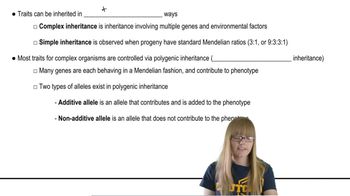
Traits and Variance

Genetic Complementation Test

A genetic complementation test is a method used to determine whether two mutations that produce similar phenotypes are in the same gene or in different genes. By crossing the two mutant lines and observing the phenotype of the offspring, researchers can infer whether the mutations complement each other (indicating different genes) or fail to complement (indicating the same gene). This test is essential for understanding the genetic basis of traits.
추천 영상:
가이드 코스
05:05
Complementation

Phenotypic Analysis

Phenotypic analysis involves studying the observable characteristics of an organism, which result from the interaction of its genotype with the environment. In this case, measuring the height of the barley plants provides data on the expression of the short-plant mutation. By comparing the phenotypes of the mutant lines and their progeny, researchers can gather evidence to support conclusions about the genetic relationships between the mutations.
추천 영상:
가이드 코스
02:48
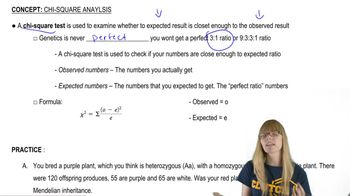
Chi Square Analysis