Ch. 4 - Gene Interaction
Sanders - Genetic Analysis: An Integrated Approach 3rd Edition
Sanders3rd EditionGenetic Analysis: An Integrated ApproachISBN: 9780135564172당신이 사용하는 게 아니라요?교과서 변경
4장, 문제 17c

The coat color in mink is controlled by two codominant alleles at a single locus. Red coat color is produced by the genotype R₁R₁, silver coat by the genotype R₁R₂, and platinum color by R₂R₂. White spotting of the coat is a recessive trait found with the genotype ss. Solid coat color is found with the S– genotype.


Two crosses are made between mink. Cross 1 is the cross of a solid, silver mink to one that is solid, platinum. Cross 2 is between a spotted, silver mink and one that is solid, silver. The progeny are described in the table below. Use these data to determine the genotypes of the parents in each cross. 
Table showing offspring results from two genetic crosses in mink coat color study.

검증된 단계별 안내
1
Step 1: Understand the genetic basis of coat color and spotting in mink. Coat color is determined by codominant alleles R₁ and R₂ at a single locus, where R₁R₁ produces red, R₁R₂ produces silver, and R₂R₂ produces platinum. Spotting is controlled by a recessive allele s, where ss results in spotted coats and S– results in solid coats.
Step 2: Analyze the offspring data from Cross 1. The progeny include solid platinum, solid silver, spotted platinum, and spotted silver. This suggests that the parents must carry alleles for both platinum and silver coat colors (R₁ and R₂) and at least one parent must carry the recessive spotting allele s.
Step 3: Deduce the genotypes of the parents in Cross 1. Since the offspring include solid coats, both parents must have at least one dominant S allele. The presence of spotted offspring indicates that both parents must carry the recessive s allele. The coat color distribution suggests one parent is R₁R₂ (silver) and the other is R₂R₂ (platinum). Thus, the genotypes are R₁R₂ Ss and R₂R₂ Ss.
Step 4: Analyze the offspring data from Cross 2. The progeny include solid and spotted coats in platinum, silver, and red colors. This indicates that the parents must carry alleles for all three coat colors (R₁ and R₂) and at least one parent must carry the recessive spotting allele s.
Step 5: Deduce the genotypes of the parents in Cross 2. The presence of red offspring (R₁R₁) suggests that one parent must be R₁R₁. The presence of spotted offspring indicates that both parents must carry the recessive s allele. The coat color distribution suggests the other parent is R₁R₂ (silver). Thus, the genotypes are R₁R₁ Ss and R₁R₂ Ss.

비슷한 문제에 대한 검증된 영상 답변:

이 영상 해법은 위 문제에 도움이 된다고 튜터들이 추천한 것입니다.
영상 길이:
6m
도움이 되었나요?

주요 개념

질문에 올바르게 답하기 위해 반드시 이해해야 하는 핵심 개념들은 다음과 같습니다.

Codominance

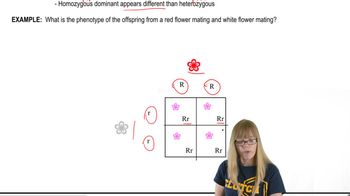
Codominance occurs when two different alleles at a locus are both expressed in the phenotype of a heterozygote. In the case of mink coat color, the alleles R₁ and R₂ are codominant, resulting in distinct coat colors when combined. Understanding codominance is crucial for predicting the phenotypic outcomes of genetic crosses involving these alleles.
추천 영상:
가이드 코스
04:37
Variations on Dominance

Genotype and Phenotype

The genotype refers to the genetic makeup of an organism, while the phenotype is the observable expression of that genotype. In the context of the question, the genotypes of the mink (e.g., R₁R₁, R₁R₂, R₂R₂, ss) determine their coat colors. Analyzing the offspring's phenotypes helps infer the genotypes of the parent mink in the crosses.
추천 영상:
가이드 코스
07:52
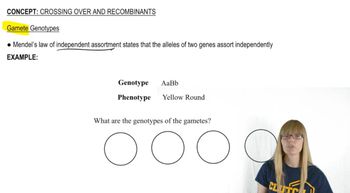
Gamete Genotypes

Punnett Square and Genetic Crosses

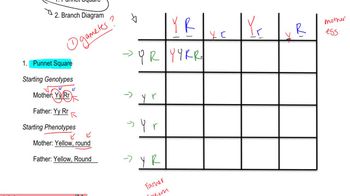
A Punnett square is a tool used to predict the genotypes of offspring from a genetic cross. By organizing the possible gametes from each parent, it allows for the visualization of potential combinations. In this question, constructing Punnett squares for the two crosses will help determine the parental genotypes based on the observed offspring ratios.
추천 영상:
관련 실천
교과서 질문

Strains of petunias come in four pure-breeding colors: white, blue, red, and purple. White petunias are produced when plants synthesize no flower pigment. Blue petunias and red petunias are produced when plants synthesize blue or red pigment only. Purple petunias are produced in plants that synthesize both red and blue pigment (the mixture of red and blue makes purple). Flower-color pigments are synthesized by gene action in two separate pigment-producing biochemical pathways. Pathway I contains gene A that produces an enzyme to catalyze conversion of a colorless pigment designated to blue pigment. In Pathway II, the enzymatic product of gene B converts the colorless pigment designated to red pigment. The two genes assort independently.

What are the possible genotype(s) for pure-breeding red petunias? 

578
views
교과서 질문

The coat color in mink is controlled by two codominant alleles at a single locus. Red coat color is produced by the genotype R₁R₁, silver coat by the genotype R₁R₂, and platinum color by R₂R₂. White spotting of the coat is a recessive trait found with the genotype ss. Solid coat color is found with the S– genotype.


What are the expected progeny phenotypes and proportions for the cross SsR₁R₂ x ssR₂R₂?

398
views
교과서 질문

Strains of petunias come in four pure-breeding colors: white, blue, red, and purple. White petunias are produced when plants synthesize no flower pigment. Blue petunias and red petunias are produced when plants synthesize blue or red pigment only. Purple petunias are produced in plants that synthesize both red and blue pigment (the mixture of red and blue makes purple). Flower-color pigments are synthesized by gene action in two separate pigment-producing biochemical pathways. Pathway I contains gene A that produces an enzyme to catalyze conversion of a colorless pigment designated to blue pigment. In Pathway II, the enzymatic product of gene B converts the colorless pigment designated to red pigment. The two genes assort independently.

What are the possible genotype(s) for true-breeding blue petunias? 

483
views
교과서 질문

The coat color in mink is controlled by two codominant alleles at a single locus. Red coat color is produced by the genotype R₁R₁, silver coat by the genotype R₁R₂, and platinum color by R₂R₂. White spotting of the coat is a recessive trait found with the genotype ss. Solid coat color is found with the S– genotype.


If the cross SsR₁R₂ x SsR₁R₁ is made, what are the progeny phenotypes, and in what proportions are they expected to occur?

418
views
교과서 질문

Strains of petunias come in four pure-breeding colors: white, blue, red, and purple. White petunias are produced when plants synthesize no flower pigment. Blue petunias and red petunias are produced when plants synthesize blue or red pigment only. Purple petunias are produced in plants that synthesize both red and blue pigment (the mixture of red and blue makes purple). Flower-color pigments are synthesized by gene action in two separate pigment-producing biochemical pathways. Pathway I contains gene A that produces an enzyme to catalyze conversion of a colorless pigment designated to blue pigment. In Pathway II, the enzymatic product of gene B converts the colorless pigment designated to red pigment. The two genes assort independently.

True-breeding red petunias are crossed to pure-breeding blue petunias, and all the F₁ progeny have purple flowers. If the F₁ are allowed to self-fertilize and produce the F₂, what is the expected phenotypic distribution of the F₂ progeny? Show your work.

632
views
교과서 질문

In cattle, an autosomal mutation called Dexter produces calves with short stature and short limbs. Embryos that are homozygous for the Dexter mutation have severely stunted development and either spontaneously abort or are stillborn. What progeny phenotypes do you expect from the cross of two Dexter cows? What are the expected proportions of the expected phenotypes?

623
views