Ch. 5 - Genetic Linkage and Mapping in Eukaryotes
Sanders - Genetic Analysis: An Integrated Approach 3rd Edition
Sanders3rd EditionGenetic Analysis: An Integrated ApproachISBN: 9780135564172당신이 사용하는 게 아니라요?교과서 변경
5장, 문제 11

Define linkage disequilibrium. What is the physical basis of linkage, and what causes linkage equilibrium? Explain how crossing over eliminates linkage disequilibrium.

검증된 단계별 안내
1
Linkage disequilibrium (LD) refers to the non-random association of alleles at different loci in a given population. It occurs when the frequency of a particular combination of alleles is different from what would be expected if the loci were independent and randomly associated.
The physical basis of linkage is the proximity of genes on the same chromosome. Genes that are close together tend to be inherited together because they are less likely to be separated by recombination during meiosis.
Linkage equilibrium is achieved when the alleles at different loci are combined randomly, and the frequency of each allele combination is equal to the product of the frequencies of the individual alleles. This occurs when there is no association between the alleles at different loci.
Crossing over, which occurs during prophase I of meiosis, involves the exchange of genetic material between homologous chromosomes. This process can break up the association of alleles at linked loci, thereby reducing linkage disequilibrium.
As crossing over continues over generations, it increases the likelihood that alleles at different loci will be inherited independently, leading to linkage equilibrium where alleles are randomly associated.

비슷한 문제에 대한 검증된 영상 답변:

이 영상 해법은 위 문제에 도움이 된다고 튜터들이 추천한 것입니다.
영상 길이:
1m
도움이 되었나요?

주요 개념

질문에 올바르게 답하기 위해 반드시 이해해야 하는 핵심 개념들은 다음과 같습니다.

Linkage Disequilibrium

Linkage disequilibrium refers to the non-random association of alleles at different loci in a given population. When certain alleles are inherited together more often than would be expected by chance, it indicates that the loci are physically close on the same chromosome. This can affect genetic variation and the mapping of traits in populations.
추천 영상:
가이드 코스
07:33
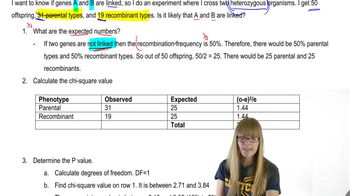
Chi Square and Linkage

Physical Basis of Linkage

The physical basis of linkage lies in the arrangement of genes on chromosomes. Genes that are located close to each other on the same chromosome tend to be inherited together during meiosis, due to the reduced likelihood of recombination events occurring between them. This proximity can lead to the phenomenon of linkage disequilibrium.
추천 영상:
가이드 코스
07:33
Chi Square and Linkage

Crossing Over and Linkage Equilibrium

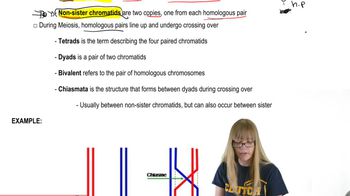
Crossing over is a process during meiosis where homologous chromosomes exchange segments, leading to new combinations of alleles. This recombination can break up the associations between alleles at linked loci, promoting linkage equilibrium, where allele combinations occur randomly. As a result, crossing over reduces linkage disequilibrium by increasing genetic diversity.
추천 영상:
가이드 코스
07:38
Crossing Over Terminology
관련 실천
교과서 질문

Syntenic genes can assort independently. Explain this observation.

732
views
교과서 질문

Researchers cross a corn plant that is pure-breeding for the dominant traits colored aleurone (C1), full kernel (Sh), and waxy endosperm (Wx) to a pure-breeding plant with the recessive traits colorless aleurone (c1), shrunken kernel (sh), and starchy (wx). The resulting F₁ plants were crossed to pure-breeding colorless, shrunken, starchy plants. Counting the kernels from about 30 ears of corn yields the following data.

Why are these data consistent with genetic linkage among the three genes?

419
views
교과서 질문

Genes A, B, C, D, and E are linked on a chromosome and occur in the order given.


Previous genetic linkage crosses have determined that recombination frequencies are 6% for genes A and B, 4% for genes B and C, 10% for genes C and D, and 11% for genes D and E. The sum of these frequencies between genes A and E is 31%. Why does the recombination distance between these genes as determined by adding the intervals between adjacent linked genes differ from the distance determined by the test cross?

1172
views
교과서 질문

On the Drosophila X chromosome, the dominant allele y⁺ produces gray body color and the recessive allele y produces yellow body. This gene is linked to one controlling full eye shape by a dominant allele lz⁺ and lozenge eye shape with a recessive allele lz. These genes recombine with a frequency of approximately 28%. The Lz gene is linked to gene F controlling bristle form, where the dominant phenotype is long bristles and the recessive one is forked bristles. The Lz and F genes recombine with a frequency of approximately 32%.


Using any genotypes you choose, design two separate crosses, one to test recombination between genes Y and Lz and the second between genes Lz and F. Assume 1000 progeny are produced by each cross, and give the number of progeny in each outcome category. (In setting up your crosses, remember that Drosophila males do not undergo recombination.)

506
views
교과서 질문

On the Drosophila X chromosome, the dominant allele y⁺ produces gray body color and the recessive allele y produces yellow body. This gene is linked to one controlling full eye shape by a dominant allele lz⁺ and lozenge eye shape with a recessive allele lz. These genes recombine with a frequency of approximately 28%. The Lz gene is linked to gene F controlling bristle form, where the dominant phenotype is long bristles and the recessive one is forked bristles. The Lz and F genes recombine with a frequency of approximately 32%.


Can any cross reveal genetic linkage between gene Y and gene F? Why or why not?

384
views
교과서 질문

Genes A, B, C, D, and E are linked on a chromosome and occur in the order given.


The test cross Ae/aE x ae/ae  indicates the genes recombine with a frequency of 28%. If 1000 progeny are produced by this test cross, determine the number of progeny in each outcome class.

837
views