Ch. 5 - Genetic Linkage and Mapping in Eukaryotes
Sanders - Genetic Analysis: An Integrated Approach 3rd Edition
Sanders3rd EditionGenetic Analysis: An Integrated ApproachISBN: 9780135564172당신이 사용하는 게 아니라요?교과서 변경
5장, 문제 9a

Genes A, B, C, D, and E are linked on a chromosome and occur in the order given.


The test cross Ae/aE x ae/ae  indicates the genes recombine with a frequency of 28%. If 1000 progeny are produced by this test cross, determine the number of progeny in each outcome class.

검증된 단계별 안내
1
Understand the problem: The genes A, B, C, D, and E are linked on a chromosome, and the recombination frequency between them is 28%. This means that 28% of the progeny will show recombinant phenotypes, while the remaining 72% will show parental phenotypes. The total number of progeny is 1000.
Determine the number of recombinant progeny: Multiply the total number of progeny (1000) by the recombination frequency (28%). This will give the number of recombinant progeny.
Determine the number of parental progeny: Subtract the number of recombinant progeny from the total number of progeny (1000). This will give the number of parental progeny.
Divide the recombinant progeny into outcome classes: If there are multiple recombinant classes, divide the total number of recombinant progeny equally among these classes, unless additional information specifies unequal distribution.
Divide the parental progeny into outcome classes: Similarly, divide the total number of parental progeny into the respective parental classes based on the gene order and test cross results.

비슷한 문제에 대한 검증된 영상 답변:

이 영상 해법은 위 문제에 도움이 된다고 튜터들이 추천한 것입니다.
영상 길이:
2m
도움이 되었나요?

주요 개념

질문에 올바르게 답하기 위해 반드시 이해해야 하는 핵심 개념들은 다음과 같습니다.

Genetic Linkage

Genetic linkage refers to the tendency of genes located close to each other on the same chromosome to be inherited together during meiosis. This is due to the physical proximity of the genes, which reduces the likelihood of recombination occurring between them. Understanding linkage is crucial for predicting the inheritance patterns of traits and calculating recombination frequencies.
추천 영상:
가이드 코스
07:33
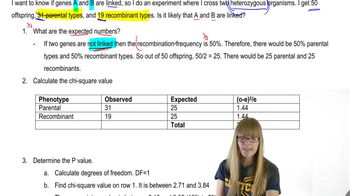
Chi Square and Linkage

Recombination Frequency

Recombination frequency is a measure of the likelihood that two genes will be separated during meiosis due to crossing over. It is expressed as a percentage, representing the proportion of recombinant offspring produced in a test cross. In this case, a recombination frequency of 28% indicates that 28% of the progeny will show new combinations of traits, which is essential for determining the outcome classes in the progeny.
추천 영상:
가이드 코스
03:51
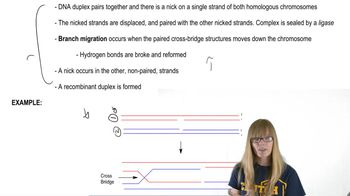
Recombination after Single Strand Breaks

Test Cross

A test cross involves breeding an individual with a homozygous recessive organism to determine the genotype of the former. This method helps reveal the presence of dominant and recessive alleles in the offspring. In the context of the question, the test cross is used to analyze the inheritance of linked genes and assess the recombination frequency, which is vital for predicting the distribution of progeny phenotypes.
추천 영상:
가이드 코스
26:08
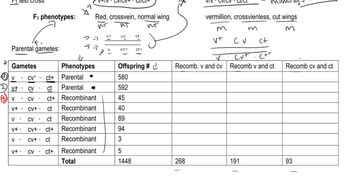
Trihybrid Cross
관련 실천
교과서 질문

Gene G recombines with gene T at a frequency of 7%, and gene G recombines with gene R at a frequency of 4%.


Draw two possible genetic maps for these three genes, and identify the recombination frequencies predicted for each map.

498
views
교과서 질문

Define linkage disequilibrium. What is the physical basis of linkage, and what causes linkage equilibrium? Explain how crossing over eliminates linkage disequilibrium.

796
views
교과서 질문

Genes A, B, and C are linked on a chromosome and found in the order A–B–C. Genes A and B recombine with a frequency of 8%, and genes B and C recombine at a frequency of 24%. For the cross a⁺b⁺c/abc⁺ × abc/abc, predict the frequency of progeny genotypes. Assume interference is zero.

1179
views
교과서 질문

Syntenic genes can assort independently. Explain this observation.

732
views
교과서 질문

Genes A, B, C, D, and E are linked on a chromosome and occur in the order given.


Previous genetic linkage crosses have determined that recombination frequencies are 6% for genes A and B, 4% for genes B and C, 10% for genes C and D, and 11% for genes D and E. The sum of these frequencies between genes A and E is 31%. Why does the recombination distance between these genes as determined by adding the intervals between adjacent linked genes differ from the distance determined by the test cross?

1172
views
교과서 질문

Gene G recombines with gene T at a frequency of 7%, and gene G recombines with gene R at a frequency of 4%.


Assuming that organisms with any desired genotype are available, propose a genetic cross whose result could be used to determine which of the proposed genetic maps is correct.

541
views