Ch. 5 - Genetic Linkage and Mapping in Eukaryotes
Sanders - Genetic Analysis: An Integrated Approach 3rd Edition
Sanders3rd EditionGenetic Analysis: An Integrated ApproachISBN: 9780135564172당신이 사용하는 게 아니라요?교과서 변경
5장, 문제 16a

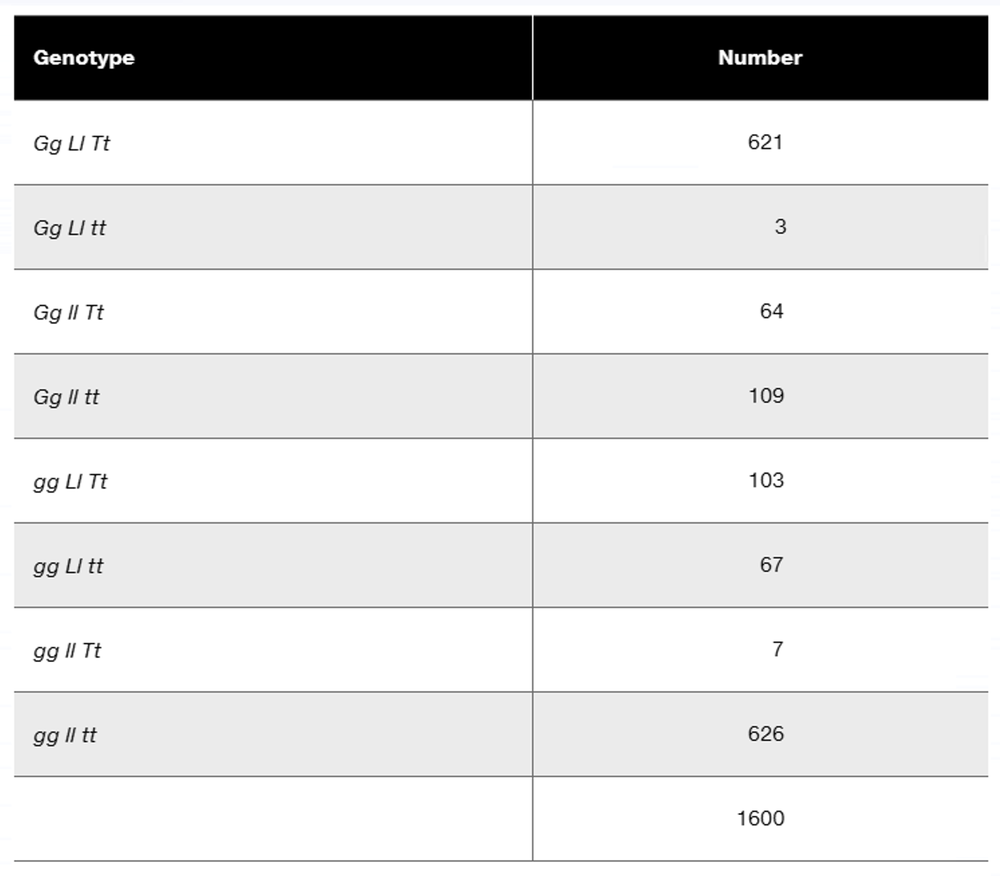
In a diploid plant species, an F₁ with the genotype Gg Ll Tt is test-crossed to a pure-breeding recessive plant with the genotype gg ll tt. The offspring genotypes are as follows:
Table displaying offspring genotypes and their frequencies from a trihybrid cross in a diploid plant species.
What is the order of these three linked genes?

검증된 단계별 안내
1
Step 1: Identify the parental genotypes and offspring genotypes. The parental genotypes are Gg Ll Tt (heterozygous for all three genes) and gg ll tt (homozygous recessive for all three genes). The offspring genotypes and their counts are provided in the table.
Step 2: Determine the parental types and recombinant types. Parental types are the genotypes that match the original parental combinations (Gg Ll Tt and gg ll tt). Recombinant types are the genotypes that result from crossing over during meiosis.
Step 3: Analyze the offspring counts to identify the parental and recombinant genotypes. The two most frequent genotypes (Gg Ll Tt and gg ll tt) are likely the parental types, while the less frequent genotypes represent recombinants.
Step 4: Use the recombinant genotypes to determine the gene order. The double crossover genotypes (the least frequent ones) provide information about the gene in the middle. Compare the double crossover genotypes to the parental types to deduce the gene order.
Step 5: Confirm the gene order by analyzing the single crossover genotypes. Single crossover events involve recombination between two of the three genes, and their frequencies can help verify the gene order deduced from the double crossover genotypes.

비슷한 문제에 대한 검증된 영상 답변:

이 영상 해법은 위 문제에 도움이 된다고 튜터들이 추천한 것입니다.
영상 길이:
10m

주요 개념

질문에 올바르게 답하기 위해 반드시 이해해야 하는 핵심 개념들은 다음과 같습니다.

Linkage and Gene Mapping

Linkage refers to the tendency of genes located close to each other on a chromosome to be inherited together. This is crucial for understanding the inheritance patterns observed in the offspring. By analyzing the frequencies of different genotypes, researchers can determine the relative positions of genes on a chromosome, which is essential for constructing genetic maps.
추천 영상:

Test Cross

A test cross involves breeding an individual with a dominant phenotype but unknown genotype with a homozygous recessive individual. This method helps reveal the genotype of the dominant individual based on the phenotypes of the offspring. In this scenario, the test cross is used to analyze the inheritance of three linked genes in the diploid plant species.
추천 영상:
가이드 코스
26:08
Trihybrid Cross

Recombination Frequency

Recombination frequency is the proportion of offspring that exhibit recombinant phenotypes compared to the total number of offspring. It provides insight into the distance between genes on a chromosome; closer genes have lower recombination frequencies. By calculating these frequencies from the offspring data, one can infer the order of linked genes and their relative distances.
추천 영상:
가이드 코스
03:51
Recombination after Single Strand Breaks
관련 실천
교과서 질문

Three dominant traits of corn seedlings, tunicate seed (T-), glossy appearance (G-), and liguled stem (L-), are studied along with their recessive counterparts, nontunicate (tt), nonglossy (gg), and liguleless (ll). A trihybrid plant with the three dominant traits is crossed to a nontunicate, nonglossy, liguleless plant. Kernels on ears of progeny plants are scored for the traits, with the following results:

If evidence of linkage is present, calculate the recombination frequency or frequencies from the data presented.

633
views
교과서 질문

In a diploid plant species, an F₁ with the genotype Gg Ll Tt is test-crossed to a pure-breeding recessive plant with the genotype gg ll tt. The offspring genotypes are as follows:

What is the interference value for this data set?

624
views
교과서 질문

In a diploid plant species, an F₁ with the genotype Gg Ll Tt is test-crossed to a pure-breeding recessive plant with the genotype gg ll tt. The offspring genotypes are as follows:

Calculate the recombination frequency between each pair of genes.

809
views
교과서 질문

Three dominant traits of corn seedlings, tunicate seed (T-), glossy appearance (G-), and liguled stem (L-), are studied along with their recessive counterparts, nontunicate (tt), nonglossy (gg), and liguleless (ll). A trihybrid plant with the three dominant traits is crossed to a nontunicate, nonglossy, liguleless plant. Kernels on ears of progeny plants are scored for the traits, with the following results:

Could all three genes be carried on the same chromosome? Discuss why or why not.

855
views
교과서 질문

Three dominant traits of corn seedlings, tunicate seed (T-), glossy appearance (G-), and liguled stem (L-), are studied along with their recessive counterparts, nontunicate (tt), nonglossy (gg), and liguleless (ll). A trihybrid plant with the three dominant traits is crossed to a nontunicate, nonglossy, liguleless plant. Kernels on ears of progeny plants are scored for the traits, with the following results:

Using the gene symbols given above, write the genotypes of F₁ and F₂ plants.

561
views
교과서 질문

In a diploid plant species, an F₁ with the genotype Gg Ll Tt is test-crossed to a pure-breeding recessive plant with the genotype gg ll tt. The offspring genotypes are as follows:

Why is the recombination frequency for the outside pair of genes not equal to the sum of recombination frequencies between the adjacent gene pairs?

739
views