Ch. 5 - Genetic Linkage and Mapping in Eukaryotes
Sanders - Genetic Analysis: An Integrated Approach 3rd Edition
Sanders3rd EditionGenetic Analysis: An Integrated ApproachISBN: 9780135564172당신이 사용하는 게 아니라요?교과서 변경
5장, 문제 15e

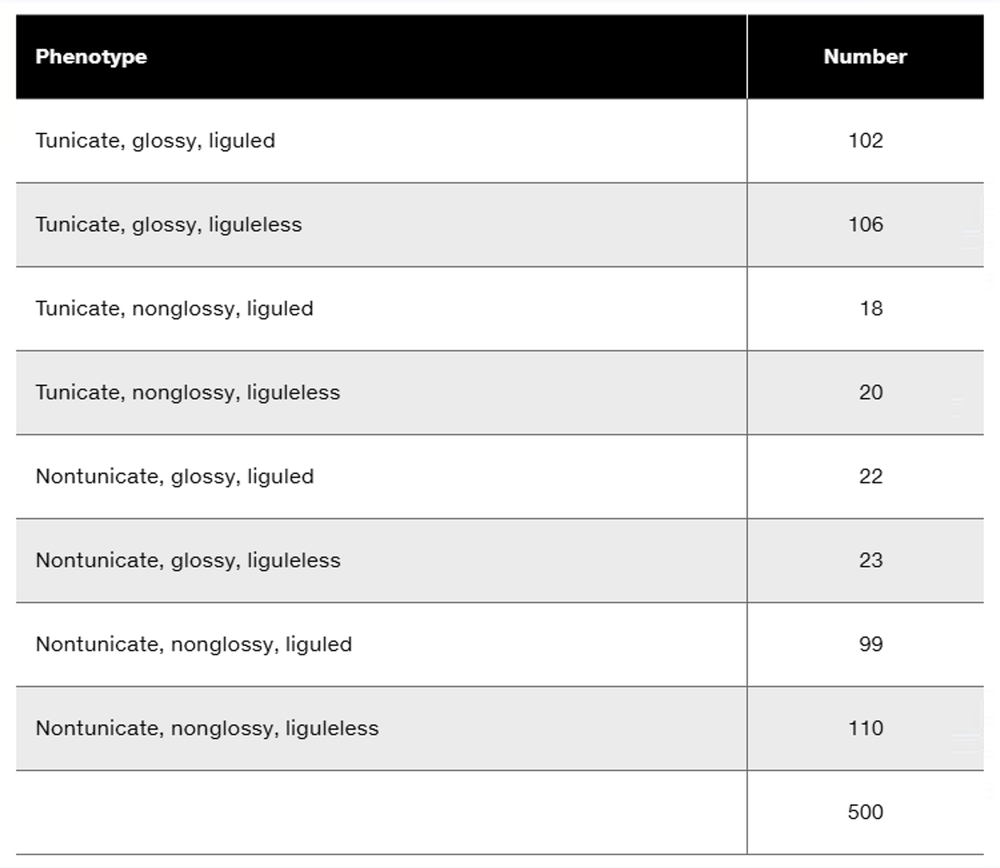
Three dominant traits of corn seedlings, tunicate seed (T-), glossy appearance (G-), and liguled stem (L-), are studied along with their recessive counterparts, nontunicate (tt), nonglossy (gg), and liguleless (ll). A trihybrid plant with the three dominant traits is crossed to a nontunicate, nonglossy, liguleless plant. Kernels on ears of progeny plants are scored for the traits, with the following results:
Table displaying phenotypes and counts of corn seedlings for genetic trait analysis.
Could all three genes be carried on the same chromosome? Discuss why or why not.

검증된 단계별 안내
1
Step 1: Begin by understanding the problem. The question asks whether the three genes (T, G, and L) are linked on the same chromosome or assort independently. To determine this, we need to analyze the phenotypic ratios of the progeny and compare them to expected ratios under independent assortment.
Step 2: Recall the concept of linkage. If genes are located on the same chromosome and are close together, they tend to be inherited together, resulting in non-Mendelian ratios. If they assort independently, the phenotypic ratios will follow Mendel's laws of independent assortment, typically a 1:1:1:1 ratio for a test cross.
Step 3: Analyze the phenotypic data provided. There are eight phenotypes listed with their respective numbers. Calculate the observed ratios for each phenotype by dividing the number of individuals with a given phenotype by the total number of progeny (500). This will help determine if the ratios deviate from the expected 1:1:1:1 ratio.
Step 4: Perform a chi-square test to statistically evaluate whether the observed ratios significantly deviate from the expected ratios under independent assortment. The formula for the chi-square test is: χ2 = Σ((O - E)2/E), where O is the observed frequency and E is the expected frequency. Calculate the chi-square value and compare it to the critical value for the degrees of freedom (df = number of phenotypic categories - 1).
Step 5: Interpret the results of the chi-square test. If the chi-square value is below the critical value, the null hypothesis (independent assortment) cannot be rejected, suggesting the genes assort independently. If the chi-square value exceeds the critical value, the null hypothesis is rejected, indicating linkage. Additionally, consider the possibility of recombination events if linkage is detected.

비슷한 문제에 대한 검증된 영상 답변:

이 영상 해법은 위 문제에 도움이 된다고 튜터들이 추천한 것입니다.
영상 길이:
4m
도움이 되었나요?

주요 개념

질문에 올바르게 답하기 위해 반드시 이해해야 하는 핵심 개념들은 다음과 같습니다.

Gene Linkage

Gene linkage refers to the tendency of genes located close to each other on the same chromosome to be inherited together during meiosis. If genes are linked, they do not assort independently, which can affect the expected phenotypic ratios in offspring. In this case, analyzing the ratios of the traits in the progeny can help determine if the genes for tunicate, glossy, and liguleless traits are linked or assorting independently.
추천 영상:
가이드 코스
07:33
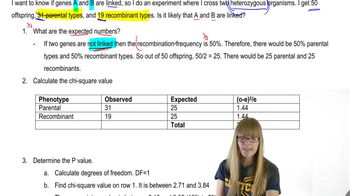
Chi Square and Linkage

Independent Assortment

Independent assortment is a principle of genetics stating that alleles for different traits segregate independently of one another during gamete formation. This concept, proposed by Gregor Mendel, implies that the inheritance of one trait will not affect the inheritance of another if the genes are located on different chromosomes or are far apart on the same chromosome. The observed phenotypic ratios can be analyzed to see if they align with Mendelian expectations of independent assortment.
추천 영상:
가이드 코스
04:58
Gamete Genetics and Independent Assortment

Chi-Square Analysis

Chi-square analysis is a statistical method used to determine if there is a significant difference between observed and expected frequencies in genetic crosses. By applying this test to the phenotypic ratios of the progeny, one can assess whether the deviations from expected ratios are due to chance or suggest linkage between the genes. This analysis is crucial for interpreting the results of the cross and understanding the genetic relationships among the traits.
추천 영상:
가이드 코스
02:48
Chi Square Analysis
관련 실천
교과서 질문

Three dominant traits of corn seedlings, tunicate seed (T-), glossy appearance (G-), and liguled stem (L-), are studied along with their recessive counterparts, nontunicate (tt), nonglossy (gg), and liguleless (ll). A trihybrid plant with the three dominant traits is crossed to a nontunicate, nonglossy, liguleless plant. Kernels on ears of progeny plants are scored for the traits, with the following results:

If evidence of linkage is present, calculate the recombination frequency or frequencies from the data presented.

633
views
교과서 질문

In a diploid plant species, an F₁ with the genotype Gg Ll Tt is test-crossed to a pure-breeding recessive plant with the genotype gg ll tt. The offspring genotypes are as follows:

What is the order of these three linked genes?

665
views
교과서 질문

In a diploid plant species, an F₁ with the genotype Gg Ll Tt is test-crossed to a pure-breeding recessive plant with the genotype gg ll tt. The offspring genotypes are as follows:

Calculate the recombination frequency between each pair of genes.

809
views
교과서 질문

Three dominant traits of corn seedlings, tunicate seed (T-), glossy appearance (G-), and liguled stem (L-), are studied along with their recessive counterparts, nontunicate (tt), nonglossy (gg), and liguleless (ll). A trihybrid plant with the three dominant traits is crossed to a nontunicate, nonglossy, liguleless plant. Kernels on ears of progeny plants are scored for the traits, with the following results:

Is there evidence of independent assortment among any of these gene pairs? If so, identify the evidence.

450
views
교과서 질문

Three dominant traits of corn seedlings, tunicate seed (T-), glossy appearance (G-), and liguled stem (L-), are studied along with their recessive counterparts, nontunicate (tt), nonglossy (gg), and liguleless (ll). A trihybrid plant with the three dominant traits is crossed to a nontunicate, nonglossy, liguleless plant. Kernels on ears of progeny plants are scored for the traits, with the following results:

Using the gene symbols given above, write the genotypes of F₁ and F₂ plants.

561
views
교과서 질문

In a diploid plant species, an F₁ with the genotype Gg Ll Tt is test-crossed to a pure-breeding recessive plant with the genotype gg ll tt. The offspring genotypes are as follows:

Why is the recombination frequency for the outside pair of genes not equal to the sum of recombination frequencies between the adjacent gene pairs?

739
views