Ch. 5 - Genetic Linkage and Mapping in Eukaryotes
Sanders - Genetic Analysis: An Integrated Approach 3rd Edition
Sanders3rd EditionGenetic Analysis: An Integrated ApproachISBN: 9780135564172당신이 사용하는 게 아니라요?교과서 변경
5장, 문제 32a

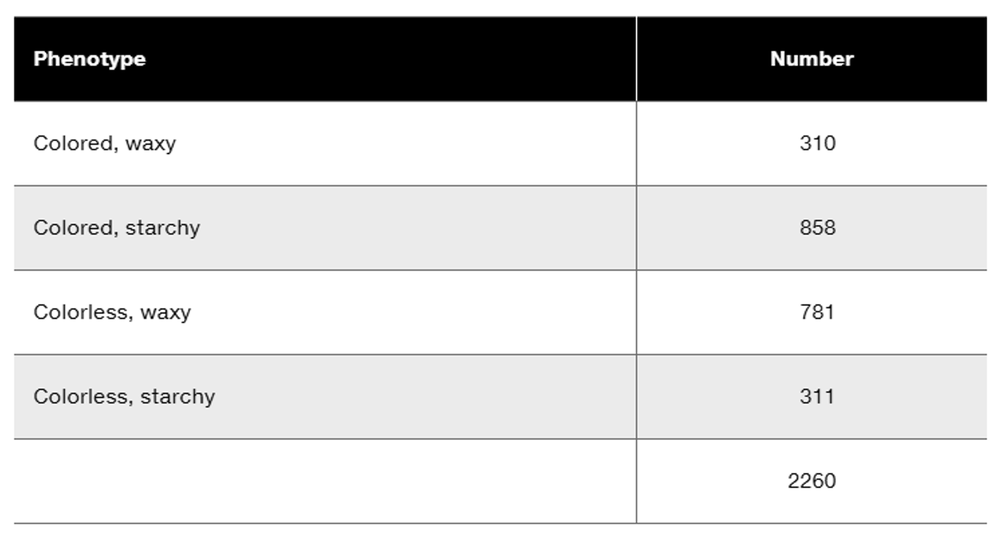
In experiments published in 1918 that sought to verify and expand the genetic linkage and recombination theory proposed by Morgan, Thomas Bregger studied potential genetic linkage in corn (Zea mays) for genes controlling kernel color (colored is dominant to colorless) and starch content (starchy is dominant to waxy). Bregger performed two crosses. In Cross 1, pure-breeding colored, starchy-kernel plants (C1 Wx/C1 Wx) were crossed to plants pure-breeding for colorless, waxy kernels (c1 wx/c1 wx). The F₁ of this cross were test-crossed to colorless, waxy plants. The test-cross progeny were as follows:
Table showing phenotypes and their corresponding numbers from genetic experiments on corn.
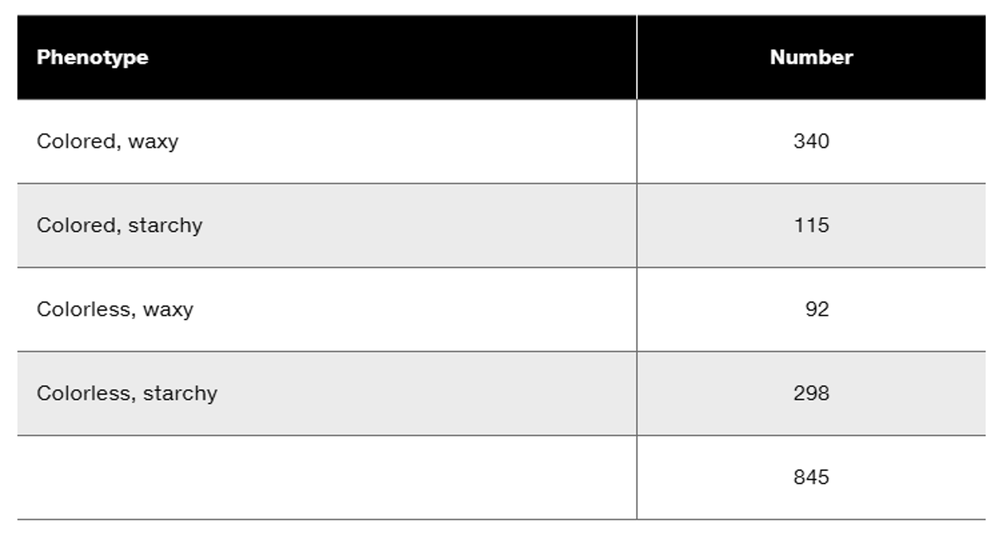
In Cross 2, plants pure-breeding for colored, waxy kernels (C1 wx/C1 wx) and colorless, starchy kernels (c1 Wx/c1 Wx) were mated, and their F₁ were test-crossed to colorless, waxy plants. The test-cross progeny were as follows:
Table displaying phenotypes and their corresponding numbers from genetic experiments on corn.
For each set of test-cross progeny, determine whether genetic linkage or independent assortment is more strongly supported by the data. Explain the rationale for your answer.

검증된 단계별 안내
1
Step 1: Understand the problem and the genetic setup. The problem involves analyzing test-cross progeny data from two crosses to determine whether the genes for kernel color (C1/c1) and starch content (Wx/wx) in corn are linked or assort independently. Genetic linkage occurs when genes are located close together on the same chromosome, leading to non-Mendelian ratios of progeny phenotypes.
Step 2: Identify the parental and recombinant phenotypes in each cross. For Cross 1, the parental phenotypes are 'colored, starchy' and 'colorless, waxy,' while the recombinant phenotypes are 'colored, waxy' and 'colorless, starchy.' For Cross 2, the parental phenotypes are 'colored, waxy' and 'colorless, starchy,' while the recombinant phenotypes are 'colored, starchy' and 'colorless, waxy.'
Step 3: Analyze the progeny numbers for each cross. In Cross 1, the parental phenotypes ('colored, starchy' and 'colorless, waxy') are more frequent (858 and 781) than the recombinant phenotypes ('colored, waxy' and 'colorless, starchy') (310 and 311). In Cross 2, the parental phenotypes ('colored, waxy' and 'colorless, starchy') are more frequent (340 and 298) than the recombinant phenotypes ('colored, starchy' and 'colorless, waxy') (115 and 92).
Step 4: Compare the observed progeny ratios to the expected ratios under independent assortment. If the genes assort independently, all four phenotypes should appear in roughly equal numbers. However, in both crosses, the parental phenotypes are significantly more frequent than the recombinant phenotypes, suggesting that the genes are linked.
Step 5: Conclude that genetic linkage is more strongly supported by the data. The excess of parental phenotypes in both crosses indicates that the genes for kernel color and starch content are located close together on the same chromosome, reducing the likelihood of recombination between them. This deviation from the expected 1:1:1:1 ratio under independent assortment supports the hypothesis of genetic linkage.

비슷한 문제에 대한 검증된 영상 답변:

이 영상 해법은 위 문제에 도움이 된다고 튜터들이 추천한 것입니다.
영상 길이:
3m
도움이 되었나요?

주요 개념

질문에 올바르게 답하기 위해 반드시 이해해야 하는 핵심 개념들은 다음과 같습니다.

Genetic Linkage

Genetic linkage refers to the tendency of genes located close to each other on a chromosome to be inherited together during meiosis. This phenomenon occurs because linked genes are less likely to be separated by recombination events. In the context of Bregger's experiments, analyzing the ratios of phenotypes in the progeny can reveal whether the genes for kernel color and starch content are linked or assort independently.
추천 영상:
가이드 코스
07:33
Chi Square and Linkage

Independent Assortment

Independent assortment is a principle of genetics stating that alleles for different traits segregate independently of one another during gamete formation. This means that the inheritance of one trait does not affect the inheritance of another. In Bregger's test crosses, if the observed phenotypic ratios align closely with expected ratios based on independent assortment, it suggests that the genes are not linked and assort independently.
추천 영상:
가이드 코스
04:58
Gamete Genetics and Independent Assortment

Test Cross

A test cross involves breeding an individual with a dominant phenotype (but unknown genotype) with a homozygous recessive individual. This method helps determine the genotype of the dominant individual based on the phenotypic ratios of the offspring. In Bregger's experiments, the test crosses provided crucial data to analyze the inheritance patterns of the traits in question, allowing for conclusions about genetic linkage or independent assortment.
추천 영상:
가이드 코스
26:08
Trihybrid Cross
관련 실천
교과서 질문

A genetic study of an early onset form of heart disease identifies 10 families containing members with the condition. No clear dominant or recessive pattern of inheritance is evident, but an analysis of SNP markers for five families detects a strong association with a marker on chromosome 12, and genetic linkage analysis for the marker produces a lod score of 2.2.


What next step do you recommend for this genetic analysis?

426
views
교과서 질문

In experiments published in 1918 that sought to verify and expand the genetic linkage and recombination theory proposed by Morgan, Thomas Bregger studied potential genetic linkage in corn (Zea mays) for genes controlling kernel color (colored is dominant to colorless) and starch content (starchy is dominant to waxy). Bregger performed two crosses. In Cross 1, pure-breeding colored, starchy-kernel plants (C1 Wx/C1 Wx) were crossed to plants pure-breeding for colorless, waxy kernels (c1 wx/c1 wx). The F₁ of this cross were test-crossed to colorless, waxy plants. The test-cross progeny were as follows:

In Cross 2, plants pure-breeding for colored, waxy kernels (C1 wx/C1 wx) and colorless, starchy kernels (c1 Wx/c1 Wx) were mated, and their F₁ were test-crossed to colorless, waxy plants. The test-cross progeny were as follows:

Merge the two sets of progeny data and determine the combined recombination frequency.

532
views
교과서 질문

In experiments published in 1918 that sought to verify and expand the genetic linkage and recombination theory proposed by Morgan, Thomas Bregger studied potential genetic linkage in corn (Zea mays) for genes controlling kernel color (colored is dominant to colorless) and starch content (starchy is dominant to waxy). Bregger performed two crosses. In Cross 1, pure-breeding colored, starchy-kernel plants (C1 Wx/C1 Wx) were crossed to plants pure-breeding for colorless, waxy kernels (c1 wx/c1 wx). The F₁ of this cross were test-crossed to colorless, waxy plants. The test-cross progeny were as follows:

In Cross 2, plants pure-breeding for colored, waxy kernels (C1 wx/C1 wx) and colorless, starchy kernels (c1 Wx/c1 Wx) were mated, and their F₁ were test-crossed to colorless, waxy plants. The test-cross progeny were as follows:

Calculate the recombination frequency for each of the progeny groups.

422
views
교과서 질문

A genetic study of an early onset form of heart disease identifies 10 families containing members with the condition. No clear dominant or recessive pattern of inheritance is evident, but an analysis of SNP markers for five families detects a strong association with a marker on chromosome 12, and genetic linkage analysis for the marker produces a lod score of 2.2.


What do the association and lod score results suggest about this genetic marker?

531
views
교과서 질문

In experiments published in 1918 that sought to verify and expand the genetic linkage and recombination theory proposed by Morgan, Thomas Bregger studied potential genetic linkage in corn (Zea mays) for genes controlling kernel color (colored is dominant to colorless) and starch content (starchy is dominant to waxy). Bregger performed two crosses. In Cross 1, pure-breeding colored, starchy-kernel plants (C1 Wx/C1 Wx) were crossed to plants pure-breeding for colorless, waxy kernels (c1 wx/c1 wx). The F₁ of this cross were test-crossed to colorless, waxy plants. The test-cross progeny were as follows:

In Cross 2, plants pure-breeding for colored, waxy kernels (C1 wx/C1 wx) and colorless, starchy kernels (c1 Wx/c1 Wx) were mated, and their F₁ were test-crossed to colorless, waxy plants. The test-cross progeny were as follows:

Taken together, are the results of these two experiments compatible with the hypothesis of genetic linkage? Explain why or why not.

473
views
교과서 질문

A Drosophila experiment examining potential genetic linkage of X-linked genes studies a recessive eye mutant (echinus), a recessive wing-vein mutation (crossveinless), and a recessive bristle mutation (scute). The wild-type phenotypes are dominant. Trihybrid wild-type females (all have the same genotype) are crossed to hemizygous males displaying the three recessive phenotypes. Among the 20,765 progeny produced from these crosses are the phenotypes and numbers listed in the table. Any phenotype not given is wild type.

Use chi-square analysis to demonstrate that the data in this experiment are not the result of independent assortment.

502
views