Ch. 5 - Genetic Linkage and Mapping in Eukaryotes
Sanders - Genetic Analysis: An Integrated Approach 3rd Edition
Sanders3rd EditionGenetic Analysis: An Integrated ApproachISBN: 9780135564172당신이 사용하는 게 아니라요?교과서 변경
5장, 문제 14c

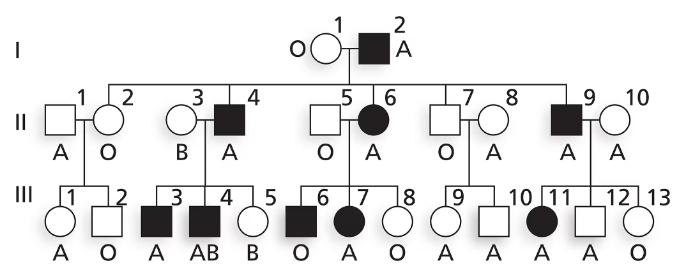
Nail–patella syndrome is an autosomal disorder affecting the shape of nails on fingers and toes as well as the structure of kneecaps. The pedigree below shows the transmission of nail–patella syndrome in a family along with ABO blood type.
Pedigree chart illustrating the inheritance of nail–patella syndrome and ABO blood types across three generations.
Using N and n to represent alleles at the nail–patella locus and Iᴬ, Iᴮ and i to represent ABO alleles, write the genotypes of I-1 and I-2 as well as their five children in generation II.

검증된 단계별 안내
1
Step 1: Understand the inheritance pattern of nail–patella syndrome. It is an autosomal dominant disorder, meaning that individuals with at least one dominant allele (N) will express the syndrome. The recessive allele (n) does not cause the syndrome.
Step 2: Review the inheritance pattern of ABO blood types. ABO blood type is determined by codominant alleles Iᴬ and Iᴮ, and the recessive allele i. Individuals with IᴬIᴬ or Iᴬi have type A blood, IᴮIᴮ or Iᴮi have type B blood, IᴬIᴮ have type AB blood, and ii have type O blood.
Step 3: Analyze the pedigree provided. Determine the phenotypes of I-1 and I-2 (the parents) for both nail–patella syndrome and ABO blood type. Use this information to deduce their genotypes. For example, if I-1 has nail–patella syndrome, they must have at least one N allele.
Step 4: Examine the phenotypes of the five children in generation II for both nail–patella syndrome and ABO blood type. Use the rules of inheritance to deduce their genotypes based on the parents' genotypes and the observed traits.
Step 5: Write the genotypes for I-1, I-2, and each of the five children in generation II. Ensure that the genotypes include both the nail–patella alleles (N and n) and the ABO alleles (Iᴬ, Iᴮ, i).

비슷한 문제에 대한 검증된 영상 답변:

이 영상 해법은 위 문제에 도움이 된다고 튜터들이 추천한 것입니다.
영상 길이:
7m

주요 개념

질문에 올바르게 답하기 위해 반드시 이해해야 하는 핵심 개념들은 다음과 같습니다.

Autosomal Inheritance

Autosomal inheritance refers to the transmission of genetic traits that are located on the autosomes, which are the non-sex chromosomes. In the case of nail-patella syndrome, it is inherited in an autosomal dominant manner, meaning that only one copy of the mutated allele (N) is sufficient to express the disorder. Understanding this concept is crucial for determining the genotypes of affected individuals in a pedigree.
추천 영상:
가이드 코스
09:08
Autosomal Pedigrees

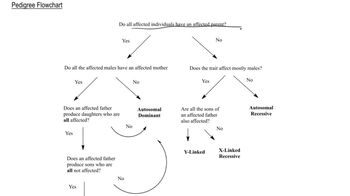
Pedigree Analysis

Pedigree analysis is a method used to trace the inheritance patterns of traits through generations in a family. It visually represents relationships and can indicate whether a trait is dominant or recessive. By analyzing the pedigree provided, one can deduce the genotypes of individuals based on their phenotypes and the inheritance patterns observed.
추천 영상:
가이드 코스
01:59
Pedigree Flowchart

Blood Type Genetics

Blood type genetics involves the inheritance of ABO blood group alleles, which include Iᴬ, Iᴮ, and i. The combination of these alleles determines an individual's blood type (A, B, AB, or O). Understanding how these alleles interact, particularly in conjunction with other genetic traits like nail-patella syndrome, is essential for accurately determining the genotypes of the individuals in the pedigree.
추천 영상:
가이드 코스
03:45
Descriptive Genetics
관련 실천
교과서 질문

Nail–patella syndrome is an autosomal disorder affecting the shape of nails on fingers and toes as well as the structure of kneecaps. The pedigree below shows the transmission of nail–patella syndrome in a family along with ABO blood type.

Explain why III-11 has nail–patella syndrome and III-12 does not. Give genotypes for these two individuals.

441
views
교과서 질문

Nail–patella syndrome is an autosomal disorder affecting the shape of nails on fingers and toes as well as the structure of kneecaps. The pedigree below shows the transmission of nail–patella syndrome in a family along with ABO blood type.

Explain why III-6 has nail–patella syndrome and III-8 does not. Give genotypes for these two individuals.

646
views
교과서 질문

Three dominant traits of corn seedlings, tunicate seed (T-), glossy appearance (G-), and liguled stem (L-), are studied along with their recessive counterparts, nontunicate (tt), nonglossy (gg), and liguleless (ll). A trihybrid plant with the three dominant traits is crossed to a nontunicate, nonglossy, liguleless plant. Kernels on ears of progeny plants are scored for the traits, with the following results:

Is there evidence of genetic linkage among any of these gene pairs? If so, identify the evidence.

441
views
교과서 질문

Nail–patella syndrome is an autosomal disorder affecting the shape of nails on fingers and toes as well as the structure of kneecaps. The pedigree below shows the transmission of nail–patella syndrome in a family along with ABO blood type.

Does this family give evidence of genetic linkage between nail–patella syndrome and ABO blood group? Why or why not?

816
views
교과서 질문

Researchers cross a corn plant that is pure-breeding for the dominant traits colored aleurone (C1), full kernel (Sh), and waxy endosperm (Wx) to a pure-breeding plant with the recessive traits colorless aleurone (c1), shrunken kernel (sh), and starchy (wx). The resulting F₁ plants were crossed to pure-breeding colorless, shrunken, starchy plants. Counting the kernels from about 30 ears of corn yields the following data.

What is the interference value for this data set?

492
views
교과서 질문

Nail–patella syndrome is an autosomal disorder affecting the shape of nails on fingers and toes as well as the structure of kneecaps. The pedigree below shows the transmission of nail–patella syndrome in a family along with ABO blood type. Is nail–patella syndrome a dominant or a recessive condition?

Is nail–patella syndrome a dominant or a recessive condition? Explain your reasoning.

580
views