
Ch. 5 - Genetic Linkage and Mapping in Eukaryotes
Sanders - Genetic Analysis: An Integrated Approach 3rd Edition
Sanders3rd EditionGenetic Analysis: An Integrated ApproachISBN: 9780135564172당신이 사용하는 게 아니라요?교과서 변경
5장, 문제 14a

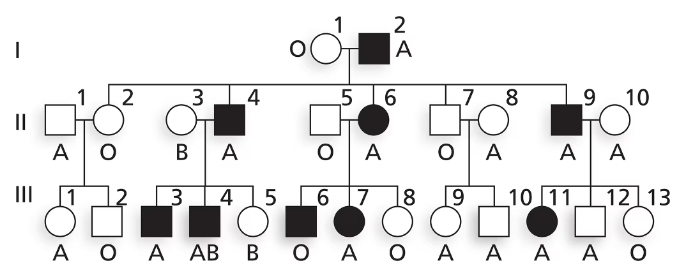
Nail–patella syndrome is an autosomal disorder affecting the shape of nails on fingers and toes as well as the structure of kneecaps. The pedigree below shows the transmission of nail–patella syndrome in a family along with ABO blood type. Is nail–patella syndrome a dominant or a recessive condition?

Is nail–patella syndrome a dominant or a recessive condition? Explain your reasoning.

검증된 단계별 안내
1
Step 1: Understand the inheritance patterns of dominant and recessive traits. A dominant trait requires only one copy of the allele to be expressed, while a recessive trait requires two copies of the allele to manifest in an individual.
Step 2: Examine the pedigree provided in the problem. Look for patterns of inheritance across generations. Specifically, check if the condition appears in every generation (indicative of dominance) or skips generations (indicative of recessiveness).
Step 3: Identify whether affected individuals have at least one affected parent. If affected individuals consistently have at least one affected parent, this supports the condition being dominant.
Step 4: Analyze unaffected individuals in the pedigree. If unaffected individuals do not pass the condition to their offspring, this further supports dominance, as recessive conditions can be carried silently by heterozygous individuals.
Step 5: Consider additional evidence, such as the co-occurrence of nail–patella syndrome with ABO blood type, to ensure the inheritance pattern aligns with the dominant trait hypothesis. Use this reasoning to conclude whether the condition is dominant or recessive.

비슷한 문제에 대한 검증된 영상 답변:

이 영상 해법은 위 문제에 도움이 된다고 튜터들이 추천한 것입니다.
영상 길이:
2m

주요 개념

질문에 올바르게 답하기 위해 반드시 이해해야 하는 핵심 개념들은 다음과 같습니다.

Autosomal Dominance and Recessiveness

Autosomal dominance and recessiveness refer to how traits are inherited through genes located on non-sex chromosomes. In dominant conditions, only one copy of the mutated gene is needed for the trait to manifest, while in recessive conditions, two copies are required. Understanding these inheritance patterns is crucial for analyzing genetic disorders like nail–patella syndrome.
추천 영상:
가이드 코스
04:37
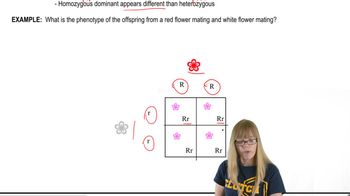
Variations on Dominance

Pedigree Analysis

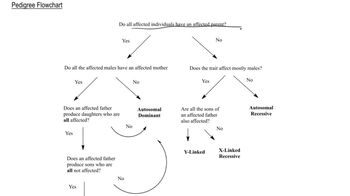
Pedigree analysis is a method used to trace the inheritance of traits through generations in a family. By examining the pedigree, one can determine how a genetic condition is passed down, identifying affected individuals and their relationships. This analysis helps in deducing whether a condition is dominant or recessive based on the presence or absence of the trait in family members.
추천 영상:
가이드 코스
01:59
Pedigree Flowchart

ABO Blood Type Inheritance

The ABO blood type system is an example of codominance and multiple alleles, where individuals can inherit one of four blood types (A, B, AB, or O) based on the alleles they receive from their parents. Understanding this system can provide insights into genetic inheritance patterns and help differentiate between traits that are inherited independently versus those that may be linked to other genetic conditions, such as nail–patella syndrome.
추천 영상:
가이드 코스
00:36
Types of Maternal Inheritance
관련 실천
교과서 질문

Nail–patella syndrome is an autosomal disorder affecting the shape of nails on fingers and toes as well as the structure of kneecaps. The pedigree below shows the transmission of nail–patella syndrome in a family along with ABO blood type.

Explain why III-6 has nail–patella syndrome and III-8 does not. Give genotypes for these two individuals.

646
views
교과서 질문

Nail–patella syndrome is an autosomal disorder affecting the shape of nails on fingers and toes as well as the structure of kneecaps. The pedigree below shows the transmission of nail–patella syndrome in a family along with ABO blood type.

Using N and n to represent alleles at the nail–patella locus and Iᴬ, Iᴮ and i to represent ABO alleles, write the genotypes of I-1 and I-2 as well as their five children in generation II.

599
views
교과서 질문

Researchers cross a corn plant that is pure-breeding for the dominant traits colored aleurone (C1), full kernel (Sh), and waxy endosperm (Wx) to a pure-breeding plant with the recessive traits colorless aleurone (c1), shrunken kernel (sh), and starchy (wx). The resulting F₁ plants were crossed to pure-breeding colorless, shrunken, starchy plants. Counting the kernels from about 30 ears of corn yields the following data.

Calculate the recombination frequencies between the gene pairs.

649
views
교과서 질문

Researchers cross a corn plant that is pure-breeding for the dominant traits colored aleurone (C1), full kernel (Sh), and waxy endosperm (Wx) to a pure-breeding plant with the recessive traits colorless aleurone (c1), shrunken kernel (sh), and starchy (wx). The resulting F₁ plants were crossed to pure-breeding colorless, shrunken, starchy plants. Counting the kernels from about 30 ears of corn yields the following data.

What is the order of these genes in corn?

440
views
교과서 질문

Nail–patella syndrome is an autosomal disorder affecting the shape of nails on fingers and toes as well as the structure of kneecaps. The pedigree below shows the transmission of nail–patella syndrome in a family along with ABO blood type.

Does this family give evidence of genetic linkage between nail–patella syndrome and ABO blood group? Why or why not?

816
views
교과서 질문

Researchers cross a corn plant that is pure-breeding for the dominant traits colored aleurone (C1), full kernel (Sh), and waxy endosperm (Wx) to a pure-breeding plant with the recessive traits colorless aleurone (c1), shrunken kernel (sh), and starchy (wx). The resulting F₁ plants were crossed to pure-breeding colorless, shrunken, starchy plants. Counting the kernels from about 30 ears of corn yields the following data.

What is the interference value for this data set?

492
views