Ch. 6 - Genetic Analysis and Mapping in Bacteria and Bacteriophages
Sanders - Genetic Analysis: An Integrated Approach 3rd Edition
Sanders3rd EditionGenetic Analysis: An Integrated ApproachISBN: 9780135564172당신이 사용하는 게 아니라요?교과서 변경
6장, 문제 11

Among the mechanisms of gene transfer in bacteria, which one is capable of transferring the largest chromosome segment from donor to recipient? Which process generally transfers the smallest donor segments to the recipient? Explain your reasoning for both answers.

검증된 단계별 안내
1
Understand the three main mechanisms of gene transfer in bacteria: transformation, transduction, and conjugation. Each mechanism has distinct characteristics regarding the size of DNA transferred.
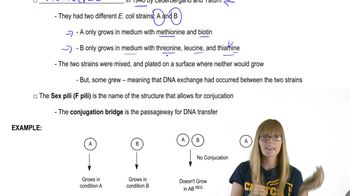
Conjugation is capable of transferring the largest chromosome segment. This process involves the direct transfer of DNA through a physical connection (pilus) between donor and recipient cells. Specifically, in Hfr (high-frequency recombination) strains, large portions of the donor's chromosome can be transferred to the recipient.
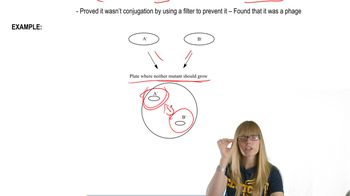
Transduction generally transfers the smallest donor segments. This process involves the transfer of bacterial DNA via a bacteriophage (virus). The phage packages small fragments of bacterial DNA during infection, limiting the size of the DNA transferred.
Reasoning for conjugation: The physical connection between cells allows for the transfer of large, continuous segments of DNA, especially in Hfr strains where the donor's chromosome is integrated into the plasmid and can be transferred sequentially.
Reasoning for transduction: The size of DNA transferred is constrained by the capacity of the bacteriophage capsid, which can only package small fragments of bacterial DNA during the infection process.

비슷한 문제에 대한 검증된 영상 답변:

이 영상 해법은 위 문제에 도움이 된다고 튜터들이 추천한 것입니다.
영상 길이:
2m

주요 개념

질문에 올바르게 답하기 위해 반드시 이해해야 하는 핵심 개념들은 다음과 같습니다.

Conjugation

Conjugation is a mechanism of gene transfer in bacteria that involves direct cell-to-cell contact. During this process, a donor bacterium transfers a large segment of its chromosome to a recipient bacterium through a structure called a pilus. This method can transfer plasmids and chromosomal DNA, making it capable of transferring larger genetic segments compared to other mechanisms.
추천 영상:
가이드 코스
04:06
Conjugation Overview

Transformation

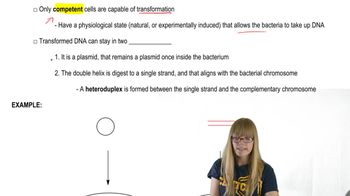
Transformation is a process where bacteria take up free DNA from their environment, which can come from lysed cells. This mechanism typically involves the uptake of smaller DNA fragments, as the DNA must be small enough to be integrated into the recipient's genome. Transformation is significant for genetic diversity but generally transfers smaller segments than conjugation.
추천 영상:

Transduction

Transduction is a gene transfer mechanism mediated by bacteriophages (viruses that infect bacteria). In this process, a bacteriophage can accidentally incorporate bacterial DNA during its replication and transfer it to another bacterium upon infection. Transduction can vary in the size of DNA segments transferred, but it usually involves intermediate-sized segments compared to conjugation and transformation.
추천 영상: