Ch. 6 - Genetic Analysis and Mapping in Bacteria and Bacteriophages
Sanders - Genetic Analysis: An Integrated Approach 3rd Edition
Sanders3rd EditionGenetic Analysis: An Integrated ApproachISBN: 9780135564172당신이 사용하는 게 아니라요?교과서 변경
6장, 문제 10

Describe the differences between genetic complementation and recombination as they relate to the detection of wild-type lysis by a mutant bacteriophage.

검증된 단계별 안내
1
Understand the concept of genetic complementation: Genetic complementation occurs when two different mutations in the genome of an organism (or virus, in this case) are brought together in the same cell, and the functional product of one mutation compensates for the defect caused by the other mutation. This allows the organism or virus to exhibit a wild-type phenotype, such as lysis in bacteriophages.
Understand the concept of recombination: Recombination involves the physical exchange of genetic material between two DNA molecules, resulting in new combinations of alleles. In bacteriophages, recombination can produce a wild-type genotype by combining non-mutated regions from two mutant genomes.
Relate complementation to wild-type lysis detection: In the case of bacteriophages, complementation can be tested by co-infecting a bacterial host with two mutant phages. If the mutations affect different genes, the phages can complement each other, leading to wild-type lysis of the host cell.
Relate recombination to wild-type lysis detection: Recombination can be detected by co-infecting a bacterial host with two mutant phages and analyzing the progeny phages. If recombination occurs, some progeny may inherit a wild-type genotype, leading to wild-type lysis of the host cell.
Compare the mechanisms: Complementation involves functional interaction between gene products without altering the genetic material, while recombination physically alters the genetic material to produce new genotypes. Both processes can result in wild-type lysis, but they are fundamentally different in their mechanisms and detection methods.

비슷한 문제에 대한 검증된 영상 답변:

이 영상 해법은 위 문제에 도움이 된다고 튜터들이 추천한 것입니다.
영상 길이:
2m
도움이 되었나요?

주요 개념

질문에 올바르게 답하기 위해 반드시 이해해야 하는 핵심 개념들은 다음과 같습니다.

Genetic Complementation

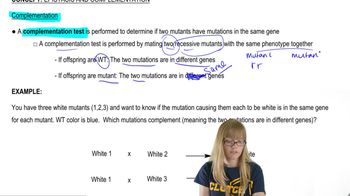
Genetic complementation occurs when two different mutations in a gene are present in the same organism, and the wild-type phenotype is restored. This process is often used to determine whether two mutations affect the same gene or different genes. In the context of bacteriophages, complementation can help identify whether a mutant phage can produce wild-type lysis when paired with another phage carrying a functional copy of the gene.
추천 영상:
가이드 코스
05:05
Complementation

Recombination

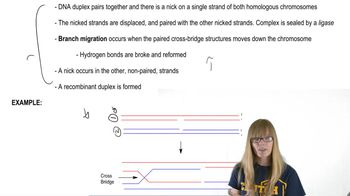
Recombination is a genetic process where genetic material is exchanged between different DNA molecules, leading to new combinations of alleles. In bacteriophages, recombination can occur during co-infection of a host cell by two different phages, resulting in progeny that may exhibit wild-type characteristics if the exchanged genetic material includes functional genes. This process is crucial for understanding genetic diversity and the evolution of phages.
추천 영상:
가이드 코스
03:51
Recombination after Single Strand Breaks

Bacteriophage Lysis

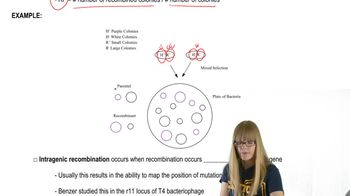
Bacteriophage lysis refers to the process by which a bacteriophage infects a bacterial cell and ultimately causes its destruction, releasing new phage particles. The ability of a phage to induce lysis is often used as a measure of its virulence and functionality. In experiments involving mutants, observing lysis can indicate whether the mutations affect essential lytic functions, which can be analyzed through complementation and recombination studies.
추천 영상:
가이드 코스
06:04
Mapping Bacteriophages