Ch. 6 - Genetic Analysis and Mapping in Bacteria and Bacteriophages
Sanders - Genetic Analysis: An Integrated Approach 3rd Edition
Sanders3rd EditionGenetic Analysis: An Integrated ApproachISBN: 9780135564172당신이 사용하는 게 아니라요?교과서 변경
6장, 문제 A.1e

Match each statement (a–e) with the best answer from the following list: consultand, 50%, prior probability, 66.7%, obligate carrier, 100%.
The probability that the son of a woman with an autosomal recessive condition is a heterozygous carrier

검증된 단계별 안내
1
Step 1: Understand the genetic inheritance pattern. Autosomal recessive conditions require two copies of the recessive allele for an individual to express the condition. A heterozygous carrier has one dominant allele and one recessive allele, meaning they do not express the condition but can pass the recessive allele to offspring.
Step 2: Identify the relationship between the woman and her son. Since the woman has the autosomal recessive condition, she must have two recessive alleles (homozygous recessive). This means she can only pass on a recessive allele to her son.
Step 3: Consider the genetic contribution from the father. If the father does not have the condition, he is assumed to be homozygous dominant (two dominant alleles) or heterozygous (one dominant and one recessive allele). The probability of the son being a carrier depends on the father's genotype.
Step 4: Calculate the probability of the son being a heterozygous carrier. If the father is homozygous dominant, the son will inherit one dominant allele from the father and one recessive allele from the mother, making him a carrier with 100% probability. If the father is heterozygous, there is a 50% chance the son will inherit the dominant allele and a 50% chance he will inherit the recessive allele from the father, resulting in a 50% probability of being a carrier.
Step 5: Match the correct probability from the list provided. Based on the analysis, the probability that the son is a heterozygous carrier is either 50% or 100%, depending on the father's genotype.

비슷한 문제에 대한 검증된 영상 답변:

이 영상 해법은 위 문제에 도움이 된다고 튜터들이 추천한 것입니다.
영상 길이:
2m
도움이 되었나요?

주요 개념

질문에 올바르게 답하기 위해 반드시 이해해야 하는 핵심 개념들은 다음과 같습니다.

Autosomal Recessive Inheritance

Autosomal recessive inheritance occurs when a trait or condition is expressed only when an individual has two copies of the recessive allele, one inherited from each parent. If a parent has an autosomal recessive condition, they carry two recessive alleles, while the other parent may be a carrier (heterozygous) or unaffected (homozygous dominant). This genetic pattern is crucial for understanding the probability of offspring inheriting the condition.
추천 영상:
가이드 코스
09:08
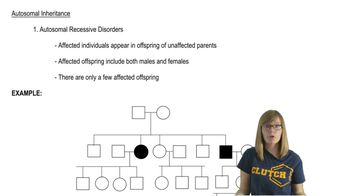
Autosomal Pedigrees

Carrier Probability

Carrier probability refers to the likelihood that an individual carries a recessive allele for a genetic condition without expressing the condition themselves. In the context of autosomal recessive disorders, if one parent is affected (homozygous recessive) and the other is a carrier (heterozygous), there is a 50% chance that their child will inherit the carrier status, making it essential to calculate the probabilities of offspring being carriers.
추천 영상:

Punnett Square

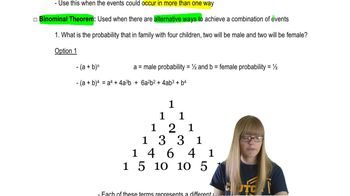
A Punnett square is a diagram used to predict the genetic makeup of offspring from a cross between two parents. It visually represents the possible combinations of alleles from each parent, allowing for the calculation of probabilities for traits, including carrier status. This tool is fundamental in genetics for understanding inheritance patterns and determining the likelihood of specific genotypes in offspring.
추천 영상:
가이드 코스
18:27
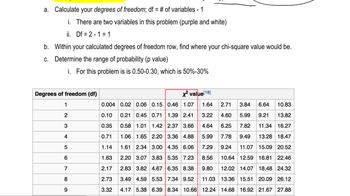
Chi Square Analysis