Ch. 6 - Genetic Analysis and Mapping in Bacteria and Bacteriophages
Sanders - Genetic Analysis: An Integrated Approach 3rd Edition
Sanders3rd EditionGenetic Analysis: An Integrated ApproachISBN: 9780135564172당신이 사용하는 게 아니라요?교과서 변경
6장, 문제 24a

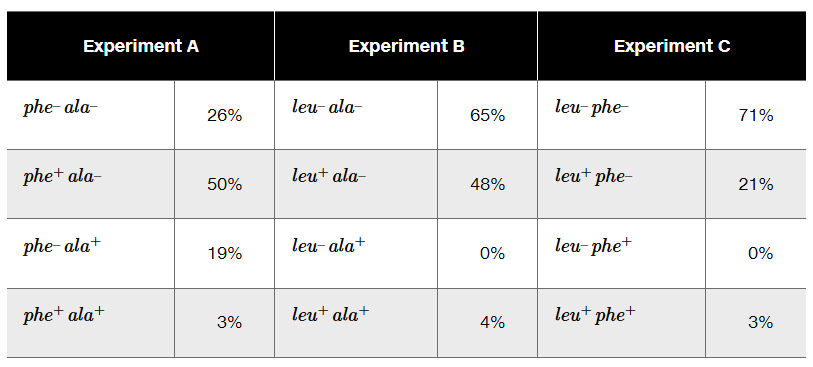
The phage P1 is used as a generalized transducing phage in an experiment combining a donor strain of E. coli of genotype leu⁺ phe⁺ ala⁺ and a recipient strain that is leu⁻ phe⁻ ala⁻. In separate experiments, transductants are selected for leu⁺ (Experiment A), for ala⁺ (Experiment B), and for phe⁺ (Experiment C). Following selection, transductant genotypes for the unselected markers are identified. The selection experiment results below show the frequency of each genotype.
Table showing transductant genotypes and frequencies for three experiments selecting for specific E. coli markers.
What compound or compounds are added to the minimal medium to select for transductants in Experiments A, B, and C?

검증된 단계별 안내
1
Step 1: Understand the concept of transduction and selection. Transduction is a process where bacterial DNA is transferred from one bacterium to another by a phage. In this experiment, the phage P1 is used to transfer genetic material between donor and recipient strains. Selection involves growing bacteria on a minimal medium supplemented with specific compounds to identify transductants that have acquired the desired genotype.
Step 2: Analyze the genotype being selected in each experiment. In Experiment A, transductants are selected for leu⁺, meaning the medium must contain leucine to allow only leu⁺ bacteria to grow. In Experiment B, transductants are selected for ala⁺, so the medium must contain alanine. In Experiment C, transductants are selected for phe⁺, requiring phenylalanine in the medium.
Step 3: Examine the genotype frequencies for unselected markers in each experiment. For Experiment A, the frequencies of phe⁻ ala⁻, phe⁺ ala⁻, phe⁻ ala⁺, and phe⁺ ala⁺ indicate the likelihood of co-transduction of phe and ala with leu. Similarly, for Experiment B and C, the frequencies of unselected markers provide insights into the genetic linkage between leu, phe, and ala.
Step 4: Determine the compounds added to the minimal medium for selection. To select for leu⁺ transductants in Experiment A, leucine is added to the medium. For ala⁺ transductants in Experiment B, alanine is added. For phe⁺ transductants in Experiment C, phenylalanine is added. These compounds ensure that only bacteria with the corresponding genotype can grow.
Step 5: Reflect on the results and genetic linkage. The frequency data suggests varying degrees of linkage between the genes leu, phe, and ala. Genes that are closer together on the bacterial chromosome are more likely to be co-transduced, as seen in the higher frequencies of certain genotypes. This information can be used to map the relative positions of these genes.

비슷한 문제에 대한 검증된 영상 답변:

이 영상 해법은 위 문제에 도움이 된다고 튜터들이 추천한 것입니다.
영상 길이:
3m
도움이 되었나요?

주요 개념

질문에 올바르게 답하기 위해 반드시 이해해야 하는 핵심 개념들은 다음과 같습니다.

Generalized Transduction

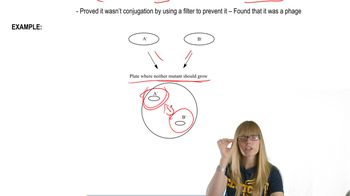
Generalized transduction is a process by which a bacteriophage (phage) transfers genetic material from one bacterium to another. In this process, the phage can incorporate any segment of the host's DNA into its own genome during the lytic cycle. When the phage infects a new bacterial cell, it can introduce this DNA, leading to genetic recombination and the potential for new phenotypes in the recipient strain.
추천 영상:

Selection of Transductants

In genetic experiments, selection of transductants involves using specific growth conditions to isolate bacteria that have acquired desired traits through transduction. For example, in the given experiments, minimal media supplemented with specific amino acids (like leucine, phenylalanine, or alanine) allows only those bacteria that have successfully taken up the corresponding genes to grow, while others are unable to survive due to their auxotrophic nature.
추천 영상:

Auxotrophy and Prototrophy

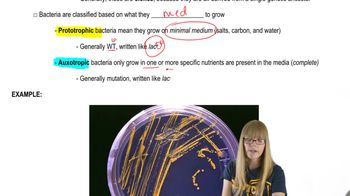
Auxotrophy refers to the inability of an organism to synthesize a particular compound required for its growth, often due to mutations in genes involved in biosynthetic pathways. Prototrophic organisms, on the other hand, can synthesize all necessary compounds from basic nutrients. In the context of the experiments, the donor strain is prototrophic for certain amino acids, while the recipient strain is auxotrophic, necessitating the addition of specific compounds to the growth medium to select for successful transductants.
추천 영상:
가이드 코스
09:35
Bacteria in the Laboratory
관련 실천
교과서 질문

The phage P1 is used as a generalized transducing phage in an experiment combining a donor strain of E. coli of genotype leu⁺ phe⁺ ala⁺ and a recipient strain that is leu⁻ phe⁻ ala⁻. In separate experiments, transductants are selected for leu⁺ (Experiment A), for ala⁺ (Experiment B), and for phe⁺ (Experiment C). Following selection, transductant genotypes for the unselected markers are identified. The selection experiment results below show the frequency of each genotype.

In Experiment B, why are there no transductants with the genotype leu⁻ ala⁺?

844
views
교과서 질문

The phage P1 is used as a generalized transducing phage in an experiment combining a donor strain of E. coli of genotype leu⁺ phe⁺ ala⁺ and a recipient strain that is leu⁻ phe⁻ ala⁻. In separate experiments, transductants are selected for leu⁺ (Experiment A), for ala⁺ (Experiment B), and for phe⁺ (Experiment C). Following selection, transductant genotypes for the unselected markers are identified. The selection experiment results below show the frequency of each genotype.

Determine the order of genes on the donor chromosome.

615
views
교과서 질문

An attribute of growth behavior of eight bacteriophage mutants (1 to 8) is investigated in experiments that establish coinfection by pairs of mutants. The experiments determine whether the mutants complement one another (+) or fail to complement (-). These eight mutants are known to result from point mutation. The results of the complementation tests are shown below.

Gene-mapping information identifies mutations 2 and 3 as the flanking markers in this group of genes. Assuming these mutations are on opposite ends of the gene map, determine the order of mutations in the region of the chromosome.

538
views
교과서 질문

Synthesis of the amino acid histidine is a multistep anabolic pathway that uses the products of 13 genes (hisA to hisM) in E. coli. Two independently isolated his- E. coli mutants, designated his1⁻ and his2⁻ are studied in a conjugation experiment. A his⁺ F' donor strain that carries a copy of the hisJ gene on the plasmid is mated with a his1⁻ recipient strain in Experiment 1 and with a his2⁻ recipient in Experiment 2. The exconjugants are grown on plates lacking histidine. Growth is observed among the exconjugants of Experiment 2 but not among those of Experiment 1.

Why is growth observed in Experiment 2 but not in Experiment 1?

586
views
교과서 질문

The phage P1 is used as a generalized transducing phage in an experiment combining a donor strain of E. coli of genotype leu⁺ phe⁺ ala⁺ and a recipient strain that is leu⁻ phe⁻ ala⁻. In separate experiments, transductants are selected for leu⁺ (Experiment A), for ala⁺ (Experiment B), and for phe⁺ (Experiment C). Following selection, transductant genotypes for the unselected markers are identified. The selection experiment results below show the frequency of each genotype.

Diagram the crossover events that form each of the transductants in Experiment A.

716
views
교과서 질문

Synthesis of the amino acid histidine is a multistep anabolic pathway that uses the products of 13 genes (hisA to hisM) in E. coli. Two independently isolated his- E. coli mutants, designated his1⁻ and his2⁻ are studied in a conjugation experiment. A his⁺ F' donor strain that carries a copy of the hisJ gene on the plasmid is mated with a his1⁻ recipient strain in Experiment 1 and with a his2⁻ recipient in Experiment 2. The exconjugants are grown on plates lacking histidine. Growth is observed among the exconjugants of Experiment 2 but not among those of Experiment 1.

What is the genotype of exconjugants in Experiment 2?

426
views