
- Ch. 1 - The Molecular Basis of Heredity, Variation, and Evolution64
- Ch. 2 - Transmission Genetics144
- Ch. 3 - Cell Division and Chromosome Heredity81
- Ch. 4 - Gene Interaction87
- Ch. 5 - Genetic Linkage and Mapping in Eukaryotes103
- Ch. 6 - Genetic Analysis and Mapping in Bacteria and Bacteriophages73
- Ch. 7 - DNA Structure and Replication71
- Ch. 8 - Molecular Biology of Transcription and RNA Processing79
- Ch. 9 - The Molecular Biology of Translation110
- Ch. 10 - Eukaryotic Chromosome Abnormalities and Molecular Organization100
- Ch. 11 - Gene Mutation, DNA Repair, and Homologous Recombination86
- Ch. 12 - Regulation of Gene Expression in Bacteria and Bacteriophage90
- Ch. 13 - Regulation of Gene Expression in Eukaryotes38
- Ch. 14 - Analysis of Gene Function via Forward Genetics and Reverse Genetics72
- Ch. 15 - Recombinant DNA Technology and Its Applications69
- Ch. 16 - Genomics: Genetics from a Whole-Genome Perspective49
- Ch. 17 - Organelle Inheritance and the Evolution of Organelle Genomes27
- Ch. 18 - Developmental Genetics43
- Ch. 19 - Genetic Analysis of Quantitative Traits66
- Ch. 20 - Population Genetics and Evolution at the Population, Species, and Molecular Levels105

The phage P1 is used as a generalized transducing phage in an experiment combining a donor strain of E. coli of genotype leu⁺ phe⁺ ala⁺ and a recipient strain that is leu⁻ phe⁻ ala⁻. In separate experiments, transductants are selected for leu⁺ (Experiment A), for ala⁺ (Experiment B), and for phe⁺ (Experiment C). Following selection, transductant genotypes for the unselected markers are identified. The selection experiment results below show the frequency of each genotype.
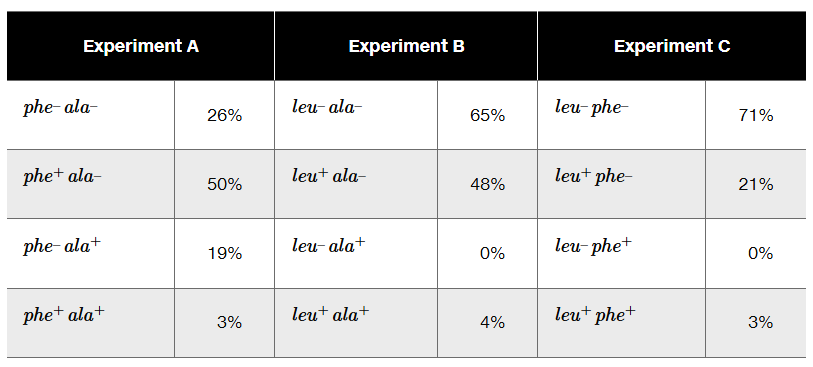
In Experiment B, why are there no transductants with the genotype leu⁻ ala⁺?
 검증된 단계별 안내
비슷한 문제에 대한 검증된 영상 답변:

주요 개념
Generalized Transduction
 05:53
05:53
Selection of Transductants
05:53Linkage and Genetic Mapping
 07:33
07:33Define the term genetic complementation.
Give another example of genetic complementation and describe how genetic complementation works in that case.
Define the term genetic complementation.
Describe how the term applies to an experiment in which two lysis-defective bacteriophages are able to coinfect a bacterial cell and produce lysis.
The phage P1 is used as a generalized transducing phage in an experiment combining a donor strain of E. coli of genotype leu⁺ phe⁺ ala⁺ and a recipient strain that is leu⁻ phe⁻ ala⁻. In separate experiments, transductants are selected for leu⁺ (Experiment A), for ala⁺ (Experiment B), and for phe⁺ (Experiment C). Following selection, transductant genotypes for the unselected markers are identified. The selection experiment results below show the frequency of each genotype.
Determine the order of genes on the donor chromosome.
The phage P1 is used as a generalized transducing phage in an experiment combining a donor strain of E. coli of genotype leu⁺ phe⁺ ala⁺ and a recipient strain that is leu⁻ phe⁻ ala⁻. In separate experiments, transductants are selected for leu⁺ (Experiment A), for ala⁺ (Experiment B), and for phe⁺ (Experiment C). Following selection, transductant genotypes for the unselected markers are identified. The selection experiment results below show the frequency of each genotype.
What compound or compounds are added to the minimal medium to select for transductants in Experiments A, B, and C?
The phage P1 is used as a generalized transducing phage in an experiment combining a donor strain of E. coli of genotype leu⁺ phe⁺ ala⁺ and a recipient strain that is leu⁻ phe⁻ ala⁻. In separate experiments, transductants are selected for leu⁺ (Experiment A), for ala⁺ (Experiment B), and for phe⁺ (Experiment C). Following selection, transductant genotypes for the unselected markers are identified. The selection experiment results below show the frequency of each genotype.
Diagram the crossover events that form each of the transductants in Experiment A.