Raymond Rodriguez and colleagues demonstrated conclusively that DNA replication in E. coli is bidirectional. Explain why locating the origin of replication on one side of the circular chromosomes and the terminus of replication on the opposite side of the chromosome supported this conclusion.
Ch. 7 - DNA Structure and Replication

7장, 문제 18
List the order in which the following proteins and enzymes are active in E. coli DNA replication: DNA pol I, SSB, ligase, helicase, DNA pol III, and primase.
검증된 단계별 안내1
Understand the process of DNA replication in E. coli, which involves unwinding the DNA, stabilizing the strands, synthesizing primers, elongating the new strands, and sealing the gaps.
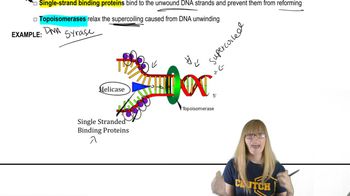
The first enzyme to act is helicase, which unwinds the DNA double helix at the replication fork by breaking hydrogen bonds between complementary bases.
Next, single-strand binding proteins (SSB) bind to the separated DNA strands to prevent them from reannealing and to protect them from degradation.
Primase synthesizes short RNA primers on the lagging strand (and occasionally on the leading strand) to provide a starting point for DNA polymerase to begin synthesis.
DNA polymerase III (DNA pol III) extends the RNA primers by adding nucleotides in the 5' to 3' direction, synthesizing the bulk of the new DNA strand. DNA polymerase I (DNA pol I) later replaces the RNA primers with DNA, and DNA ligase seals the nicks in the sugar-phosphate backbone to complete the replication process.

비슷한 문제에 대한 검증된 영상 답변:
이 영상 해법은 위 문제에 도움이 된다고 튜터들이 추천한 것입니다.
영상 길이:
2m도움이 되었나요?
주요 개념
질문에 올바르게 답하기 위해 반드시 이해해야 하는 핵심 개념들은 다음과 같습니다.
DNA Replication Process
DNA replication in E. coli is a highly coordinated process involving multiple enzymes and proteins that work in a specific order to ensure accurate duplication of the genetic material. The process begins at the origin of replication and proceeds bidirectionally, requiring the unwinding of the DNA double helix and the synthesis of new strands complementary to the original template.
추천 영상:
가이드 코스
Steps to DNA Replication
Role of Key Enzymes
Each enzyme involved in DNA replication has a distinct role. Helicase unwinds the DNA double helix, single-strand binding proteins (SSB) stabilize the unwound strands, primase synthesizes RNA primers, DNA polymerase III extends the new DNA strand, DNA polymerase I replaces RNA primers with DNA, and ligase seals the gaps between Okazaki fragments on the lagging strand.
추천 영상:
가이드 코스
RNA
Order of Enzyme Activity
The order of enzyme activity during E. coli DNA replication is crucial for the process's efficiency and accuracy. It typically follows this sequence: helicase, SSB, primase, DNA pol III, DNA pol I, and finally ligase. Understanding this sequence helps clarify how each enzyme contributes to the overall replication process and ensures that the DNA is copied correctly.
추천 영상:
가이드 코스
Prokaryotic Transcription
관련 실천
교과서 질문
440
views
교과서 질문
Which of the following equalities is not true for double-stranded DNA?
(G+C)=(A+T)
484
views
교과서 질문
Which of the following equalities is not true for double-stranded DNA?
(G+A)=(C+T)
471
views
교과서 질문
Matthew Meselson and Franklin Stahl demonstrated that DNA replication is semiconservative in bacteria. Briefly outline their experiment and its results for two DNA replication cycles, and identify how the alternative models of DNA replication were excluded by the data.
725
views
교과서 질문
Which of the following equalities is not true for double-stranded DNA?
(G+T)=(A+C)
501
views
교과서 질문
Two viral genomes are sequenced, and the following percentages of nucleotides are identified:
Genome 1: A=28%, C=22%,G=28%,T=22%
Genome 2: A=22%, C=28%,G=28%,T=22%
Are the DNA molecules in each genome single-stranded or double-stranded?
584
views
