Ch. 7 - DNA Structure and Replication
Sanders - Genetic Analysis: An Integrated Approach 3rd Edition
Sanders3rd EditionGenetic Analysis: An Integrated ApproachISBN: 9780135564172당신이 사용하는 게 아니라요?교과서 변경
7장, 문제 26d

Telomeres are found at the ends of eukaryotic chromosomes. Why is telomerase usually active in germ-line cells but not in somatic cells?

검증된 단계별 안내
1
Understand the role of telomeres: Telomeres are repetitive DNA sequences at the ends of eukaryotic chromosomes that protect the genetic material from degradation during replication. Each time a cell divides, telomeres shorten due to the inability of DNA polymerase to fully replicate the ends of linear DNA.
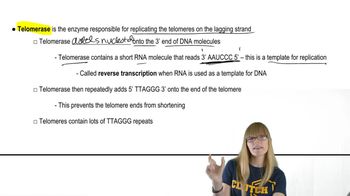
Learn about telomerase: Telomerase is an enzyme that adds repetitive nucleotide sequences to the ends of telomeres, counteracting their shortening. It is composed of a protein component and an RNA template that guides the addition of telomeric repeats.
Recognize the difference between germ-line and somatic cells: Germ-line cells are responsible for passing genetic information to offspring and undergo many divisions over generations. Somatic cells, on the other hand, are the cells that make up the body and typically have a limited lifespan.
Understand why telomerase is active in germ-line cells: Germ-line cells require telomerase activity to maintain telomere length across generations, ensuring the integrity of genetic material for reproduction. Without telomerase, germ-line cells would experience telomere shortening, leading to genomic instability and loss of fertility.
Explain why telomerase is not active in most somatic cells: In somatic cells, telomerase is usually inactive to limit the number of cell divisions. This helps prevent uncontrolled cell growth, which could lead to cancer. The progressive shortening of telomeres in somatic cells acts as a natural mechanism for aging and cellular senescence.

비슷한 문제에 대한 검증된 영상 답변:

이 영상 해법은 위 문제에 도움이 된다고 튜터들이 추천한 것입니다.
영상 길이:
3m
도움이 되었나요?

주요 개념

질문에 올바르게 답하기 위해 반드시 이해해야 하는 핵심 개념들은 다음과 같습니다.

Telomeres

Telomeres are repetitive nucleotide sequences located at the ends of eukaryotic chromosomes. They protect the chromosome from deterioration and prevent fusion with neighboring chromosomes. Each time a cell divides, telomeres shorten, which is associated with aging and cellular senescence.
추천 영상:
가이드 코스
08:38
Telomeres and Telomerase

Telomerase

Telomerase is an enzyme that adds nucleotide sequences to the ends of telomeres, effectively extending their length. This enzyme is typically active in germ-line cells, allowing them to maintain telomere length across generations, which is crucial for reproductive success. In contrast, most somatic cells have low or absent telomerase activity, leading to gradual telomere shortening.
추천 영상:
가이드 코스
08:38
Telomeres and Telomerase

Germ-line vs. Somatic Cells

Germ-line cells are reproductive cells that give rise to gametes (sperm and eggs), while somatic cells make up the rest of the body. The activity of telomerase in germ-line cells ensures that the genetic information is preserved for future generations, whereas somatic cells do not require this mechanism, as they do not contribute directly to reproduction.
추천 영상:
가이드 코스
09:49
Point Mutations
관련 실천
교과서 질문

Telomeres are found at the ends of eukaryotic chromosomes. What is the sequence composition of telomeres?

515
views
교과서 질문

Telomeres are found at the ends of eukaryotic chromosomes. How does telomerase assemble telomeres?

521
views
교과서 질문

A family consisting of a mother (I-1), a father (I-2), and three children (II-1, II-2, and II-3) are genotyped by PCR for a region of an autosome containing repeats of a 10-bp sequence. The mother carries 16 repeats on one chromosome and 21 on the homologous chromosome. The father carries repeat numbers of 18 and 26.

Identify all the possible genotypes of children of this couple by specifying PCR fragment lengths in each genotype.

542
views
교과서 질문

A family consisting of a mother (I-1), a father (I-2), and three children (II-1, II-2, and II-3) are genotyped by PCR for a region of an autosome containing repeats of a 10-bp sequence. The mother carries 16 repeats on one chromosome and 21 on the homologous chromosome. The father carries repeat numbers of 18 and 26.

What genetic term best describes the pattern of inheritance of this DNA marker? Explain your choice.

597
views
교과서 질문

A family consisting of a mother (I-1), a father (I-2), and three children (II-1, II-2, and II-3) are genotyped by PCR for a region of an autosome containing repeats of a 10-bp sequence. The mother carries 16 repeats on one chromosome and 21 on the homologous chromosome. The father carries repeat numbers of 18 and 26.

Following the layout of the following figure, which aligns members of a pedigree with their DNA fragments in a gel, draw a DNA gel containing the PCR fragments generated by amplification of DNA from the parents (I-1 and I-2). Label the size of each fragment.

679
views
교과서 질문

Telomeres are found at the ends of eukaryotic chromosomes. What is the functional role of telomeres?

663
views