Ch. 8 - Molecular Biology of Transcription and RNA Processing
Sanders - Genetic Analysis: An Integrated Approach 3rd Edition
Sanders3rd EditionGenetic Analysis: An Integrated ApproachISBN: 9780135564172당신이 사용하는 게 아니라요?교과서 변경
8장, 문제 29f

The DNA sequence below gives the first 12 base pairs of the transcribed region of a gene, and the template and nontemplate strands of DNA are identified. The transcription start is the thymine nucleotide at the end of the sequence given. Use the diagram to answer the list of questions. Make a copy of the diagram before you begin answering the questions, or have one group member diagram the answers for bacteria and another group member diagram the answers for eukaryotes.
Nontemplate strand ___________ TTGCTACGGTCA___________
Template strand    ___________ AACGATGCCAGT___________
Assuming the sequence shown is part of a eukaryotic gene, what consensus sequence(s) would you expect to identify within about 100 base pairs of the start of transcription?

검증된 단계별 안내
1
Identify the transcription start site, which is the thymine nucleotide at the end of the sequence provided. This is the +1 position, and transcription begins here.
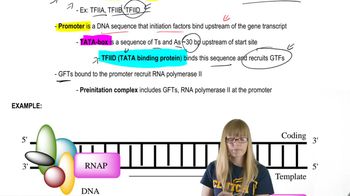
Understand that in eukaryotic genes, consensus sequences are regulatory elements found near the transcription start site. These sequences help recruit transcription machinery. The most common consensus sequences are the TATA box (around -25 to -30 base pairs upstream) and the CAAT box (around -75 base pairs upstream).
Examine the nontemplate strand sequence provided (TTGCTACGGTCA) and consider the upstream region (approximately 100 base pairs before the transcription start site). Look for sequences that resemble the TATA box (TATAAA) or the CAAT box (GGCCAATCT).
If no exact matches for the TATA box or CAAT box are found, consider that variations in these sequences are common. Look for sequences that are similar to the consensus sequences, as they may still function as regulatory elements.
Conclude that the presence of these consensus sequences (or their variants) within 100 base pairs upstream of the transcription start site is expected in eukaryotic genes, as they play a critical role in initiating transcription by recruiting RNA polymerase and other transcription factors.

비슷한 문제에 대한 검증된 영상 답변:

이 영상 해법은 위 문제에 도움이 된다고 튜터들이 추천한 것입니다.
영상 길이:
3m

주요 개념

질문에 올바르게 답하기 위해 반드시 이해해야 하는 핵심 개념들은 다음과 같습니다.

Transcription in Eukaryotes

Transcription in eukaryotes involves the synthesis of RNA from a DNA template, occurring in the nucleus. It begins at a specific site called the promoter, which is recognized by RNA polymerase and associated transcription factors. The process includes several steps: initiation, elongation, and termination, with the pre-mRNA undergoing further processing, such as capping and splicing, before becoming mature mRNA.
추천 영상:
가이드 코스
09:16
Eukaryotic Transcription

Consensus Sequences

Consensus sequences are short, recurring patterns in DNA that are crucial for the binding of transcription factors and RNA polymerase. These sequences are typically found in promoter regions and can include elements like the TATA box and other regulatory motifs. Identifying these sequences helps predict where transcription will initiate and is essential for understanding gene regulation.
추천 영상:
가이드 코스
08:55
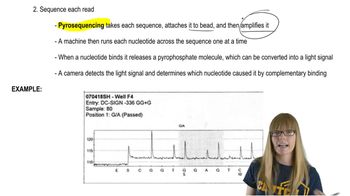
Sequencing Overview

Template and Nontemplate Strands

In DNA, the template strand is the strand that RNA polymerase reads to synthesize RNA, while the nontemplate strand, also known as the coding strand, has the same sequence as the RNA (except for thymine being replaced by uracil). Understanding the roles of these strands is vital for interpreting the direction of transcription and the resulting RNA sequence, which is essential for answering questions about gene expression.
추천 영상:
가이드 코스
03:03
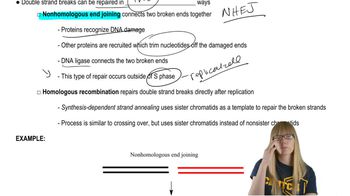
Double Strand Breaks
관련 실천
교과서 질문

Genomic DNA from a mouse is isolated, fragmented, and denatured into single strands. It is then mixed with mRNA isolated from the cytoplasm of mouse cells. The image represents an electron micrograph result showing the hybridization of single-stranded DNA and mRNA.

Which nucleic acid is indicated by the 'b' pointer? Justify your answer. 

559
views
교과서 질문

The DNA sequence below gives the first 12 base pairs of the transcribed region of a gene, and the template and nontemplate strands of DNA are identified. The transcription start is the thymine nucleotide at the end of the sequence given. Use the diagram to answer the list of questions. Make a copy of the diagram before you begin answering the questions, or have one group member diagram the answers for bacteria and another group member diagram the answers for eukaryotes. Nontemplate strand ___________TTGCTACGGTCA___________

Template strand ___________AACGATGCCAGT___________

Write the anticipated bacterial consensus sequence(s) in the approximate position(s) on the diagram.

515
views
교과서 질문

The DNA sequence below gives the first 12 base pairs of the transcribed region of a gene, and the template and nontemplate strands of DNA are identified. The transcription start is the thymine nucleotide at the end of the sequence given. Use the diagram to answer the list of questions. Make a copy of the diagram before you begin answering the questions, or have one group member diagram the answers for bacteria and another group member diagram the answers for eukaryotes.

Nontemplate strand ___________ TTGCTACGGTCA___________

Template strand    ___________ AACGATGCCAGT___________

Write the anticipated eukaryotic consensus sequence(s) in the approximate position(s) on the diagram.

456
views
교과서 질문

Genomic DNA from a mouse is isolated, fragmented, and denatured into single strands. It is then mixed with mRNA isolated from the cytoplasm of mouse cells. The image represents an electron micrograph result showing the hybridization of single-stranded DNA and mRNA.

Which nucleic acid is indicated by the 'a' pointer? Justify your answer. 

738
views
교과서 질문

The DNA sequence below gives the first 12 base pairs of the transcribed region of a gene, and the template and nontemplate strands of DNA are identified. The transcription start is the thymine nucleotide at the end of the sequence given. Use the diagram to answer the list of questions. Make a copy of the diagram before you begin answering the questions, or have one group member diagram the answers for bacteria and another group member diagram the answers for eukaryotes. Nontemplate strand ___________TTGCTACGGTCA___________

Template strand ___________ AACGATGCCAGT___________

Assuming the sequence shown is part of a bacterial gene, what consensus sequence(s) would you expect to identify in the promoter?

553
views
교과서 질문

The DNA sequence below gives the first 12 base pairs of the transcribed region of a gene, and the template and nontemplate strands of DNA are identified. The transcription start is the thymine nucleotide at the end of the sequence given. Use the diagram to answer the list of questions. Make a copy of the diagram before you begin answering the questions, or have one group member diagram the answers for bacteria and another group member diagram the answers for eukaryotes. Nontemplate strand ___________TTGCTACGGTCA___________

Template strand ___________ AACGATGCCAGT___________

Assuming the sequence shown is part of a bacterial gene, draw the approximate positions of the promoter sequence and the termination sequence.

576
views