Ch. 9 - The Molecular Biology of Translation
Sanders - Genetic Analysis: An Integrated Approach 3rd Edition
Sanders3rd EditionGenetic Analysis: An Integrated ApproachISBN: 9780135564172당신이 사용하는 게 아니라요?교과서 변경
9장, 문제 6

Describe three features of tRNA molecules that lead to their correct charging by tRNA synthetase enzymes.

검증된 단계별 안내
1
Identify the structure of tRNA: tRNA molecules have a cloverleaf structure with an acceptor stem, D-loop, anticodon loop, and TψC loop. The acceptor stem is crucial for the attachment of amino acids.
Understand the role of the anticodon: The anticodon loop contains a specific sequence of three nucleotides that pairs with the corresponding codon on mRNA, ensuring the correct amino acid is added during protein synthesis.
Recognize the importance of the acceptor stem: The 3' end of the tRNA, specifically the CCA tail, is where the amino acid is covalently attached by the tRNA synthetase enzyme.
Explore the specificity of tRNA synthetase: Each tRNA synthetase enzyme is specific to one amino acid and its corresponding tRNA(s). The enzyme recognizes the correct tRNA through specific interactions with the anticodon and other structural features of the tRNA.
Consider the proofreading mechanism: Some tRNA synthetases have proofreading abilities to ensure the correct amino acid is attached to the tRNA, preventing errors in protein synthesis.

비슷한 문제에 대한 검증된 영상 답변:

이 영상 해법은 위 문제에 도움이 된다고 튜터들이 추천한 것입니다.
영상 길이:
1m
도움이 되었나요?

주요 개념

질문에 올바르게 답하기 위해 반드시 이해해야 하는 핵심 개념들은 다음과 같습니다.

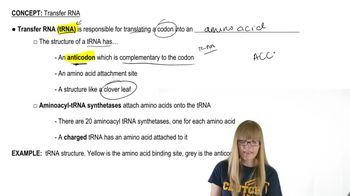
tRNA Structure

Transfer RNA (tRNA) molecules have a unique cloverleaf structure that allows them to fold into a three-dimensional shape. This structure includes an anticodon region that pairs with the corresponding codon on mRNA, and an acceptor stem where the amino acid is attached. The specific shape and regions of tRNA are crucial for its recognition and interaction with tRNA synthetase enzymes.
추천 영상:
가이드 코스
03:49
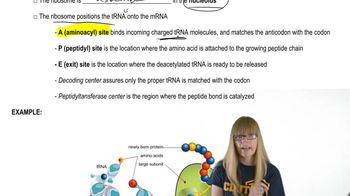
Ribosome Structure

Aminoacyl-tRNA Synthetase

Aminoacyl-tRNA synthetases are enzymes that catalyze the attachment of amino acids to their corresponding tRNA molecules, a process known as 'charging.' Each synthetase is specific to one amino acid and its corresponding tRNA, ensuring that the correct amino acid is linked to the appropriate tRNA. This specificity is vital for accurate protein synthesis.
추천 영상:

Recognition and Specificity

The correct charging of tRNA by synthetase enzymes relies on recognition elements within the tRNA structure, such as the anticodon and specific nucleotide sequences in the acceptor stem. These features allow the synthetase to distinguish between different tRNAs and ensure that each tRNA is charged with the correct amino acid, which is essential for maintaining the fidelity of protein translation.
추천 영상:
가이드 코스
01:45
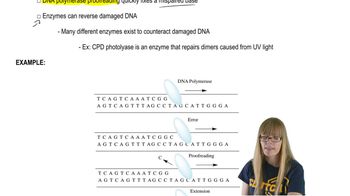
DNA Proofreading
관련 실천
교과서 질문

A couple and some of their relatives are screened for Gaucher disease in a community-based screening program. The woman is homozygous for the dominant allele, represented by G. The woman's father, sister, and paternal grandmother are heterozygous carriers of the mutant allele, represented by g. Her paternal grandfather, her mother, and both of her mother's parents are homozygous for the dominant allele. The man is heterozygous and he has a brother with Gaucher disease. The man's parents and grandparents have not been tested, but it is known that none of them has Gaucher disease.

On the pedigree, write the genotypes (GG, Gg, or gg) for each person who has been tested or for whom you can deduce a genotype. If a genotype cannot be determined completely, list the alleles you know or deduce must be present.

386
views
교과서 질문

A portion of a DNA template strand has the base sequence

5′-...ACGCGATGCGTGATGTATAGAGCT...-3′

Assume the mRNA is written in the correct reading frame. Determine the amino acid sequence encoded by this fragment. Identify the N- and C-terminal directions of the polypeptide.

716
views
교과서 질문

A couple and some of their relatives are screened for Gaucher disease in a community-based screening program. The woman is homozygous for the dominant allele, represented by G. The woman's father, sister, and paternal grandmother are heterozygous carriers of the mutant allele, represented by g. Her paternal grandfather, her mother, and both of her mother's parents are homozygous for the dominant allele. The man is heterozygous and he has a brother with Gaucher disease. The man's parents and grandparents have not been tested, but it is known that none of them has Gaucher disease.

Explain why you are able to assign genotypes to the man's parents despite their not being tested.

387
views
교과서 질문

A couple and some of their relatives are screened for Gaucher disease in a community-based screening program. The woman is homozygous for the dominant allele, represented by G. The woman's father, sister, and paternal grandmother are heterozygous carriers of the mutant allele, represented by g. Her paternal grandfather, her mother, and both of her mother's parents are homozygous for the dominant allele. The man is heterozygous and he has a brother with Gaucher disease. The man's parents and grandparents have not been tested, but it is known that none of them has Gaucher disease.

Draw a pedigree of this family, including the woman, the man, their siblings, parents, and grandparents.

376
views
교과서 질문

A portion of a DNA template strand has the base sequence

5′-...ACGCGATGCGTGATGTATAGAGCT...-3′

Which is the third amino acid added to the polypeptide chain?

651
views
교과서 질문

A portion of a DNA template strand has the base sequence

5′-...ACGCGATGCGTGATGTATAGAGCT...-3′

Identify the sequence and polarity of the mRNA transcribed from this fragmentary template-strand sequence.

797
views