Ch. 9 - The Molecular Biology of Translation
Sanders - Genetic Analysis: An Integrated Approach 3rd Edition
Sanders3rd EditionGenetic Analysis: An Integrated ApproachISBN: 9780135564172당신이 사용하는 게 아니라요?교과서 변경
9장, 문제 33

Diagram a eukaryotic gene containing three exons and two introns, the pre-mRNA and mature mRNA transcript of the gene, and a partial polypeptide that contains the following sequences and features. Carefully align the nucleic acids, and locate each sequence or feature on the appropriate molecule.

a. The AG and GU dinucleotides corresponding to intron-exon junctions
b. The +1 nucleotide
c. The 5' UTR and the 3' UTR
d. The start codon sequence
e. A stop codon sequence
f. A codon sequence for the amino acids Gly-His-Arg at the end of exon 1 and a codon sequence for the amino acids Leu-Trp-Ala at the beginning of exon 2

검증된 단계별 안내
1
span>1. **Diagram the Eukaryotic Gene Structure**: Begin by sketching a linear representation of a eukaryotic gene. Label three exons (Exon 1, Exon 2, Exon 3) and two introns (Intron 1, Intron 2) between them. Indicate the 5' and 3' ends of the gene.
span>2. **Identify Intron-Exon Junctions**: Mark the AG and GU dinucleotides at the intron-exon junctions. Typically, the 5' end of an intron starts with GU and the 3' end ends with AG.
span>3. **Locate the +1 Nucleotide**: Identify the transcription start site, which is the +1 nucleotide, located just upstream of the first exon.
span>4. **Label the UTRs**: Indicate the 5' Untranslated Region (UTR) before the start codon in Exon 1 and the 3' UTR after the stop codon in Exon 3.
span>5. **Map the Codon Sequences**: In Exon 1, identify the codon sequence for Gly-His-Arg. In Exon 2, locate the codon sequence for Leu-Trp-Ala. Also, mark the start codon (usually AUG) in Exon 1 and a stop codon (e.g., UAA, UAG, UGA) in Exon 3.

비슷한 문제에 대한 검증된 영상 답변:

이 영상 해법은 위 문제에 도움이 된다고 튜터들이 추천한 것입니다.
영상 길이:
3m

주요 개념

질문에 올바르게 답하기 위해 반드시 이해해야 하는 핵심 개념들은 다음과 같습니다.

Gene Structure

Eukaryotic genes are composed of exons and introns, where exons are coding sequences that will be expressed as proteins, and introns are non-coding sequences that are removed during RNA processing. Understanding the arrangement of these elements is crucial for diagramming the gene and its transcripts accurately.
추천 영상:
가이드 코스
03:49
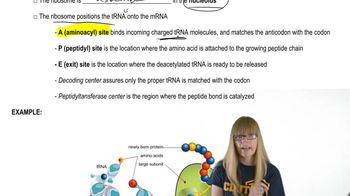
Ribosome Structure

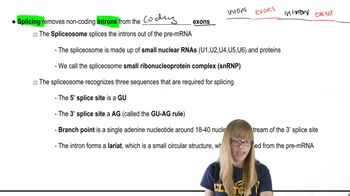
RNA Processing

After transcription, the pre-mRNA undergoes several modifications, including the removal of introns and the addition of a 5' cap and a poly-A tail. This process results in mature mRNA, which is essential for translation. Recognizing the significance of these modifications helps in identifying features like the 5' UTR and 3' UTR in the final mRNA transcript.
추천 영상:
가이드 코스
08:39
mRNA Processing

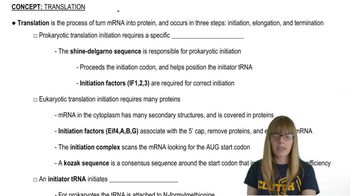
Translation and Codons

Translation is the process by which ribosomes synthesize proteins based on the sequence of codons in mRNA. Each codon corresponds to a specific amino acid, and understanding the start and stop codons is vital for determining where translation begins and ends. This knowledge is necessary for accurately depicting the polypeptide sequence derived from the mRNA.
추천 영상:
가이드 코스
07:58
Translation initiation
관련 실천
교과서 질문

A eukaryotic mRNA has the following sequence. The 5' cap is indicated in italics (CAP), and the 3' poly(A) tail is indicated by italicized adenines.

5′-CAPCCAAGCGUUACAUGUAUGGAGAGAAUGAAACUGAGGCUUGCCACGUUUGUUAAGCACCUAUGCUACCGAAAAAAAAAAAAAAAAAAAAAAAA-3′

Locate the start codon and stop codon in this sequence.

795
views
교과서 질문

A portion of the coding strand of DNA for a gene has the sequence

5′-...GGAGAGAATGAATCT...-3′

Assuming the mRNA is in the correct reading frame, write the amino acid sequence of the polypeptide using three-letter abbreviations and, separately, the amino acid sequence using one-letter abbreviations.

1314
views
교과서 질문

Table D lists α-globin and β-globin gene sequences for the 11 or 12 nucleotides preceding the start codon and the first nucleotide following the start codon (see Problem 34). The data are for 16 vertebrate globin genes reported by Kozak (1987). The sequences are written from -12 to +4 with the start codon sequence in capital letters. Use the data in this table to:

Compare the consensus sequence for these globin genes to the consensus sequence derived from the larger study of 699 vertebrate genes in Problem 34. 

553
views
교과서 질문

A eukaryotic mRNA has the following sequence. The 5' cap is indicated in italics (CAP), and the 3' poly(A) tail is indicated by italicized adenines.

5′-CAPCCAAGCGUUACAUGUAUGGAGAGAAUGAAACUGAGGCUUGCCACGUUUGUUAAGCACCUAUGCUACCGAAAAAAAAAAAAAAAAAAAAAAAA-3′

Determine the amino acid sequence of the polypeptide produced from this mRNA. Write the sequence using the three-letter and one-letter abbreviations for amino acids.

759
views
교과서 질문

Table C contains DNA-sequence information compiled by Marilyn Kozak (1987). The data consist of the percentage of A, C, G, and T at each position among the 12 nucleotides preceding the start codon in 699 genes from various vertebrate species and at the first nucleotide after the start codon. (The start codon occupies positions +1 to +3 and the first nucleotide immediately after the start codon occupies position +4) Use the data to determine the consensus sequence for the 13 nucleotides ( -12 to -1 and +4) surrounding the start codon in vertebrate genes.

645
views
교과서 질문

Table D lists α-globin and β-globin gene sequences for the 11 or 12 nucleotides preceding the start codon and the first nucleotide following the start codon (see Problem 34). The data are for 16 vertebrate globin genes reported by Kozak (1987). The sequences are written from -12 to +4 with the start codon sequence in capital letters. Use the data in this table to:

Determine the consensus sequence for the 16 selected α-globin and β-globin genes.

549
views