Ch.10 Proteins Workers of the Cell
Frost - General, Organic and Biological Chemistry 4th Edition
Frost4th EditionGeneral, Organic and Biological ChemistryISBN: 9780134988696당신이 사용하는 게 아니라요?교과서 변경
6장, 문제 67b

Would you expect to find this segment at the center or on the surface of a globular protein? Why?

검증된 단계별 안내
1
Identify the segment in question and determine its chemical properties, such as whether it is hydrophobic (nonpolar) or hydrophilic (polar). This is crucial because the location of the segment in a globular protein depends on its polarity.
Recall that globular proteins are typically folded in such a way that hydrophobic (nonpolar) regions are buried in the interior (center) of the protein, away from water, while hydrophilic (polar) regions are exposed on the surface, interacting with the aqueous environment.
Analyze the amino acid composition of the segment. If the segment contains mostly nonpolar amino acids (e.g., leucine, valine, phenylalanine), it is likely to be found in the center of the protein. If it contains mostly polar or charged amino acids (e.g., serine, lysine, glutamate), it is likely to be on the surface.
Consider the role of hydrogen bonding and ionic interactions. Polar amino acids on the surface can form hydrogen bonds or ionic interactions with water or other molecules, stabilizing the protein structure in an aqueous environment.
Conclude the reasoning based on the segment's properties. For example, if the segment is hydrophobic, it would be expected to be at the center of the globular protein to avoid water, whereas a hydrophilic segment would be on the surface to interact with water.

비슷한 문제에 대한 검증된 영상 답변:

이 영상 해법은 위 문제에 도움이 된다고 튜터들이 추천한 것입니다.
영상 길이:
3m

주요 개념

질문에 올바르게 답하기 위해 반드시 이해해야 하는 핵심 개념들은 다음과 같습니다.

Globular Proteins

Globular proteins are spherical in shape and are typically soluble in water. They play crucial roles in biological processes, including enzyme activity, transport, and immune responses. Their structure allows for a diverse range of functions, as the folding of the protein creates specific active sites and binding pockets.
추천 영상:
가이드 코스
2:01
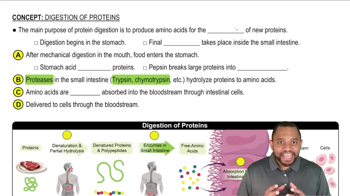
Digestion of Proteins Concept 1

Hydrophobic and Hydrophilic Interactions

In globular proteins, amino acids can be classified as hydrophobic (water-repelling) or hydrophilic (water-attracting). Hydrophobic amino acids tend to be found in the interior of the protein, away from water, while hydrophilic amino acids are usually located on the surface, interacting with the aqueous environment. This distribution is crucial for the protein's stability and function.
추천 영상:
가이드 코스
2:41
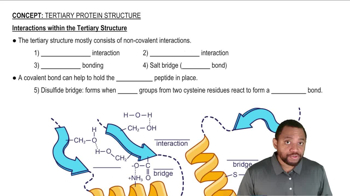
Interactions within the Tertiary Structure Concept 2

Protein Folding

Protein folding is the process by which a linear chain of amino acids acquires its functional three-dimensional structure. This process is driven by various interactions, including hydrogen bonds, ionic bonds, and van der Waals forces. Proper folding is essential for the protein's functionality, and misfolding can lead to diseases.
추천 영상:
가이드 코스
1:17
Tertiary Protein Structure Example 1