Ch.10 Proteins Workers of the Cell
Frost - General, Organic and Biological Chemistry 4th Edition
Frost4th EditionGeneral, Organic and Biological ChemistryISBN: 9780134988696당신이 사용하는 게 아니라요?교과서 변경
6장, 문제 71d

Identify the level of protein structure associated with each of the following:
d. intermolecular forces between R groups

검증된 단계별 안내
1
Understand that proteins have four levels of structure: primary, secondary, tertiary, and quaternary. Each level describes a different aspect of the protein's organization.
Recall that the tertiary structure of a protein refers to the three-dimensional folding of the polypeptide chain, which is stabilized by interactions between the R groups (side chains) of amino acids.
Recognize that intermolecular forces between R groups include hydrogen bonding, ionic interactions, hydrophobic interactions, and disulfide bonds. These forces contribute to the overall shape and stability of the protein's tertiary structure.
Differentiate this from the quaternary structure, which involves interactions between multiple polypeptide chains, and the secondary structure, which involves local folding patterns like alpha-helices and beta-sheets stabilized by hydrogen bonds in the backbone.
Conclude that the level of protein structure associated with intermolecular forces between R groups is the tertiary structure.

비슷한 문제에 대한 검증된 영상 답변:

이 영상 해법은 위 문제에 도움이 된다고 튜터들이 추천한 것입니다.
영상 길이:
3m

주요 개념

질문에 올바르게 답하기 위해 반드시 이해해야 하는 핵심 개념들은 다음과 같습니다.

Protein Structure Levels

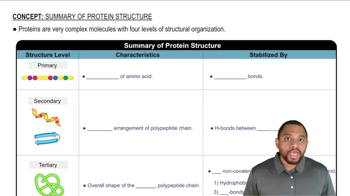
Proteins have four levels of structure: primary, secondary, tertiary, and quaternary. Each level represents a different aspect of protein organization, from the sequence of amino acids to the overall three-dimensional shape formed by interactions between multiple polypeptide chains.
추천 영상:
가이드 코스
2:56
Summary of Protein Structure Concept 1

Tertiary Structure

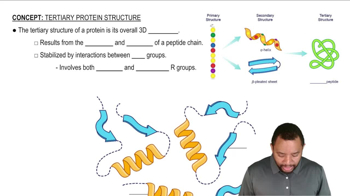
The tertiary structure of a protein refers to its overall three-dimensional shape, which is formed by the folding of the polypeptide chain. This folding is driven by interactions among the R groups (side chains) of the amino acids, including hydrogen bonds, ionic bonds, hydrophobic interactions, and disulfide bridges.
추천 영상:
가이드 코스
2:07
Tertiary Protein Structure Concept 1

Intermolecular Forces

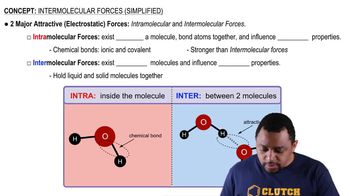
Intermolecular forces are the attractive forces between molecules or different parts of a molecule. In the context of proteins, these forces, such as hydrogen bonds and van der Waals forces, play a crucial role in stabilizing the tertiary structure by influencing how R groups interact with each other and with the surrounding environment.
추천 영상:
가이드 코스
01:59
Intermolecular Forces (Simplified) Concept 1