Ch.10 Proteins Workers of the Cell
Frost - General, Organic and Biological Chemistry 4th Edition
Frost4th EditionGeneral, Organic and Biological ChemistryISBN: 9780134988696당신이 사용하는 게 아니라요?교과서 변경
6장, 문제 95c

Pepsin, an enzyme that hydrolyzes peptide bonds in proteins, functions in the stomach at a pH optimum of 1.5 to 2.0. How is the rate of a pepsin-catalyzed reaction affected by each of the following conditions?
c. running the reaction at 0 °C

검증된 단계별 안내
1
Understand the role of temperature in enzyme activity: Enzymes, including pepsin, are proteins that catalyze reactions. Their activity is highly dependent on temperature. At lower temperatures, such as 0 °C, the kinetic energy of molecules decreases, leading to slower movement and fewer effective collisions between the enzyme and substrate.
Recall the concept of the optimal temperature for enzymes: Most enzymes have an optimal temperature range where their activity is maximized. For pepsin, this optimal temperature is typically around human body temperature (37 °C). Deviating significantly from this range, especially lowering the temperature, reduces the enzyme's catalytic efficiency.
Consider the effect of 0 °C on reaction rate: At 0 °C, the enzyme's activity is significantly reduced because the molecular motion is slowed down. This results in a lower rate of reaction, as fewer substrate molecules interact with the active site of pepsin.
Relate temperature to enzyme structure: While 0 °C does not denature pepsin (denaturation typically occurs at high temperatures), it does cause the enzyme to function less effectively due to reduced flexibility in its active site, which is necessary for binding substrates.
Conclude the impact: Running the reaction at 0 °C will slow down the rate of the pepsin-catalyzed reaction significantly, as the enzyme's activity is hindered by the low temperature.

비슷한 문제에 대한 검증된 영상 답변:

이 영상 해법은 위 문제에 도움이 된다고 튜터들이 추천한 것입니다.
영상 길이:
6m
도움이 되었나요?

주요 개념

질문에 올바르게 답하기 위해 반드시 이해해야 하는 핵심 개념들은 다음과 같습니다.

Enzyme Activity and Temperature

Enzymes, including pepsin, are proteins that catalyze biochemical reactions. Their activity is highly dependent on temperature; generally, as temperature increases, enzyme activity rises due to increased molecular movement. However, extreme temperatures can denature enzymes, leading to a loss of function. At low temperatures, such as 0 °C, enzyme activity is significantly reduced because molecular interactions slow down, resulting in fewer effective collisions between the enzyme and substrate.
추천 영상:
가이드 코스
1:31
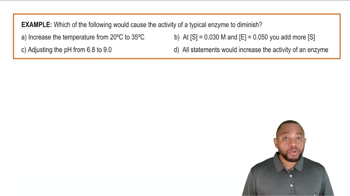
Factors Affecting Enzyme Activity Example 1

pH and Enzyme Function

Enzymes have optimal pH ranges where they function most effectively. Pepsin, for instance, operates best in the highly acidic environment of the stomach (pH 1.5 to 2.0). Deviations from this optimal pH can lead to decreased enzyme activity or denaturation. At a neutral or basic pH, pepsin's structure may be altered, impairing its ability to hydrolyze peptide bonds efficiently.
추천 영상:
가이드 코스
02:16
Logarithmic Functions

Reaction Rate and Substrate Concentration

The rate of an enzyme-catalyzed reaction is influenced by substrate concentration. Initially, as substrate concentration increases, the reaction rate also increases, as more substrate molecules are available for the enzyme to act upon. However, this relationship only holds until the enzyme becomes saturated; beyond this point, additional substrate does not increase the reaction rate. At low temperatures, the reduced kinetic energy can further limit the effective concentration of substrate molecules interacting with the enzyme.
추천 영상:
가이드 코스
02:16
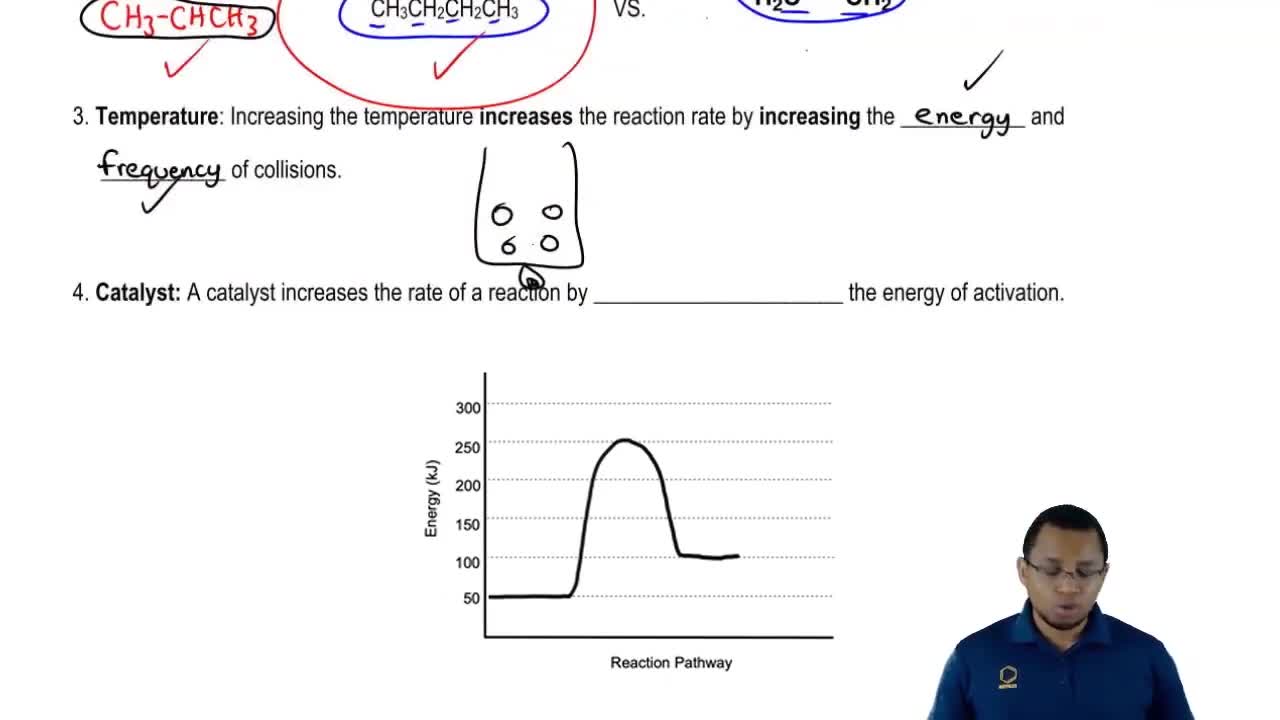
Rate of Reaction Concept 7