
Ch.10 Proteins Workers of the Cell
Frost - General, Organic and Biological Chemistry 4th Edition
Frost4th EditionGeneral, Organic and Biological ChemistryISBN: 9780134988696당신이 사용하는 게 아니라요?교과서 변경
6장, 문제 93a

If each of the following amino acid side chains is present in the active site of an enzyme, indicate whether it would (a) serve a catalytic function, (b) serve to hold the substrate, or (c) both.
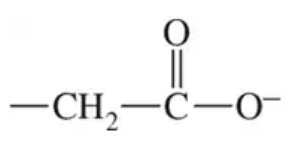
a. aspartate
Chemical structure of aspartate, showing its carboxylate group and backbone, relevant to enzyme function.

검증된 단계별 안내
1
Understand the problem: The question asks us to determine the role of the amino acid side chain (aspartate) in the active site of an enzyme. The options are (a) catalytic function, (b) holding the substrate, or (c) both.
Recall the structure and properties of aspartate: Aspartate is a negatively charged amino acid at physiological pH due to its carboxylate (-COO⁻) group in the side chain. This charge makes it capable of interacting with positively charged groups or participating in acid-base catalysis.
Consider catalytic function: Aspartate can serve a catalytic function because its negatively charged side chain can act as a nucleophile or participate in proton transfer during enzymatic reactions.
Consider substrate binding: The negative charge on aspartate's side chain can also interact with positively charged regions of the substrate, helping to hold the substrate in place within the active site.
Conclude the role: Based on its ability to participate in both catalytic activity and substrate binding, aspartate can serve both functions (c).

비슷한 문제에 대한 검증된 영상 답변:

이 영상 해법은 위 문제에 도움이 된다고 튜터들이 추천한 것입니다.
영상 길이:
3m

주요 개념

질문에 올바르게 답하기 위해 반드시 이해해야 하는 핵심 개념들은 다음과 같습니다.

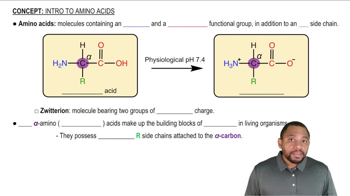
Amino Acid Side Chains

Amino acid side chains, or R groups, determine the chemical properties and functions of amino acids in proteins. They can be polar, nonpolar, acidic, or basic, influencing how they interact with substrates and other molecules. Understanding the nature of these side chains is crucial for predicting their roles in enzyme activity, including catalysis and substrate binding.
추천 영상:
가이드 코스
3:04
Intro to Amino Acids Concept 1

Enzyme Active Site

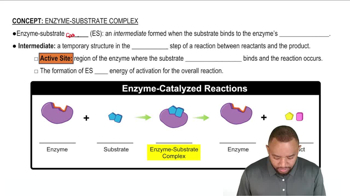
The active site of an enzyme is a specific region where substrate molecules bind and undergo a chemical reaction. The structure and chemical environment of the active site are tailored to facilitate the conversion of substrates into products. The presence of specific amino acid side chains in this region can enhance catalytic efficiency or stabilize substrate binding.
추천 영상:
가이드 코스
1:06
Factors Affecting Enzyme Activity Concept 1

Catalytic Function vs. Substrate Binding

Catalytic function refers to the ability of an enzyme to accelerate a chemical reaction, often involving the formation of transient intermediates. In contrast, substrate binding involves the non-covalent interactions that hold the substrate in place within the active site. Some amino acids can perform both roles, while others may specialize in one, impacting the overall enzymatic activity.
추천 영상:
가이드 코스
2:32
Enzyme-Substrate Complex Concept 1
관련 실천
교과서 질문

A substrate is held in the active site of an enzyme by attractive forces between the substrate and the amino acid side chains. For the outlined regions A, B, and C on the following substrate molecule:

b. Could the amino acids serine, lysine, or glutamate be present in the active site? Support your answer.

806
views
교과서 질문

If each of the following amino acid side chains is present in the active site of an enzyme, indicate whether it would (a) serve a catalytic function, (b) serve to hold the substrate, or (c) both.

d. lysine

648
views
교과서 질문

Pepsin, an enzyme that hydrolyzes peptide bonds in proteins, functions in the stomach at a pH optimum of 1.5 to 2.0. How is the rate of a pepsin-catalyzed reaction affected by each of the following conditions?

c. running the reaction at 0 °C

1371
views
교과서 질문

Pepsin, an enzyme that hydrolyzes peptide bonds in proteins, functions in the stomach at a pH optimum of 1.5 to 2.0. How is the rate of a pepsin-catalyzed reaction affected by each of the following conditions?

a. increasing the concentration of proteins

977
views
교과서 질문

Does each of the following statements describe a simple enzyme (no cofactor or coenzyme necessary), an enzyme that requires a cofactor, or an enzyme that requires a coenzyme?

c. contains vitamin B6 in its active site

1034
views
교과서 질문

Does each of the following statements describe a simple enzyme (no cofactor or coenzyme necessary), an enzyme that requires a cofactor, or an enzyme that requires a coenzyme?

b. consists of one polypeptide chain in its active form

844
views