Ch.10 Proteins Workers of the Cell
Frost - General, Organic and Biological Chemistry 4th Edition
Frost4th EditionGeneral, Organic and Biological ChemistryISBN: 9780134988696당신이 사용하는 게 아니라요?교과서 변경
6장, 문제 49

What level of protein structure is involved in the formation of an enzyme’s active site?

검증된 단계별 안내
1
Understand the levels of protein structure: Proteins have four levels of structure—primary, secondary, tertiary, and quaternary. Each level contributes to the overall shape and function of the protein.
Recall the primary structure: This is the sequence of amino acids in the protein, connected by peptide bonds. It determines the basic framework of the protein but does not directly form the active site.
Examine the secondary structure: This involves local folding patterns such as alpha helices and beta sheets, stabilized by hydrogen bonds. These structures contribute to the protein's shape but are not solely responsible for the active site.
Focus on the tertiary structure: The tertiary structure is the three-dimensional folding of the entire polypeptide chain, driven by interactions such as hydrogen bonds, ionic bonds, hydrophobic interactions, and disulfide bridges. This level of structure is crucial for forming the enzyme's active site, as it creates the specific shape and environment needed for substrate binding.
Consider the quaternary structure (if applicable): In some enzymes, multiple polypeptide chains come together to form a functional protein. The quaternary structure can also contribute to the active site if the enzyme is composed of multiple subunits.

비슷한 문제에 대한 검증된 영상 답변:

이 영상 해법은 위 문제에 도움이 된다고 튜터들이 추천한 것입니다.
영상 길이:
3m

주요 개념

질문에 올바르게 답하기 위해 반드시 이해해야 하는 핵심 개념들은 다음과 같습니다.

Protein Structure Levels

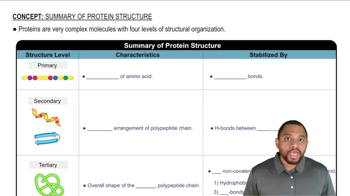
Proteins have four levels of structure: primary, secondary, tertiary, and quaternary. The primary structure is the sequence of amino acids, while secondary structure refers to local folding patterns like alpha helices and beta sheets. Tertiary structure is the overall 3D shape of a single polypeptide chain, and quaternary structure involves the assembly of multiple polypeptide chains. Understanding these levels is crucial for grasping how enzymes function.
추천 영상:
가이드 코스
2:56
Summary of Protein Structure Concept 1

Active Site

The active site of an enzyme is a specific region where substrate molecules bind and undergo a chemical reaction. This site is typically formed by the unique arrangement of amino acids in the enzyme's tertiary structure. The shape and chemical environment of the active site are critical for the enzyme's specificity and catalytic activity, making it essential for understanding enzyme function.
추천 영상:
가이드 코스
1:06
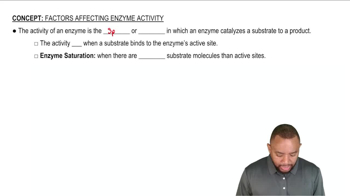
Factors Affecting Enzyme Activity Concept 1

Enzyme Functionality

Enzymes are biological catalysts that speed up chemical reactions by lowering the activation energy required. Their functionality is heavily dependent on their structure, particularly the active site, which determines the enzyme's specificity for its substrate. Changes in the enzyme's structure, such as denaturation, can significantly affect its ability to catalyze reactions, highlighting the importance of protein structure in enzymatic activity.
추천 영상:
가이드 코스
02:16
Logarithmic Functions