Ch.14 Carboxylic Acids, Esters, Amines, and Amides
Timberlake - Chemistry: An Introduction to General, Organic, and Biological Chemistry 13th Edition
Timberlake13th EditionChemistry: An Introduction to General, Organic, and Biological ChemistryISBN: 9780134421353당신이 사용하는 게 아니라요?교과서 변경
14장, 문제 40c

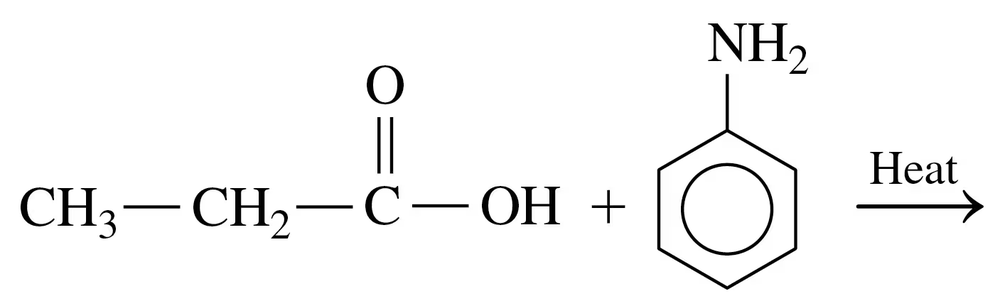
Draw the condensed structural or line-angle formula for the amide formed in each of the following reactions:
c. Condensed structural formula showing a carboxylic acid and an amine reacting with heat to form an amide.

검증된 단계별 안내
1
Identify the reactants in the given reaction. In the formation of an amide, the reactants typically include a carboxylic acid (or its derivative) and an amine (primary or secondary). Analyze the structure of the reactants provided in the image.
Understand the reaction mechanism. The carboxylic acid (or its derivative) reacts with the amine, where the hydroxyl group (-OH) of the carboxylic acid is replaced by the amine group (-NH2 or -NHR) to form the amide bond (-CONH-).
Determine the structure of the amide product. Combine the carbonyl group (C=O) from the carboxylic acid with the nitrogen atom from the amine, ensuring the correct connectivity of atoms.
Draw the condensed structural formula for the amide. Write the formula by grouping atoms together to represent the structure compactly, such as CH3CONH2 for acetamide.
Alternatively, draw the line-angle formula for the amide. Use lines to represent bonds between carbon atoms, with the carbonyl group and amine group clearly depicted. Ensure the drawing reflects the correct geometry and connectivity of the molecule.

비슷한 문제에 대한 검증된 영상 답변:

이 영상 해법은 위 문제에 도움이 된다고 튜터들이 추천한 것입니다.
영상 길이:
1m
도움이 되었나요?

주요 개념

질문에 올바르게 답하기 위해 반드시 이해해야 하는 핵심 개념들은 다음과 같습니다.

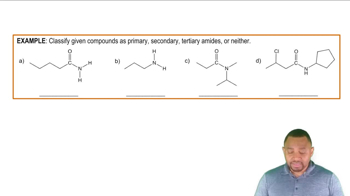
Amides

Amides are organic compounds derived from carboxylic acids where the hydroxyl group (-OH) is replaced by an amine group (-NH2, -NHR, or -NR2). They are characterized by the functional group -C(=O)N-, which is crucial for understanding their structure and reactivity. Amides can be formed through the reaction of carboxylic acids with amines, and they play significant roles in biochemistry, particularly in the formation of proteins.
추천 영상:
가이드 코스
1:03
Intro to Amides Example 1

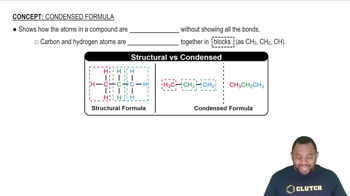
Condensed Structural Formula

A condensed structural formula is a way of representing a chemical structure that shows the arrangement of atoms in a molecule without depicting all the bonds explicitly. In this format, groups of atoms are grouped together, and the connectivity is implied rather than drawn out. This method is useful for simplifying complex structures and is commonly used in organic chemistry to convey information quickly and efficiently.
추천 영상:
가이드 코스
1:53
Condensed Formula Concept 1

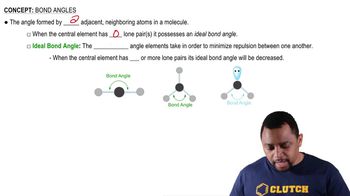
Line-Angle Formula

The line-angle formula, also known as the skeletal formula, is a shorthand representation of organic molecules where vertices represent carbon atoms and lines represent bonds. This method omits hydrogen atoms attached to carbons, making it easier to visualize larger organic structures. Understanding line-angle formulas is essential for interpreting chemical structures quickly, especially in the context of organic reactions and mechanisms.
추천 영상:
가이드 코스
01:24
Bond Angles (Simplified) Concept 1