Ch.18 Metabolic Pathways and ATP Production
Timberlake - Chemistry: An Introduction to General, Organic, and Biological Chemistry 13th Edition
Timberlake13th EditionChemistry: An Introduction to General, Organic, and Biological ChemistryISBN: 9780134421353당신이 사용하는 게 아니라요?교과서 변경
18장, 문제 38c

Identify the reaction(s) of the citric acid cycle that involve(s)
c. hydration

검증된 단계별 안내
1
Step 1: Begin by recalling the citric acid cycle (also known as the Krebs cycle or TCA cycle), which is a series of chemical reactions used by all aerobic organisms to generate energy through the oxidation of acetyl-CoA.
Step 2: Understand that hydration reactions involve the addition of water (H₂O) to a molecule. In the citric acid cycle, this typically occurs when a double bond is converted into a single bond by the addition of water.
Step 3: Identify the specific step in the citric acid cycle where hydration occurs. This is the conversion of fumarate to malate, catalyzed by the enzyme fumarase. During this reaction, water is added to the double bond in fumarate, forming malate.
Step 4: Write the chemical equation for the hydration reaction: Fumarate+H2OMalate. This shows the addition of water to fumarate to produce malate.
Step 5: Conclude by noting that this hydration reaction is essential for the continuation of the citric acid cycle, as malate is subsequently oxidized to oxaloacetate in the next step of the cycle.

비슷한 문제에 대한 검증된 영상 답변:

이 영상 해법은 위 문제에 도움이 된다고 튜터들이 추천한 것입니다.
영상 길이:
1m
도움이 되었나요?

주요 개념

질문에 올바르게 답하기 위해 반드시 이해해야 하는 핵심 개념들은 다음과 같습니다.

Citric Acid Cycle

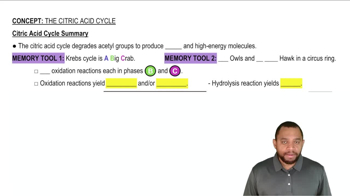
The citric acid cycle, also known as the Krebs cycle, is a series of enzymatic reactions that occur in the mitochondria, playing a crucial role in cellular respiration. It processes acetyl-CoA derived from carbohydrates, fats, and proteins to produce energy in the form of ATP, as well as electron carriers NADH and FADH2, which are essential for the electron transport chain.
추천 영상:
가이드 코스
2:31
Citric Acid Cycle Summary Concept 12

Hydration Reaction

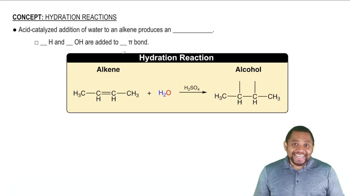
A hydration reaction involves the addition of water to a molecule, which can lead to the formation of new chemical bonds. In the context of the citric acid cycle, hydration specifically refers to the conversion of fumarate to malate, where water is added to fumarate, resulting in the formation of malate, an important intermediate in the cycle.
추천 영상:
가이드 코스
1:25
Symmetric Alkene Hydration Concept 1

Enzymatic Catalysis

Enzymatic catalysis refers to the acceleration of chemical reactions by enzymes, which are biological catalysts. In the citric acid cycle, specific enzymes facilitate each step, including the hydration reaction, ensuring that the reactions occur efficiently and at a rate suitable for cellular metabolism. For example, the enzyme fumarase catalyzes the hydration of fumarate to malate.
추천 영상:
가이드 코스
3:09
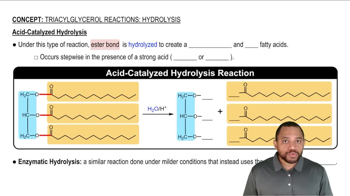
Triacylglycerol Reactions: Hydrolysis Concept 1