Ch.4 Atoms and Elements
Timberlake - Chemistry: An Introduction to General, Organic, and Biological Chemistry 13th Edition
Timberlake13th EditionChemistry: An Introduction to General, Organic, and Biological ChemistryISBN: 9780134421353당신이 사용하는 게 아니라요?교과서 변경
4장, 문제 94d

Indicate if each of the following statements is true or false:
d. The proton and the electron have about the same mass.

검증된 단계별 안내
1
Understand the context: The problem is asking about the relative masses of a proton and an electron. This involves knowledge of subatomic particles and their properties.
Recall the mass of a proton: A proton has a mass of approximately 1.67 × 10⁻²⁷ kg, which is significantly larger than the mass of an electron.
Recall the mass of an electron: An electron has a mass of approximately 9.11 × 10⁻³¹ kg, which is much smaller than the mass of a proton.
Compare the two masses: The mass of a proton is roughly 1836 times greater than the mass of an electron. This indicates that their masses are not similar.
Conclude the statement's validity: Based on the comparison, the statement 'The proton and the electron have about the same mass' is false.

비슷한 문제에 대한 검증된 영상 답변:

이 영상 해법은 위 문제에 도움이 된다고 튜터들이 추천한 것입니다.
영상 길이:
31s
도움이 되었나요?

주요 개념

질문에 올바르게 답하기 위해 반드시 이해해야 하는 핵심 개념들은 다음과 같습니다.

Mass of Subatomic Particles

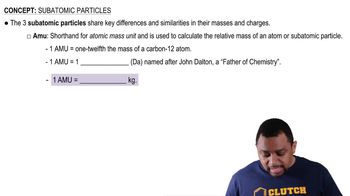
In atomic physics, the mass of subatomic particles is crucial for understanding their behavior. Protons, which are found in the nucleus of an atom, have a mass of approximately 1.67 x 10^-27 kg, while electrons, which orbit the nucleus, have a much smaller mass of about 9.11 x 10^-31 kg. This significant difference in mass affects the overall mass of an atom and its chemical properties.
추천 영상:
가이드 코스
01:25
Subatomic Particles (Simplified) Concept 1

Charge of Subatomic Particles

Protons and electrons carry opposite electric charges, which is fundamental to the structure of atoms. Protons have a positive charge, while electrons have a negative charge. This charge difference leads to the electromagnetic force that holds electrons in orbit around the nucleus, balancing the atom's overall charge and contributing to its stability.
추천 영상:
가이드 코스
01:25
Subatomic Particles (Simplified) Concept 1

Atomic Structure

The atomic structure is the arrangement of protons, neutrons, and electrons within an atom. Understanding this structure is essential for grasping concepts in chemistry and physics, including how atoms interact in chemical reactions. The mass and charge of protons and electrons play a vital role in determining the atom's identity and its behavior in various contexts.
추천 영상: