Ch.4 Atoms and Elements
Timberlake - Chemistry: An Introduction to General, Organic, and Biological Chemistry 13th Edition
Timberlake13th EditionChemistry: An Introduction to General, Organic, and Biological ChemistryISBN: 9780134421353당신이 사용하는 게 아니라요?교과서 변경
4장, 문제 110

Why is the ionization energy of Cl lower than F, but higher than that of S?

검증된 단계별 안내
1
Ionization energy is the energy required to remove an electron from a neutral atom in the gaseous state. It depends on factors such as nuclear charge, electron shielding, and atomic radius.
Fluorine (F) has a smaller atomic radius than chlorine (Cl), meaning its valence electrons are closer to the nucleus and experience a stronger electrostatic attraction. This makes it harder to remove an electron from F, resulting in a higher ionization energy compared to Cl.
Chlorine (Cl) has a larger atomic radius than F, so its valence electrons are farther from the nucleus and experience slightly less attraction. This makes it easier to remove an electron from Cl, giving it a lower ionization energy than F.
Sulfur (S) has a larger atomic radius than Cl and also has one more electron in its valence shell. The additional electron increases electron-electron repulsion, which slightly reduces the effective nuclear attraction on the outermost electrons. This makes it easier to remove an electron from S, resulting in a lower ionization energy compared to Cl.
In summary, the ionization energy trend is influenced by atomic radius, nuclear charge, and electron shielding. F has the highest ionization energy due to its small size and strong nuclear attraction, Cl has a lower ionization energy than F but higher than S due to its intermediate size and shielding effects, and S has the lowest ionization energy among the three due to its larger size and increased electron repulsion.

비슷한 문제에 대한 검증된 영상 답변:

이 영상 해법은 위 문제에 도움이 된다고 튜터들이 추천한 것입니다.
영상 길이:
9m

주요 개념

질문에 올바르게 답하기 위해 반드시 이해해야 하는 핵심 개념들은 다음과 같습니다.

Ionization Energy

Ionization energy is the energy required to remove an electron from an atom in its gaseous state. It reflects the strength of the attraction between the nucleus and the electrons. Generally, ionization energy increases across a period due to increasing nuclear charge and decreases down a group due to increased electron shielding.
추천 영상:
가이드 코스
02:13
Periodic Trend: Ionization Energy (Simplified) Concept 1

Atomic Structure and Electron Configuration

The atomic structure of an element, including its electron configuration, plays a crucial role in determining its ionization energy. Fluorine (F) has a higher ionization energy than chlorine (Cl) because it has a smaller atomic radius and fewer electron shells, leading to a stronger attraction between the nucleus and its outermost electron.
추천 영상:
가이드 코스
01:08
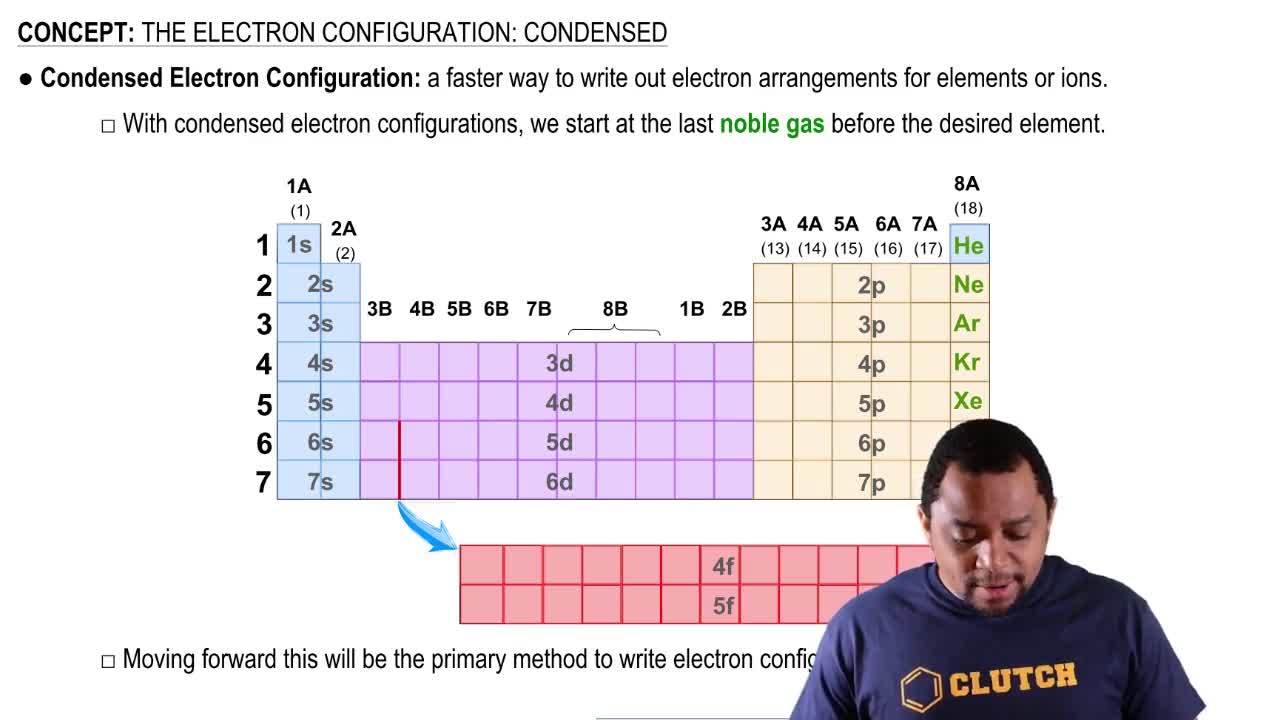
The Electron Configuration: Condensed

Electron Shielding

Electron shielding occurs when inner-shell electrons repel outer-shell electrons, reducing the effective nuclear charge felt by the outer electrons. In the case of sulfur (S), the additional electron shells compared to chlorine lead to greater shielding, resulting in a lower ionization energy for sulfur than for chlorine, despite sulfur being further down the periodic table.
추천 영상:
가이드 코스
01:23
Electronic Structure: Electron Spin Concept 1