Indicate whether aqueous solutions of each of the following solutes contain only ions, only molecules, or mostly molecules and a few ions:
c. fructose, C₆H₁₂O₆, a nonelectrolyte
검증된 단계별 안내
1
Identify the type of solute: Fructose (C₆H₁₂O₆) is a nonelectrolyte.
Understand the behavior of nonelectrolytes in water: Nonelectrolytes do not dissociate into ions when dissolved in water.
Recognize the composition of the solution: Since fructose is a nonelectrolyte, it will dissolve in water as intact molecules.
Conclude the nature of the solution: The aqueous solution of fructose will contain only molecules.
Summarize the findings: Fructose in water remains as molecules, with no ions present in the solution.
비슷한 문제에 대한 검증된 영상 답변:
이 영상 해법은 위 문제에 도움이 된다고 튜터들이 추천한 것입니다.
영상 길이:
2m
영상 재생:
0 댓글
주요 개념
질문에 올바르게 답하기 위해 반드시 이해해야 하는 핵심 개념들은 다음과 같습니다.
Electrolytes vs. Nonelectrolytes
Electrolytes are substances that dissociate into ions when dissolved in water, allowing the solution to conduct electricity. In contrast, nonelectrolytes do not dissociate into ions; they remain as intact molecules in solution. Understanding this distinction is crucial for predicting the behavior of solutes in aqueous solutions.
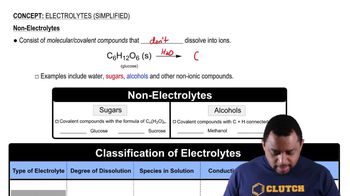
Dissociation refers to the process by which a compound separates into its constituent ions in a solvent, typically water. This process is essential for electrolytes, as it determines the conductivity of the solution. For nonelectrolytes like fructose, there is no dissociation, and the solute exists solely as molecules.
Fructose, a simple sugar (monosaccharide), is classified as a nonelectrolyte because it does not ionize in solution. When dissolved in water, fructose molecules remain intact, resulting in a solution that contains mostly molecules rather than ions. This property affects the solution's physical and chemical behavior, including its conductivity.

 2:13분
2:13분 검증된 단계별 안내
 02:11
02:11