Select the diagram that represents the solution formed by a solute that is a (9.2)
c. strong electrolyte
검증된 단계별 안내
1
Identify the characteristics of a strong electrolyte, which completely dissociates into ions in solution.
Examine the provided diagram to determine if it represents a solution with free ions.
Look for separate, distinct particles in the diagram, indicating the presence of ions.
Consider that a strong electrolyte solution should show ions dispersed throughout the solvent.
Select the diagram that best illustrates these characteristics of a strong electrolyte solution.
비슷한 문제에 대한 검증된 영상 답변:
이 영상 해법은 위 문제에 도움이 된다고 튜터들이 추천한 것입니다.
영상 길이:
4m
영상 재생:
0 댓글
주요 개념
질문에 올바르게 답하기 위해 반드시 이해해야 하는 핵심 개념들은 다음과 같습니다.
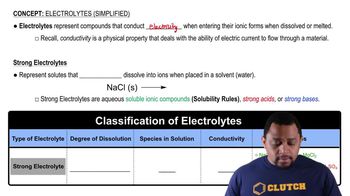
Strong Electrolytes
Strong electrolytes are substances that completely dissociate into ions when dissolved in water. This means that they produce a high concentration of ions in solution, which allows them to conduct electricity efficiently. Common examples include salts like sodium chloride (NaCl) and strong acids like hydrochloric acid (HCl). Understanding strong electrolytes is crucial for analyzing solutions and their conductive properties.
Dissociation refers to the process by which an ionic compound separates into its constituent ions in a solvent, typically water. This process is essential for the formation of solutions, particularly for electrolytes. The extent of dissociation determines whether a substance behaves as a strong or weak electrolyte, influencing the solution's conductivity and chemical behavior.
The conductivity of a solution is a measure of its ability to conduct electric current, which is directly related to the concentration of ions present. Strong electrolytes, which fully dissociate in solution, result in high conductivity, while weak electrolytes only partially dissociate, leading to lower conductivity. Understanding this concept is vital for interpreting the behavior of different solutions in electrochemical contexts.