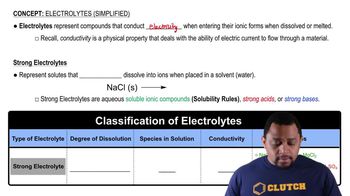
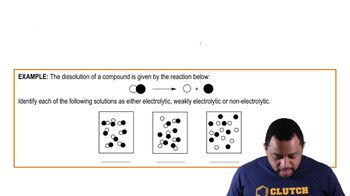
An electrolyte is a substance that produces ions when dissolved in water, allowing the solution to conduct electricity.
Electrolytes can be acids, bases, or salts that dissociate into positive and negative ions in solution.
Strong electrolytes dissociate completely in solution, while weak electrolytes only partially dissociate.
Common examples of electrolytes include sodium chloride (NaCl), potassium chloride (KCl), and acetic acid (CH₃COOH).
Electrolytes are crucial for various physiological functions, such as nerve impulse transmission and muscle contraction.
비슷한 문제에 대한 검증된 영상 답변:
이 영상 해법은 위 문제에 도움이 된다고 튜터들이 추천한 것입니다.
영상 길이:
56s
영상 재생:
0 댓글
주요 개념
질문에 올바르게 답하기 위해 반드시 이해해야 하는 핵심 개념들은 다음과 같습니다.
Definition of Electrolytes
Electrolytes are substances that dissociate into ions when dissolved in water, allowing the solution to conduct electricity. Common examples include salts, acids, and bases. The presence of these charged particles is essential for various physiological processes in living organisms.
Electrolytes can be classified into strong and weak electrolytes. Strong electrolytes, like sodium chloride, completely dissociate into ions in solution, while weak electrolytes, such as acetic acid, only partially dissociate. This distinction affects the conductivity and reactivity of the solutions they form.
In biological systems, electrolytes play a crucial role in maintaining fluid balance, transmitting nerve impulses, and muscle contraction. Key electrolytes include sodium, potassium, calcium, and chloride. Imbalances in these ions can lead to serious health issues, highlighting their importance in physiology.

 0:56분
0:56분 검증된 단계별 안내
 02:48
02:48