Classify the solute represented in each of the following equations as a strong, weak, or nonelectrolyte:
a. K₂SO₄(s) →H₂O 2K⁺(aq) + SO₄²⁻(aq)
검증된 단계별 안내
1
Identify the solute in the equation: K₂SO₄ is the solute.
Determine the dissociation of the solute in water: K₂SO₄ dissociates completely into ions (2K⁺ and SO₄²⁻) in water.
Understand the definition of a strong electrolyte: A strong electrolyte is a compound that completely dissociates into ions in solution.
Compare the dissociation behavior of K₂SO₄ with the definition of a strong electrolyte.
Classify K₂SO₄ based on its dissociation: Since K₂SO₄ completely dissociates into ions, it is classified as a strong electrolyte.
비슷한 문제에 대한 검증된 영상 답변:
이 영상 해법은 위 문제에 도움이 된다고 튜터들이 추천한 것입니다.
영상 길이:
2m
영상 재생:
0 댓글
주요 개념
질문에 올바르게 답하기 위해 반드시 이해해야 하는 핵심 개념들은 다음과 같습니다.
Electrolytes
Electrolytes are substances that dissociate into ions when dissolved in water, allowing the solution to conduct electricity. They are classified into strong electrolytes, which completely dissociate into ions, weak electrolytes, which partially dissociate, and nonelectrolytes, which do not dissociate at all. Understanding the behavior of electrolytes is crucial for predicting the conductivity and chemical reactivity of solutions.
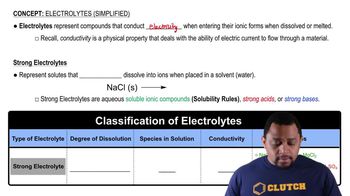
Strong electrolytes are substances that completely ionize in solution, resulting in a high concentration of ions. Common examples include soluble salts like potassium sulfate (K₂SO₄), which dissociates fully into potassium (K⁺) and sulfate (SO₄²⁻) ions in water. This complete dissociation is essential for applications in chemistry, such as predicting the outcomes of reactions and calculating solution concentrations.
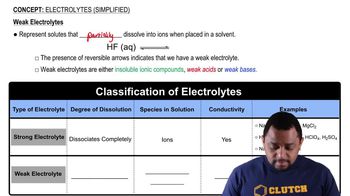
Weak electrolytes are substances that only partially ionize in solution, leading to a lower concentration of ions compared to strong electrolytes. Examples include acetic acid and ammonia, which establish an equilibrium between the undissociated molecules and the ions. Recognizing weak electrolytes is important for understanding acid-base reactions and the behavior of solutions in various chemical contexts.