Select the diagram that represents the solution formed by a solute that is a (9.2)
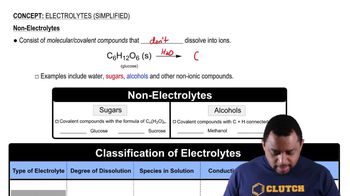
a. nonelectrolyte
검증된 단계별 안내
1
Identify the characteristics of a nonelectrolyte: Nonelectrolytes do not dissociate into ions in solution, meaning they do not conduct electricity.
Examine the provided diagram: Look for a representation where molecules are intact and not separated into ions.
Consider the molecular structure: Nonelectrolytes typically consist of covalent compounds where atoms are bonded together without forming ions.
Analyze the image: Check if the diagram shows molecules that are not broken into ions, indicating a nonelectrolyte solution.
Select the diagram: Choose the one that best represents a solution where the solute remains as whole molecules, not dissociated into ions.
비슷한 문제에 대한 검증된 영상 답변:
이 영상 해법은 위 문제에 도움이 된다고 튜터들이 추천한 것입니다.
영상 길이:
4m
영상 재생:
0 댓글
주요 개념
질문에 올바르게 답하기 위해 반드시 이해해야 하는 핵심 개념들은 다음과 같습니다.
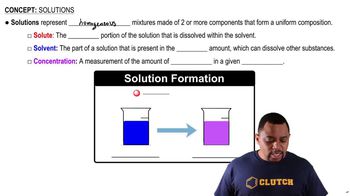
Solute and Solvent
In a solution, the solute is the substance that is dissolved, while the solvent is the medium in which the solute dissolves. For example, in a saltwater solution, salt is the solute and water is the solvent. Understanding the roles of solutes and solvents is crucial for analyzing how solutions form and behave.
Electrolytes are substances that dissociate into ions when dissolved in water, allowing the solution to conduct electricity. In contrast, nonelectrolytes do not dissociate into ions and do not conduct electricity. Recognizing the difference between these two types of solutes is essential for understanding the properties of solutions and their applications in chemistry.
Diagrams representing solutions often use spheres to depict solute and solvent molecules. The size and color of the spheres can indicate different types of molecules, such as blue for solvent and red for solute. Analyzing these representations helps in visualizing how solutes interact with solvents at the molecular level, which is key to understanding solution chemistry.

 4:11분
4:11분
 검증된 단계별 안내
 01:39
01:39