Ch. 11 - Characterizing and Classifying Prokaryotes
Bauman - Microbiology with Diseases by Taxonomy 6th Edition
Bauman6th EditionMicrobiology with Diseases by TaxonomyISBN: 9780134832302당신이 사용하는 게 아니라요?교과서 변경
11장, 문제 5

How is Halobacterium salinarum distinctive?


a. It is absolutely dependent on high salt concentrations to maintain its cell wall.
b. It is found in terrestrial volcanic habitats.
c. It photosynthesizes without chlorophyll.
d. It can survive 5 million rad of radiation.

검증된 단계별 안내
1
Step 1: Understand the organism Halobacterium salinarum. It is an extremophile archaeon known for thriving in environments with very high salt concentrations.
Step 2: Analyze option (a): Halobacterium salinarum requires high salt concentrations to maintain the integrity of its cell wall and overall cellular structure, which is a key characteristic of halophilic archaea.
Step 3: Consider option (b): Terrestrial volcanic habitats are typically associated with thermophilic or acidophilic organisms, not halophiles like Halobacterium salinarum.
Step 4: Evaluate option (c): While Halobacterium salinarum can perform a type of photosynthesis using bacteriorhodopsin (a pigment different from chlorophyll), this is a distinctive feature but not the primary defining trait related to its salt dependence.
Step 5: Review option (d): Resistance to extremely high radiation doses is characteristic of organisms like Deinococcus radiodurans, not Halobacterium salinarum.

비슷한 문제에 대한 검증된 영상 답변:

이 영상 해법은 위 문제에 도움이 된다고 튜터들이 추천한 것입니다.
영상 길이:
1m
도움이 되었나요?

주요 개념

질문에 올바르게 답하기 위해 반드시 이해해야 하는 핵심 개념들은 다음과 같습니다.

Halobacterium salinarum and Halophilicity

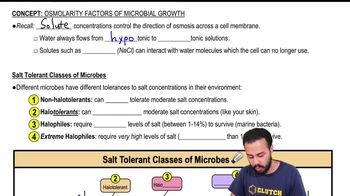
Halobacterium salinarum is an extremophilic archaeon that thrives in environments with very high salt concentrations, often above 20%. Its cellular structures, including the cell wall and membrane, require these conditions to maintain stability and function, making it obligately halophilic.
추천 영상:
가이드 코스
06:30
Osmolarity Factors for Microbial Growth

Phototrophy without Chlorophyll

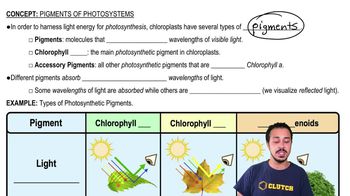
Unlike plants and many bacteria that use chlorophyll for photosynthesis, Halobacterium salinarum uses a pigment called bacteriorhodopsin to capture light energy. This pigment enables it to perform a form of phototrophy by pumping protons to generate ATP without traditional chlorophyll-based photosynthesis.
추천 영상:
가이드 코스
05:58
Pigments of Photosynthesis

Radiation Resistance and Habitat

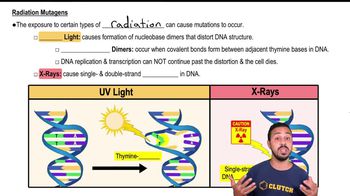
While some microorganisms can survive extreme radiation, Halobacterium salinarum is not known for extraordinary radiation resistance. It is primarily found in hypersaline environments like salt lakes, not volcanic habitats, distinguishing its ecological niche and stress adaptations.
추천 영상:
가이드 코스
02:55
Radiation Mutagens