
Ch. 13 - Characterizing and Classifying Viruses, Viroids, and Prions
Bauman - Microbiology with Diseases by Taxonomy 6th Edition
Bauman6th EditionMicrobiology with Diseases by TaxonomyISBN: 9780134832302당신이 사용하는 게 아니라요?교과서 변경
13장, 문제 7

How is a provirus like a prophage? How is it different?

검증된 단계별 안내
1
Step 1: Understand the definitions of both terms. A prophage is the viral DNA of a bacteriophage that has integrated into the bacterial host genome, while a provirus is the viral DNA of a virus (often a retrovirus) that has integrated into the genome of a eukaryotic host cell.
Step 2: Identify the similarity: Both a prophage and a provirus represent a latent form of the virus where the viral genetic material is integrated into the host's genome and can be replicated along with the host DNA without causing immediate lysis or destruction of the host cell.
Step 3: Recognize the difference in host type: A prophage is specific to bacterial hosts (prokaryotes), whereas a provirus is found in eukaryotic host cells.
Step 4: Note the difference in viral life cycle: Prophages can enter the lytic cycle, where they excise themselves and produce new phage particles leading to host cell lysis. Proviruses, especially retroviruses, typically remain integrated and may produce new viruses without necessarily killing the host cell immediately.
Step 5: Summarize that both represent viral latency through genome integration, but differ mainly in the type of host organism and the details of their replication and activation cycles.

비슷한 문제에 대한 검증된 영상 답변:

이 영상 해법은 위 문제에 도움이 된다고 튜터들이 추천한 것입니다.
영상 길이:
3m
도움이 되었나요?

주요 개념

질문에 올바르게 답하기 위해 반드시 이해해야 하는 핵심 개념들은 다음과 같습니다.

Provirus

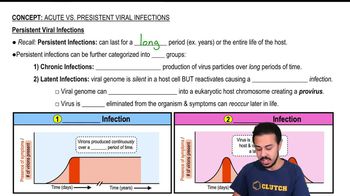
A provirus is the viral genome of a virus that integrates into the DNA of a eukaryotic host cell. It remains dormant within the host's genome and can be replicated along with the host's DNA, potentially reactivating to produce new viruses later.
추천 영상:
가이드 코스
05:12
Persistent Viral Infections

Prophage

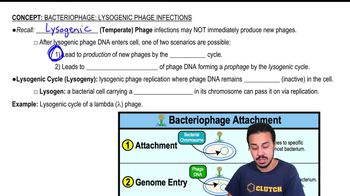
A prophage is the viral DNA of a bacteriophage that has integrated into the bacterial host's genome. Like a provirus, it remains latent and replicates with the host DNA, but it specifically refers to viruses infecting bacteria.
추천 영상:
가이드 코스
05:27
Bacteriophage: Lysogenic Phage Infections

Similarity and Difference between Provirus and Prophage

Both provirus and prophage represent integrated viral genomes that remain dormant within host DNA and replicate with it. The key difference is that a provirus infects eukaryotic cells, while a prophage infects bacterial cells. Additionally, prophages can enter a lytic cycle more readily, causing host cell lysis.
추천 영상:
가이드 코스
05:32
Reviewing the Different Types of Microscopes