
Ch. 13 - Characterizing and Classifying Viruses, Viroids, and Prions
Bauman - Microbiology with Diseases by Taxonomy 6th Edition
Bauman6th EditionMicrobiology with Diseases by TaxonomyISBN: 9780134832302당신이 사용하는 게 아니라요?교과서 변경
13장, 문제 7

Another name for a complete virus is ___________.
a. Virion
b. Viroid
c. Prion
d. Capsid

검증된 단계별 안내
1
Understand the terminology related to viruses: a complete virus particle includes the genetic material (DNA or RNA) enclosed within a protein coat called the capsid, and sometimes an envelope.
Review the options given: 'virion', 'viroid', 'prion', and 'capsid'.
Recall that a 'virion' refers to a fully assembled, infectious virus particle that is complete and capable of infecting a host cell.
Know that a 'viroid' is a small infectious RNA molecule without a protein coat, and a 'prion' is an infectious protein without nucleic acid.
Recognize that 'capsid' is just the protein coat of a virus, not the complete virus particle itself.

비슷한 문제에 대한 검증된 영상 답변:

이 영상 해법은 위 문제에 도움이 된다고 튜터들이 추천한 것입니다.
영상 길이:
2m
도움이 되었나요?

주요 개념

질문에 올바르게 답하기 위해 반드시 이해해야 하는 핵심 개념들은 다음과 같습니다.

Virion

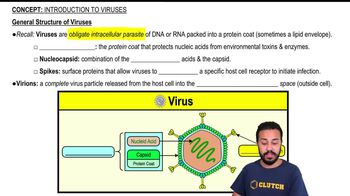
A virion is the complete, infectious form of a virus outside a host cell, consisting of the viral genome enclosed within a protective protein coat called the capsid. It is capable of infecting a host and initiating viral replication.
추천 영상:
가이드 코스
03:04
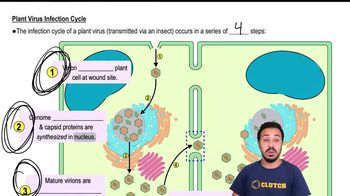
Plant VirusesPlant Virus Infection Cycle

Viroid

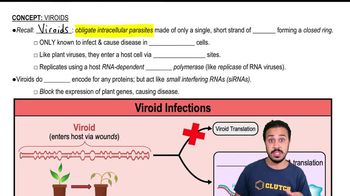
Viroids are small, circular RNA molecules that infect plants but lack a protein coat. Unlike viruses, viroids do not form virions and rely entirely on host machinery for replication, causing disease without encoding proteins.
추천 영상:

Capsid

The capsid is the protein shell that encases and protects the viral genetic material. It is made of protein subunits called capsomeres and plays a key role in virus attachment and entry into host cells, but alone it is not a complete virus.
추천 영상:
가이드 코스
04:47
General Structure of Viruses