Ch. 14 - Infection, Infectious Diseases, and Epidemiology
Bauman - Microbiology with Diseases by Taxonomy 6th Edition
Bauman6th EditionMicrobiology with Diseases by TaxonomyISBN: 9780134832302당신이 사용하는 게 아니라요?교과서 변경
14장, 문제 4

List Koch’s four postulates, and describe situations in which not all may be applicable.

검증된 단계별 안내
1
Step 1: Understand Koch's four postulates, which are criteria designed to establish a causative relationship between a microbe and a disease. They are: (1) The microorganism must be found in all organisms suffering from the disease, but not in healthy organisms. (2) The microorganism must be isolated from a diseased organism and grown in pure culture. (3) The cultured microorganism should cause disease when introduced into a healthy organism. (4) The microorganism must be re-isolated from the experimentally infected host and identified as being identical to the original specific causative agent.
Step 2: Recognize that these postulates are foundational in microbiology for linking pathogens to diseases, but they have limitations in certain contexts.
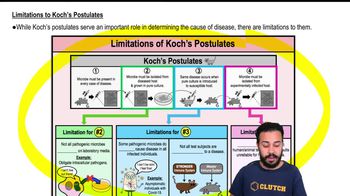
Step 3: Identify situations where Koch's postulates may not be fully applicable, such as when the microorganism cannot be cultured in vitro (e.g., viruses that require host cells), or when asymptomatic carriers harbor the pathogen without showing disease symptoms.
Step 4: Consider diseases caused by multiple pathogens or those influenced by host factors, where a single microorganism may not fulfill all postulates, such as polymicrobial infections or diseases with complex etiologies.
Step 5: Summarize that while Koch's postulates provide a useful framework, modern microbiology often uses molecular and genetic evidence to complement or modify these criteria when studying pathogens that do not meet all traditional postulates.

비슷한 문제에 대한 검증된 영상 답변:

이 영상 해법은 위 문제에 도움이 된다고 튜터들이 추천한 것입니다.
영상 길이:
2m
도움이 되었나요?

주요 개념

질문에 올바르게 답하기 위해 반드시 이해해야 하는 핵심 개념들은 다음과 같습니다.

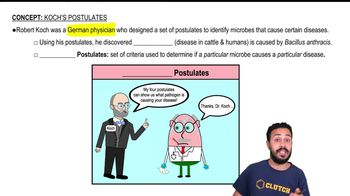
Koch’s Four Postulates

Koch’s four postulates are criteria established to link a specific microorganism to a particular disease. They include: the microorganism must be found in all diseased individuals, isolated and grown in pure culture, cause disease when introduced to a healthy host, and be re-isolated from the experimentally infected host.
추천 영상:
01:36
Koch's Postulates

Limitations of Koch’s Postulates

Not all diseases meet Koch’s postulates due to factors like asymptomatic carriers, inability to culture some pathogens, or diseases caused by multiple organisms. For example, viruses require host cells to grow, making pure culture isolation impossible, and some chronic diseases involve complex microbial communities.
추천 영상:
02:58
Limitations to Koch's Postulates

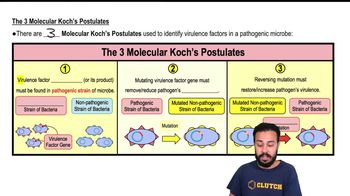
Modern Adaptations and Molecular Koch’s Postulates

Modern microbiology uses molecular techniques to overcome limitations of traditional postulates. Molecular Koch’s postulates focus on identifying specific genes responsible for pathogenicity, allowing the study of pathogens that cannot be cultured or cause disease only under certain conditions.
추천 영상:
03:20
The 3 Molecular Koch's Postulates