Ch. 3 - Cell Structure and Function
Bauman - Microbiology with Diseases by Taxonomy 6th Edition
Bauman6th EditionMicrobiology with Diseases by TaxonomyISBN: 9780134832302당신이 사용하는 게 아니라요?교과서 변경
3장, 문제 11

A Gram-negative cell is moving uric acid across the cytoplasmic membrane against its chemical gradient. Which of the following statements is true?


a. The exterior of the cell is probably electrically negative compared to the interior of the cell.
b. The acid probably moves by a passive means such as facilitated diffusion.
c. The acid moves by an active process such as active transport.
d. The movement of the acid requires phagocytosis.

검증된 단계별 안내
1
Step 1: Understand the nature of the transport process described. The problem states that uric acid is moving across the cytoplasmic membrane against its chemical gradient, which means it is moving from a region of lower concentration to a region of higher concentration.
Step 2: Recall that moving a substance against its concentration gradient requires energy input, which is characteristic of active transport mechanisms, not passive transport.
Step 3: Evaluate the options: (a) concerns electrical charge differences, which may relate to membrane potential but does not directly explain movement against a chemical gradient; (b) suggests passive transport, which cannot move substances against their gradient; (c) suggests active transport, which fits the requirement of moving against the gradient; (d) involves phagocytosis, a process for engulfing large particles, not small molecules like uric acid.
Step 4: Conclude that the correct statement must describe an active process, since energy is needed to move uric acid against its chemical gradient.
Step 5: Therefore, the correct understanding is that the acid moves by an active process such as active transport.

비슷한 문제에 대한 검증된 영상 답변:

이 영상 해법은 위 문제에 도움이 된다고 튜터들이 추천한 것입니다.
영상 길이:
3m
도움이 되었나요?

주요 개념

질문에 올바르게 답하기 위해 반드시 이해해야 하는 핵심 개념들은 다음과 같습니다.

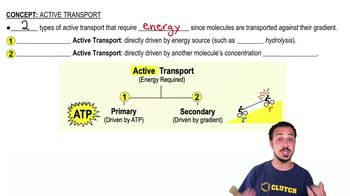
Active Transport

Active transport is the movement of molecules across a cell membrane against their concentration gradient, requiring energy input, often from ATP or proton motive force. This process allows cells to accumulate substances like uric acid even when their concentration is higher inside the cell.
추천 영상:
가이드 코스
02:37
Active Transport

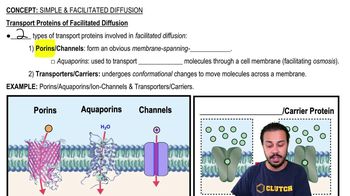
Passive Transport and Facilitated Diffusion

Passive transport involves the movement of molecules down their concentration gradient without energy expenditure. Facilitated diffusion uses membrane proteins to help molecules cross but cannot move substances against their gradient, making it unsuitable for moving uric acid uphill.
추천 영상:
가이드 코스
04:49
Transport Proteins of Facilitated Diffusion

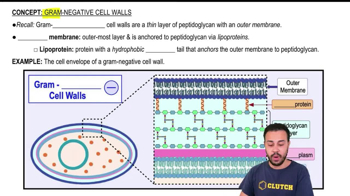
Membrane Potential in Gram-negative Bacteria

Gram-negative bacteria have an electrochemical gradient across their cytoplasmic membrane, typically with the inside being electrically negative relative to the outside. This membrane potential influences ion movement but does not alone drive molecules against their chemical gradient without energy.
추천 영상:
가이드 코스
3:04
Gram-Negative Cell Walls