Ch. 3 - Cell Structure and Function
Bauman - Microbiology with Diseases by Taxonomy 6th Edition
Bauman6th EditionMicrobiology with Diseases by TaxonomyISBN: 9780134832302당신이 사용하는 게 아니라요?교과서 변경
3장, 문제 11

How do archaeal flagella differ from bacterial flagella and eukaryotic flagella?

검증된 단계별 안내
1
Step 1: Understand the basic structure and function of flagella in all three domains: bacteria, archaea, and eukaryotes. Flagella are appendages used for motility, but their composition and mechanism differ.
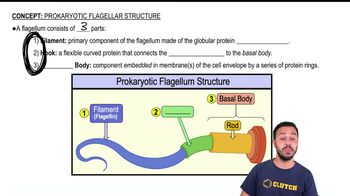
Step 2: Compare archaeal flagella to bacterial flagella by focusing on their protein composition. Archaeal flagella are made of different proteins called archaellins, whereas bacterial flagella are primarily composed of flagellin proteins.
Step 3: Examine the assembly process. Archaeal flagella are assembled from the base by adding subunits at the base, similar to bacterial flagella, but the machinery involved is more closely related to type IV pili assembly systems rather than the bacterial flagellar motor.
Step 4: Contrast archaeal flagella with eukaryotic flagella. Eukaryotic flagella have a complex '9+2' arrangement of microtubules inside, powered by dynein motor proteins, whereas archaeal flagella lack microtubules and have a simpler structure.
Step 5: Summarize the key differences: archaeal flagella are structurally and genetically distinct from bacterial flagella and eukaryotic flagella, with unique protein composition, assembly mechanisms, and motility functions.

비슷한 문제에 대한 검증된 영상 답변:

이 영상 해법은 위 문제에 도움이 된다고 튜터들이 추천한 것입니다.
영상 길이:
1m
도움이 되었나요?

주요 개념

질문에 올바르게 답하기 위해 반드시 이해해야 하는 핵심 개념들은 다음과 같습니다.

Structure and Composition of Flagella

Archaeal flagella, called archaella, are structurally distinct from bacterial and eukaryotic flagella. Unlike bacterial flagella made of flagellin, archaella are composed of glycosylated proteins and are thinner. Eukaryotic flagella have a complex microtubule-based structure called the axoneme.
추천 영상:
가이드 코스
02:53
Prokaryotic Flagellar Structure

Mechanism of Movement

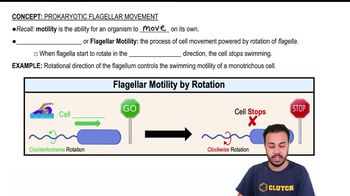
Bacterial flagella rotate like a propeller powered by a proton or sodium motive force, while archaeal flagella also rotate but are powered by ATP hydrolysis. Eukaryotic flagella move with a whip-like motion driven by dynein motor proteins along microtubules.
추천 영상:
가이드 코스
02:43
Prokaryotic Flagellar Movement

Evolutionary and Functional Differences

Archaeal flagella are evolutionarily unrelated to bacterial flagella despite similar functions, reflecting convergent evolution. Eukaryotic flagella evolved from different cellular components and serve diverse roles including locomotion and sensory functions.
추천 영상:
가이드 코스
06:04
Functional Groups