Ch. 3 - Cell Structure and Function
Bauman - Microbiology with Diseases by Taxonomy 6th Edition
Bauman6th EditionMicrobiology with Diseases by TaxonomyISBN: 9780134832302당신이 사용하는 게 아니라요?교과서 변경
3장, 문제 12

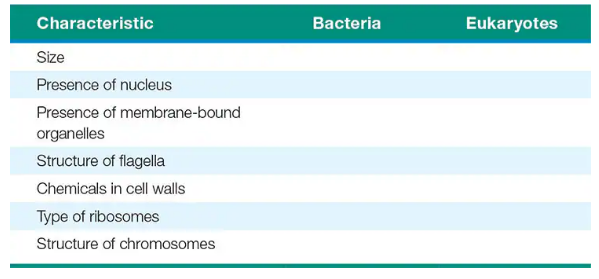
Contrast bacterial and eukaryotic cells by filling in the following table.


Table comparing characteristics of bacteria and eukaryotes, including size, nucleus, organelles, flagella, cell wall chemicals, ribosomes, and chromosomes.

검증된 단계별 안내
1
Step 1: Compare the size of bacterial and eukaryotic cells. Bacteria are generally smaller, typically ranging from 1 to 10 micrometers, while eukaryotic cells are larger, usually 10 to 100 micrometers.
Step 2: Examine the presence of a nucleus. Bacteria lack a true nucleus; their genetic material is not enclosed within a membrane. Eukaryotes have a well-defined nucleus enclosed by a nuclear membrane.
Step 3: Look at the presence of membrane-bound organelles. Bacteria do not have membrane-bound organelles such as mitochondria or the endoplasmic reticulum, whereas eukaryotic cells contain various membrane-bound organelles.
Step 4: Analyze the structure of flagella. Bacterial flagella are composed of the protein flagellin and rotate like a propeller, while eukaryotic flagella have a complex 9+2 arrangement of microtubules and move in a whip-like manner.
Step 5: Identify the chemicals in the cell walls. Bacterial cell walls typically contain peptidoglycan, a polymer unique to bacteria. Eukaryotic cells, if they have cell walls (like plants and fungi), contain cellulose or chitin instead.
Step 6: Compare the type of ribosomes. Bacteria have 70S ribosomes, which are smaller, while eukaryotes have larger 80S ribosomes in the cytoplasm.
Step 7: Consider the structure of chromosomes. Bacteria usually have a single, circular chromosome, whereas eukaryotes have multiple, linear chromosomes contained within the nucleus.

비슷한 문제에 대한 검증된 영상 답변:

이 영상 해법은 위 문제에 도움이 된다고 튜터들이 추천한 것입니다.
영상 길이:
3m
도움이 되었나요?

주요 개념

질문에 올바르게 답하기 위해 반드시 이해해야 하는 핵심 개념들은 다음과 같습니다.

Cellular Structure Differences

Bacterial cells are prokaryotic, lacking a true nucleus and membrane-bound organelles, whereas eukaryotic cells have a defined nucleus and various membrane-bound organelles. This fundamental difference affects cell complexity and function.
추천 영상:
가이드 코스
05:32
Reviewing the Different Types of Microscopes

Cell Wall Composition and Flagella Structure

Bacteria have cell walls made of peptidoglycan and flagella composed of the protein flagellin, while eukaryotic cells, if they have cell walls, use different chemicals like cellulose or chitin, and their flagella have a complex microtubule structure (9+2 arrangement).
추천 영상:
가이드 코스
02:53
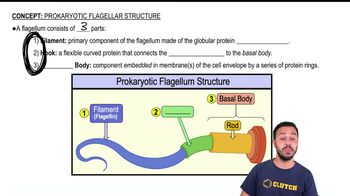
Prokaryotic Flagellar Structure

Ribosomes and Chromosome Structure

Bacterial ribosomes are smaller (70S) compared to eukaryotic ribosomes (80S). Bacteria typically have a single circular chromosome, whereas eukaryotes have multiple linear chromosomes within the nucleus, influencing genetic organization and protein synthesis.
추천 영상:
가이드 코스
08:39
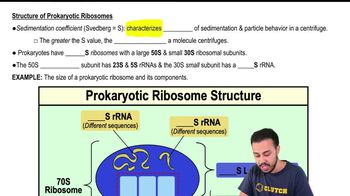
Structure of Prokaryotic Ribosomes